











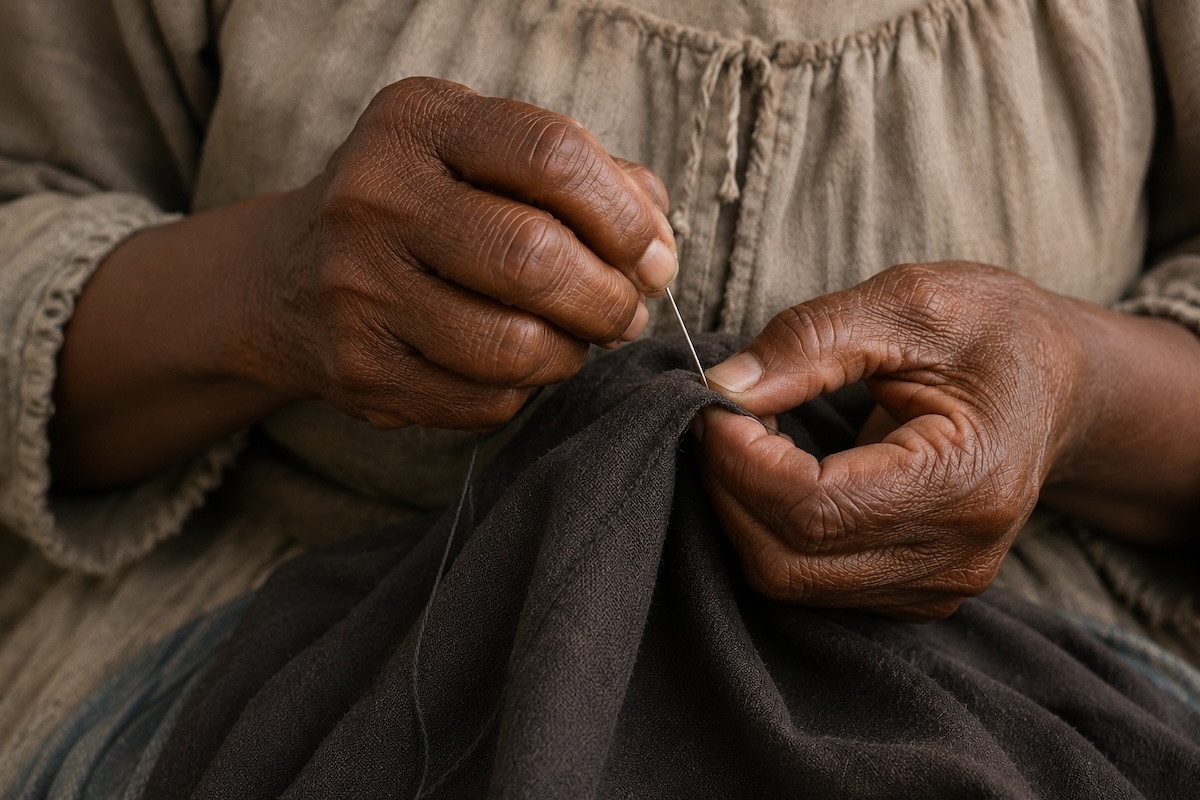
The labor of enslaved women helped sustain the households, farms and local economies that made the American Revolution possible, even as those women were denied the liberty the revolution promised.
That contradiction is at the heart of “Bearing the Nation: Enslaved Women, Labor, and the Creation of the United States,” an America 250 lecture to be presented Saturday afternoon at the Suffolk County Historical Society Museum in Riverhead.
The lecture will be presented by Melanie Cardone-Leathers, a certified archivist and local history librarian at Longwood Public Library in Middle Island.
Cardone-Leathers said the talk examines what she describes as the “unfinished revolutions for women,” particularly women of African descent on Long Island and in New York, whose labor supported the men who were publicly debating liberty, freedom and the creation of a new nation.
“They’re the ones who were giving these guys a household that you can come back to,” Cardone-Leathers said in an interview. “They basically did all the foundational work that these men could then go off and espouse these ideals and change the world, but they left these women behind.”
Her work grew out of a question posed by a colleague several years ago: What did enslaved people on Long Island eat?
Cardone-Leathers said she initially thought the answer would be easy to find. Instead, she discovered that much of the scholarship on African American foodways focused on the South, leaving gaps in the documented experience of enslaved people in New York and on Long Island.
That question led her into a broader study of early Black New Yorkers, from the New Netherland period through the Civil War era. She later earned a second master’s degree from Empire State University, concentrating on the African American experience and enslavement on Long Island and in New York.
One of the enduring misconceptions she encounters, Cardone-Leathers said, is the idea that slavery in New York was somehow benign compared with slavery in the South.
She said that belief is often rooted in histories written decades after slavery ended in New York, giving later writers time to soften or recast the record.
“Slavery was slavery,” she said. “Slavery was an inhumane system that was forced onto people, and no matter how you color it, it’s still you’re owning someone else.”
Slavery on Long Island was different in scale and structure from the plantation system of the South, but not in its essential character.
Local historian Richard Wines, in his book “A Farm Family on Long Island’s North Fork: The Lost World of the Hallocks and Their Sound Avenue Community,” writes that slavery had “deep roots” on the North Fork, with the first enslaved people likely arriving in the 1650s.
By the time New York fully abolished slavery in 1827, Wines writes, about 550 enslaved people had lived in what are now the towns of Southold and Riverhead. At slavery’s local peak in 1776, enslaved people made up 7.4% of the area’s population.
The pattern differed from plantation slavery in the South, Wines writes. On the North Fork, where there were no large estates and land was more broadly distributed, most enslavers held only one or two enslaved people — often just a single child or laborer. More than four was uncommon.
That smaller scale can obscure the history. Enslaved people on Long Island often appear in the surviving record only as numbers in census documents, names in wills or entries in property transactions. But their labor was woven into the households and farms that sustained local communities during the Revolutionary era.
Cardone-Leathers said the lack of names does not mean the history is unknowable or unimportant.
“We know that they’re there, but we can’t put a name to them,” she said.
Her research has focused primarily on Brookhaven Town, where she said the documentation is often sparse. The North Fork, she said, has left a somewhat larger paper trail because of older town structures, recordkeeping and local historical research.
Still, recovering the lives of enslaved people, and especially enslaved women, requires looking closely at fragmentary records and asking different questions of familiar sources.
Cardone-Leathers said the Revolutionary era is often remembered through the language of liberty and independence, and through the stories of men who spoke and wrote about those ideals. Her lecture asks audiences to consider the women whose work made those public lives possible, including women enslaved by men celebrated as patriots.
The talk will also address New York’s own emancipation history.
New York formally abolished slavery on July 4, 1827. Cardone-Leathers said Black New Yorkers marked the end of slavery in the state the following day, July 5, with parades, church services and other gatherings, in part to avoid conflict with white Independence Day celebrations.
The July 5 commemorations, she said, predated Juneteenth by several decades.
For Cardone-Leathers, recovering this history is not about diminishing the American story, but making it more complete.
She said public memory often preserves only the parts of history people are comfortable telling.
“If we only know a part of our history, we don’t know our full story,” she said. “We can’t just concentrate on what makes us comfortable.”
Saturday’s talk is scheduled for 1 p.m. Admission is $8; members are admitted free. RSVP is required by calling 631-727-2881, ext. 100. The Suffolk County Historical Society Museum is located at 300 W. Main St. in Riverhead.
The survival of local journalism depends on your support.
We are a small family-owned operation. You rely on us to stay informed, and we depend on you to make our work possible. Just a few dollars can help us continue to bring this important service to our community.
Support RiverheadLOCAL today.
