




























Residents and immigrant rights advocates again pressed the Riverhead Town Board Tuesday night to schedule a public discussion of OLA of Eastern Long Island’s proposed public safety and accountability law. The measure was developed by the Latino advocacy group, which says it is intended to set local procedures for town employees and police interactions with federal immigration enforcement.
People have attended Riverhead Town Board meeting consistently since the proposal was first unveiled in February urge the board to adopt the law or at least have a public discussion of the proposal with OLA.
Town board members have consistently declined to respond to advocates during board meetings. Tuesday night, the board again offered no public response.
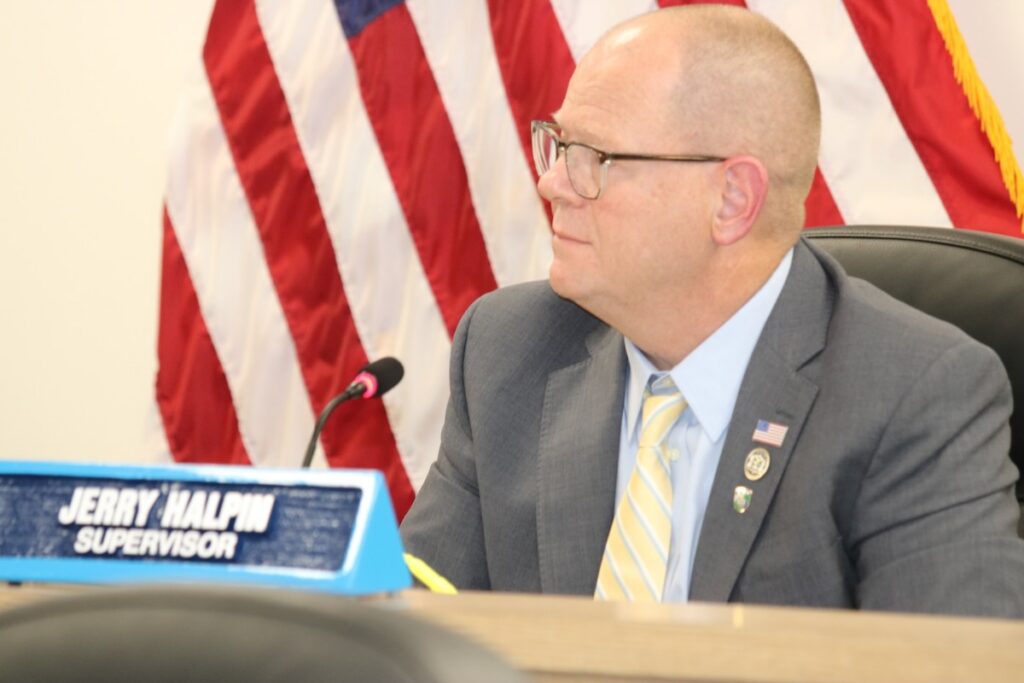
The proposal has been before the town since February. OLA Executive Director Minerva Perez has repeatedly asked Supervisor Jerry Halpin to place it on a work session agenda, saying the organization is not asking the town to interfere with federal immigration enforcement, but to create clear rules, reporting requirements and public accountability when federal immigration activity affects local residents.
“No one’s asking you to stop ICE,” Perez told the board Tuesday. “We’re talking about public safety and having a plan.”
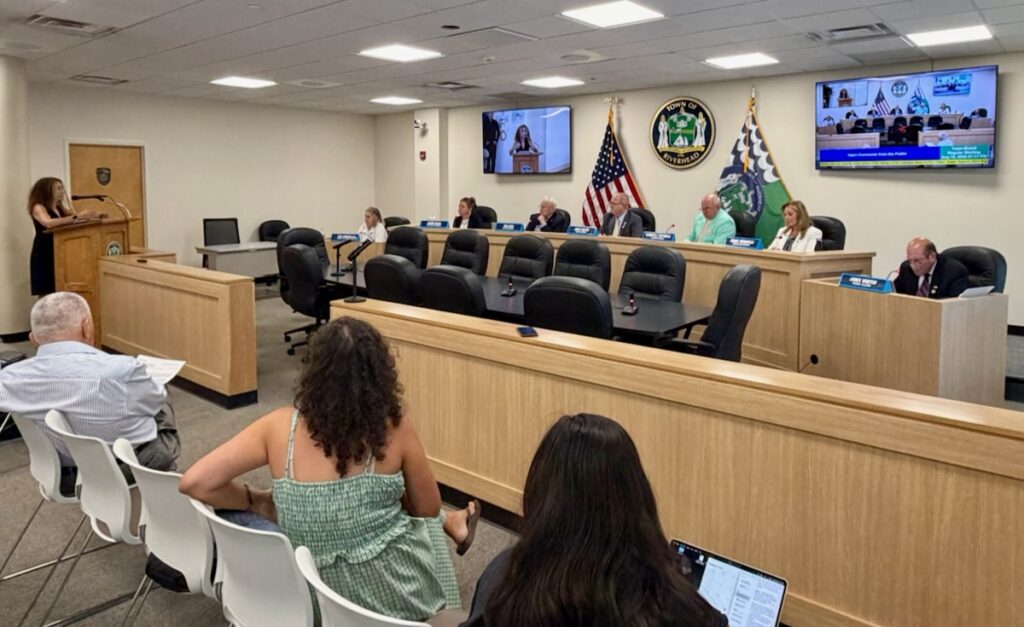
Perez said OLA is asking for a conversation with the board in public, not a private reassurance that town officials support police.
“We all support law enforcement,” she said. “That’s not what this is about.”
The proposal would require notification to town leadership and the town board when Riverhead police respond to federal immigration enforcement activity, create a community task force, make related records available through the Freedom of Information Law, and establish rules for federal agents seeking access to nonpublic areas of town property.
The town board has not scheduled a work session on the proposal.
‘Silence itself is a decision’

Several residents told the board Tuesday that silence is itself a decision.
“You have people coming here meeting after meeting asking for the same thing,” Colin Tooker of Riverhead said. “They’re not asking you to vote yes tonight. They’re asking you to put it on the agenda and talk about it.”
Tooker also submitted written correspondence questioning the role of the town’s Hispanic Development, Empowerment and Education Committee, which the town board created in February 2025 to advise the board on issues affecting Riverhead’s Hispanic community.
In the letter, Tooker asked Councilman Ken Rothwell, the committee’s town board liaison, three questions: “Do you feel that the HDEEC is succeeding at meeting its stated goals under your leadership?” “What is the Committee’s greatest achievement during its 18-month tenure?” and “What is the HDEEC’s advice to the board regarding OLA’s proposed Safety and Accountability legislation?”
Other correspondence submitted for the meeting raised detailed questions about the town’s existing police policy.
Desmond Wong of Reeves Park submitted an 11-page letter and exhibits based on town records produced through two Freedom of Information Law requests. Wong asked town officials to “identify and publish the operative RPD Policy 414,” the Riverhead Police Department’s policy on immigration violations, and to explain how the policy governs continued custody or transfer to federal immigration authorities.
Wong wrote that two versions of Policy 414 were produced by the town, one with a footer dated Jan. 3, 2025 and one dated Aug. 3, 2026. He said those appear to be the vendor’s copyright dates, not town approval or effective dates. The town police department contracts with Lexipol for management of its procedural policies.
Both versions of policy 414 state that Riverhead police officers should not detain someone solely for a civil immigration violation. One section says, “Arrestees shall not be detained solely pursuant to a request from Immigration and Customs Enforcement (ICE) to hold the arrestee or on the basis of an ICE administrative warrant.” It also says, “ICE administrative warrants are not enforceable by local law enforcement officers” and that detention for immigration violations “shall only be conducted pursuant to a judicial warrant.”
The substantive change in the more recent policy is in the list of documents required to support an ICE detainer. The August police changed “a warrant, affidavit of probable cause, or removal order” to “a judicial warrant, court order, or removal order (Executive Law § 170-k).”
Wong said he asked Police Chief Ed Frost to identify which version of Policy 414 is operative, its effective date and approving authority, and to publish it on the police department’s website. He also asked Frost and Town Attorney Erik Howard to explain how the policy’s detention, ICE notification and detainer provisions “operate together.”
‘The moral crisis of our era’
John McAuliff of Riverhead also submitted a letter urging the board to stop relying on political talking points and address what he called “the moral crisis of our era.”
“It is too easy to fall back on talking points and national political loyalties,” McAuliff wrote. He described current federal immigration policy as “Stephen Miller’s campaign to mass-deport undocumented immigrants because of a displacement theory that is inherently racist.”
McAuliff said earlier waves of immigrants, including Irish, Italian, Polish, Jewish and Chinese immigrants, faced the same kinds of fear and prejudice now directed at people from Latin America and the Caribbean.
“Sooner or later ICE will bring tragic consequences to Riverhead or another East End town,” he wrote. “Your refusal to seriously deal with the OLA legislation will weigh on your consciences.”
McAuliff urged Halpin, a former minister, to use his “ministerial training to organize a deep dive” into race relations and immigration in Riverhead. He also called for a public discussion of whether Riverhead should move from at-large town board elections to a council district system to create a more representative local government.
In another handwritten letter, Warren McKnight of Riverhead asked board members to research ICE and publicly share their own conclusions.
“You are smarter & have more research skills than me,” McKnight wrote. “Let me know and hear or write your evaluation of ICE.”
McKnight also invoked the 14th Amendment, asking board members to “note the word All,” which he wrote means “any person in the world.”
More than 20 residents addressed the board Tuesday night to urge it to have a public discussion with OLA.
Cindy Clifford said the board’s refusal to put the proposal on an agenda sends a message to immigrant residents who live, work and raise families in Riverhead.
“What is pledging liberty and justice for all if we’re ignoring the height of prejudice and cruelty that ignores the rule of law that is the backbone of our constitution? Instead of liberty and justice, we’re seeing people being harmed, targeted, essentially punished for how they look, and all the while they’re just trying to live their lives, take care of their families, and do the hard work that supports our local businesses and industries,” Clifford said.
“As an elected official, your first responsibility should be to make sure every resident, regardless of their heritage, is safe and secure and knows that you and our police department are working for their best interest. The OLA resolution doesn’t have to be accepted exactly as it is, but it cannot be any longer blatantly ignored,” she said.
Brianne Ahearn spoke of the fear and anxiety experienced by immigrant families, especially children.
“In order for them to grow up, to be healthy and happy, and become productive, well-adjusted members of society, they must feel safe and protected,” Ahearn said. Instead, “they fear coming home from school, camp, or an outing with friends to find their parents and caregivers gone. Can you imagine that fear, that anxiety, that trauma? What kind of impact is this state of being having on their psyche?” We need a local law that requires ICE to be transparent with and accountable to our institutions and local law enforcement. We, as a community, must understand who the affected individuals are, so we can respond accordingly.”
Allyson Matwey urged the board to practice “radical empathy,” which she described as putting aside one’s personal bias, ego and judgment “to truly immerse yourself in another person’s lived experience.” She urged boat members to fulfill the oath they took to the institution and “represent all Riverhead residents, regardless of their status.”
“Please consider joining me and so many others here in expressing radical empathy for all of our neighbors. It feels really good to love rather than hate. Supporting the OLA legislation is a start,” Mateway said. “You might even make some new friends.”
Several speakers said they were frustrated that town officials have made comments outside of meetings about supporting police, supporting law enforcement or supporting ICE, while declining to respond to residents at board meetings.
“I constantly hear people say there’s a right way and a wrong way in relation to immigration, but there’s also a right way and a wrong way to treat people, and there’s a right way and a wrong way to enforce the law. The right way is by not breaking the law yourself,” Sarah Reynolds of Riverhead said.
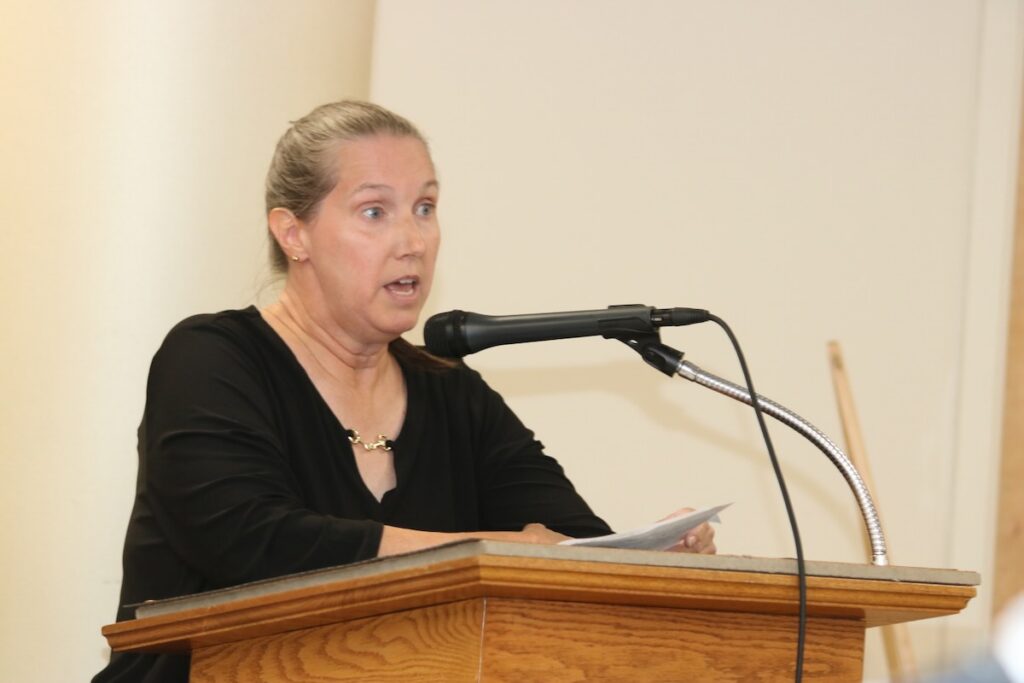
Kerry Flanagan said the board members’ leadership abilities is in question. “If the town board leaders can’t lead with open minds, void of their personal opinions toward certain people based on their immigration status, and they can’t be concerned with everyone. They have failed as leaders, and they should lead no one and be voted out,” Flanagan said.
Trisha Martinez said she’s seen “firsthand the fear and uncertainty many are experiencing because of recent immigration enforcement.” That’s why she supports OLA’s public safety law, she said. “y So this is why I support the OLA Public Safety Law. “This is not an anti-ICE law. It does not stop lawful federal immigration enforcement. It creates clear communication, transparency, and accountability for our local leaders when immigration enforcement activities are taking place,” she said, This allows local leaders to “and can “respond appropriately to protect our community,” and helps “ensure that residents can continue reporting crimes, seeking emergency assistance, accessing schools and healthcare without unnecessary fear.”
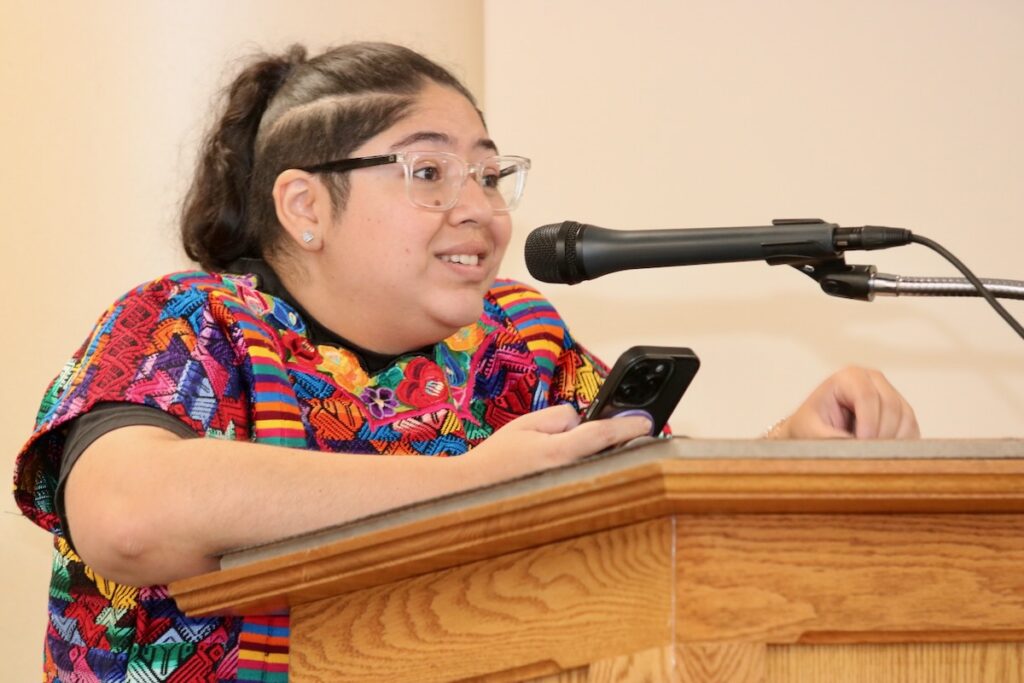
Others spoke from personal experience with immigration. Rosario Rodriguez of Riverhead said she immigrated to the U.S. from Guatemala as a child in 2001, grew up in Greenport and attended school on the East End before going to college at SUNY Oneonta. She became a permanent resident and then a U.S. citizen.
Claims that ICE is only arresting and deporting violent criminals are false, Rodriguez said. Many people that aren’t convicted violent criminals are being picked up by ICE and are not receiving due process of law, she said.
“We’ve had community members on the East End here, where we live, that had no deportation order, no record of violence and no criminal record” but were picked up on ICE sweeps, Rosario said.. Some had work permits. “They were doing it legally,” she said.
“I love the East End with all my heart, especially Greenport because that’s where I grew up. It gave me the opportunity to achieve the American dream, and I know and I know for sure that Riverhead can do the same,” Rodriguez said. “So, if you guys are fighting for America, as you say, I hope that you consider the realities of all of it to everyone.”

Georgette Lauzier of South Jamesport told the board she has “had to quell the fears of my granddaughter that her friends won’t be there when she gets to school tomorrow morning, or that they will be harmed because something happens to someone in their family.”
Children who were born in the U.S. and are U.S. citizens, but they’ve seen TV coverage of ICE enforcement, “and unfortunately, we can’t help them unsee it and we know that children in crisis cannot learn, said Lauzier a longtime elementary educator. “As a taxpayer, as well as a teacher, I want to know that the majority of my tax dollar that’s going into our school district is being adequately and effectively used, and it can’t as long as we have children in crisis,” she said.
Pastor Patricia Chuppe urged the board to meet with OLA and community members.
“Please sit down and talk,” Chuppe said. “That is all people are asking.”
Riverhead is not the only East End municipality where OLA has pressed for adoption of the legislation. East Hampton Village adopted a version of the law in April, and East Hampton Town adopted one in May. Other East End towns and villages have either not acted or are still reviewing the proposal or related policies.
Riverhead officials have not scheduled a work session on OLA’s proposal.
Perez told the board Tuesday that OLA remains ready to meet.
“We’re still here,” she said. “We’re still asking.”
Editor’s note: The version of the proposed Public Safety and Accountability local law originally published with this story (dated March 2, 2026) has been replaced with a later draft dated May 29, 2026.
The May 29 draft adds references to Chapter 55 of the Laws of 2026, a state budget law signed by Gov. Kathy Hochul on May 27, after the March 2 draft was circulated. The revised draft states proposed local law is a measure to help implement the new state law locally. It revises several definitions to track state law and removes an earlier section that would have separately prohibited certain federal immigration enforcement activity in nonpublic areas of designated town or village property.
In addition, this story was previously updated to correct quotations from speakers at the Aug. 18 Riverhead Town Board meeting after further review against the meeting transcript.
The survival of local journalism depends on your support.
We are a small family-owned operation. You rely on us to stay informed, and we depend on you to make our work possible. Just a few dollars can help us continue to bring this important service to our community.
Support RiverheadLOCAL today.
