


























Riverhead officials are preparing to step up parking enforcement downtown, using an electronic system to issue tickets and transmit the information directly to the justice court. The system will allow people who receive tickets to respond online and allow the court to process parking tickets without paper files.
Town Board members discussed the plans with Riverhead Police Chief Ed Frost, Justice Lori Hulse, parking consultant Kevin Wood and data management contractor Dennis Farrell at Thursday’s work session.
The new system will eliminate the need to manually process information recorded on paper tickets, increasing efficiency and accuracy, officials said. It will also drastically reduce the time spent handling and managing paper files. Farrell, president of FBS Parking Solutions, said the system should lead to a significant increase in voluntary compliance.
FBS currently handles parking-ticket data management for the justice court.
Town police issued just under 4,000 parking tickets in 2025, with the number peaking during the summer months to more than double the number issued at other times of year, according to data released by the Riverhead Police Department in January.
Hulse said dealing with paper tickets is time-consuming and inefficient.
“I’ve come in for court when we have a very heavy calendar, and we have to dedicate staff to inputting all of the information on the tickets that we’re receiving,” Hulse said. “Obviously in the summertime we have a glut of those tickets.”
The town is purchasing six handheld electronic devices and portable printers, along with required custom software, from FBS.
The new system will allow officers to create a digital record of a parking violation, including photographs, GPS coordinates and time-marking information. The ticket will include a QR code, allowing motorists to pay the ticket or plead not guilty online. Motorists will not need to appear in court simply to answer the ticket.
The startup cost will be $24,259, including a $2,500 one-time fee to integrate the software with the town’s GoGov online permitting software. Costs will be $3,000 per year in years two and three, Farrell said.
If the town moves quickly, the system could be deployed in early to mid-August, Farrell said.
The rollout will begin with Main Street and parking lots south of East Main Street, on the eastern end of Heidi Behr Way, stretching from the Town Square area to Turkuaz Grill.
Business owners have complained that workers, tenants and other long-term parkers are occupying spaces intended for customers, Councilwoman Denise Merrifield, the Town Board liaison to the Parking District Advisory Committee, said.
The immediate goal is to increase turnover in parking spaces used by downtown businesses, particularly as construction continues in the downtown area, officials said.
Merrifield said the parking committee has also raised concerns that workers connected to the Heatherwood construction project have continued parking in the rear lots despite an agreement that they were not supposed to use those spaces.
The problem, she said, is not only a lack of compliance but also a gap in the town code. One of the lots did not have a parking time limit in the code, which meant police could not issue tickets there, Merrifield said.
The town is now preparing a code amendment to impose two-hour parking limits in the two rear lots from 8 a.m. to 11 p.m., with overnight parking permitted from 11 p.m. to 8 a.m. Merrifield said the later start for overnight parking is intended to prevent someone from taking a space during the dinner rush and then leaving the vehicle there overnight.
A resolution scheduling a public hearing on the code amendment is on the Town Board’s agenda this afternoon. If approved, the hearing will be scheduled for July 21 at 2:10 p.m., when the board could also vote to adopt the change.
Main Street already has time-limited parking, officials said, so enforcement there can begin sooner. Officials discussed issuing warnings before tickets are written. Several board members and Wood said they favor a 30-day warning period.
Frost said he supports the enforcement push, but warned that enforcing timed parking without newer technology will be labor-intensive. Without meters, chalking or automated plate readers, officers must be able to prove a vehicle remained in the same space beyond the allowed time, he said.
Frost said chalking tires is no longer allowed, and an officer cannot simply assume a vehicle stayed in one spot because a driver could claim the vehicle was moved and later returned to the same space.
The handheld devices are intended as the first step toward a more comprehensive parking-management system that could eventually include paid parking, license-plate readers and pay-by-plate technology, Wood said. The long-term goal is to integrate the handhelds with GoGov and eventually with mobile-payment technology and license-plate readers.
Wood said the industry standard is moving toward “pay by plate,” where a vehicle’s license plate functions as the permit. Riverhead already has about 7,000 permits in GoGov, he said, but they are assigned by permit number rather than license plate number. Going forward, he said, plate numbers would need to become a required field.
Frost said license-plate readers will be necessary if the town wants serious enforcement downtown, especially in large municipal lots where it would be impractical for officers to walk every space repeatedly.
“At least one plate reader, at least for the downtown area, would be efficient,” Frost said.
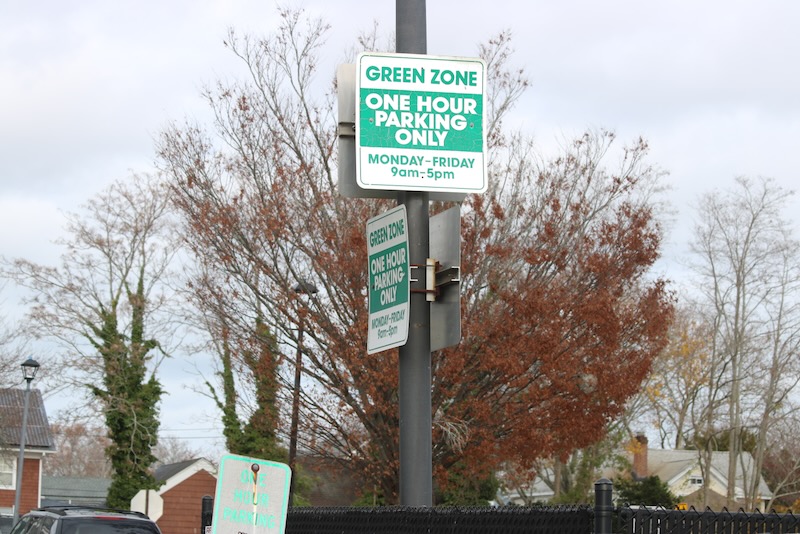
Officials also discussed signage and striping in municipal lots, particularly the larger lot near Summerwind Square and 40 Peconic Avenue. Some spaces in that area are marked for three-hour parking, while others may be two-hour or unrestricted, creating potential confusion for motorists and enforcement officers.
Town Attorney Erik Howard said the code does not currently specify parking-stall colors, but if the town continues to use colors to distinguish parking limits, the signage should clearly explain what each color means.
Frost and Howard both said parking limits must be clearly marked before officers are asked to enforce them.
Officials said the enforcement initiative will be discussed with downtown business groups before tickets are issued. Merrifield said the Chamber of Commerce is aware of the proposal and supports the effort. Councilwoman Joann Waski said she would like Merrifield to brief BIDMA on the plan.
Dawn Thomas, the town’s planning and community development administrator, said the enforcement effort is part of a phased approach to downtown parking: first studying the system, then enforcing existing rules, then adding technology and eventually considering paid parking.
The town does not want to impose a paid parking program abruptly, Thomas said. The goal, she said, is to roll out the changes gradually so businesses, residents and visitors can adjust.
The survival of local journalism depends on your support.
We are a small family-owned operation. You rely on us to stay informed, and we depend on you to make our work possible. Just a few dollars can help us continue to bring this important service to our community.
Support RiverheadLOCAL today.
