



























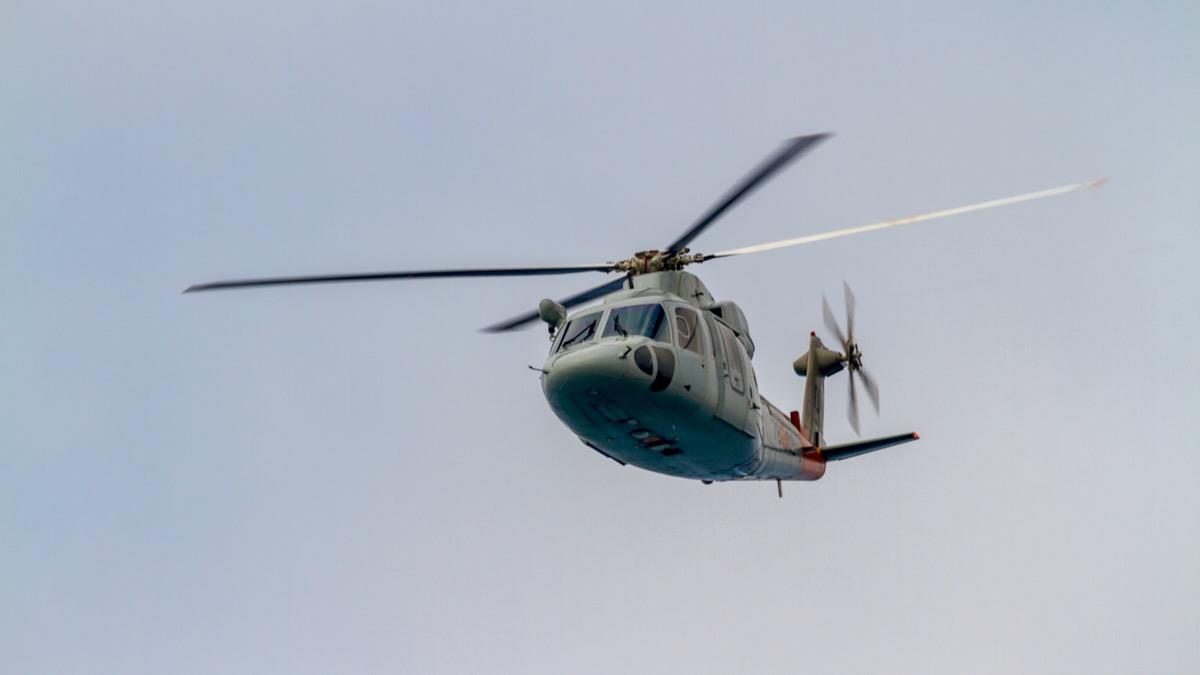
Riverhead Town will reconvene its helicopter noise task force after Wading River residents complained that low-flying helicopters have again made summer weekends unbearable — just weeks before the federal rule requiring civilian helicopters to use the North Shore helicopter route is set to expire.
After listening to complaints at Tuesday’s Town Board meeting, Council Member Ken Rothwell, the board’s liaison to the task force, said he would reconnect with longtime helicopter noise opponent John Cullen and reconvene the group.
He said in a phone interview Friday he’s spoken with several task force members and has set a date of July 16 at 4 p.m. for the task force meeting. It will be held in the Town Hall meeting room and will be open to the public.
Patricia Berry of Wading River told board members Tuesday that helicopter noise over Wading River has become “unbearable,” with aircraft flying over residential neighborhoods after turning inland near the Shoreham power plant and crossing town toward Gabreski Airport, East Hampton Airport or the Southampton Heliport.
She said she attended a June 25 meeting of the Gabreski Airport noise committee and learned that the airport recorded 567 complaints from January through April 2026, including 83 from Wading River — none of which were hers, because she had not known how to file a complaint.
Berry told the board she tracked one helicopter over her home July 5 at 800 feet at 10:58 a.m. and reported it to the FAA. She said another helicopter flew over her home that afternoon at 975 feet and returned that evening at 1,050 feet.
“These are taxi services,” Berry said, saying flight-tracking apps identify whether aircraft are police, military or private flights.
Berry said pilots are ignoring the mandatory New York North Shore Helicopter Route, which was adopted by the FAA in 2012 after years of complaints from North Shore residents about helicopter noise from aircraft traveling to and from the Hamptons.
The current rule, extended by the FAA in July 2022, requires pilots operating civil helicopters under visual flight rules along Long Island’s North Shore to use the New York North Shore Helicopter Route when flying between Lloyd Harbor and Orient Point. The rule allows pilots to deviate from the route and altitude requirements when necessary for safety, weather conditions or when transitioning to or from a destination or point of landing.
The rule is scheduled to expire July 29, unless the FAA extends, replaces or otherwise modifies it.
The FAA in 2022 adopted the route as an interim final rule for four more years while the agency assessed possible route modifications and the then-unresolved operating status of East Hampton Airport, which had been the subject of litigation after East Hampton Town sought to close the public-use airport and reopen it as a private-use facility. The airport is open and operating and helicopters carrying passengers from Manhattan to the Hamptons land there.
Berry’s complaints are familiar to residents of the North Fork who for years fought first for a route that required flights to remain over the Long Island Sound and then for enforcement of the FAA rule, which requires minimum altitudes of 2,500 feet unless weather requires a lower altitude.
See: Helicopter noise still disrupting quality of life, task force chairperson says (Aug. 2, 2019)
The point at which helicopters traverse land to reach the south shore from the North Shore route has shifted west from the eastern Riverhead-western Southold area to Wading River, according to residents, like Berry and Cullen, of Northville, who track helicopter traffic with online and mobile apps.
“The weekends are absolutely horrible in Wading River,” Berry said.
“It’s important that Wading River gets some relief,” Cullen said at Tuesday’s meeting.
Cullen said he would work with Berry, Rothwell and Halpin and would again contact East Hampton Airport Director Jim Brundage and the Eastern Region Helicopter Council.
Rothwell said Tuesday the town has not received many recent helicopter complaints aside from Berry’s letter, but he would reconvene the task force, he said.
Some of the helicopter activity residents see may be Suffolk County Police Aviation, which is increasingly used for EMS and public-safety calls, Rothwll said. He acknowledged that private helicopter traffic remains a concern.
“There’s definitely private ones out there. I have seen what you have seen as well,” said Rothwell, also a Wading River resident.
Councilmember Denise Merrifield, who also lives in Wading River, said she has also noticed an increase in helicopter traffic and does not believe all of the aircraft are police helicopters.
Barbara Toronto of Wading River also told the board that helicopter noise has worsened.
“For years this has been happening and getting worse,” Toronto said. She said she previously complained to the FAA when helicopters flew so low she could read the numbers on the aircraft. “They are out of control,” she said.
Berry, who first contacted RiverheadLOCAL June 22, said in an interview that the noise has intensified over the past few years and that helicopters sometimes fly so low her house shakes.
She said she believes many helicopters are following Long Island Sound east, then turning inland near the Shoreham power plant and using the former Grumman runway in Calverton as a visual guide before continuing toward the South Fork.
That inland crossing, Berry said, means Wading River is bearing the burden of aircraft that should be kept offshore.
Longtime helicopter noise opponents on the North Fork say the problem has not gone away, though the worst impacts have shifted.
Teresa McKaskie of Mattituck, who has advocated for years against helicopter and seaplane noise, said in an interview that some areas of the North Fork have seen improvement as more helicopters use routes farther south or over water. But she said other communities, including parts of Wading River and Southampton, continue to be affected by helicopters and seaplanes. She said noise from seaplanes is now the main problem on the North Fork, as the use of seaplanes has increased over the years.
McKaskie said the FAA has not adequately addressed the broader problem.
“Fly respectfully, fly higher, fly with noise-abatement procedures,” she said. “Respect your neighbors.”
Sid Bail, president of the Wading River Civic Association, said last month that helicopter noise remains one of the familiar sounds of spring and summer in Wading River, though he said he had not recently seen the kind of organized opposition that existed several years ago.
The renewed complaints come at a time when local officials and residents have a narrow window to push the FAA for action before the existing North Shore route rule reaches its expiration date.
The FAA has not yet responded to questions from RiverheadLOCAL about whether it plans to extend or modify the North Shore route or allow it to expire.
The survival of local journalism depends on your support.
We are a small family-owned operation. You rely on us to stay informed, and we depend on you to make our work possible. Just a few dollars can help us continue to bring this important service to our community.
Support RiverheadLOCAL today.
