


























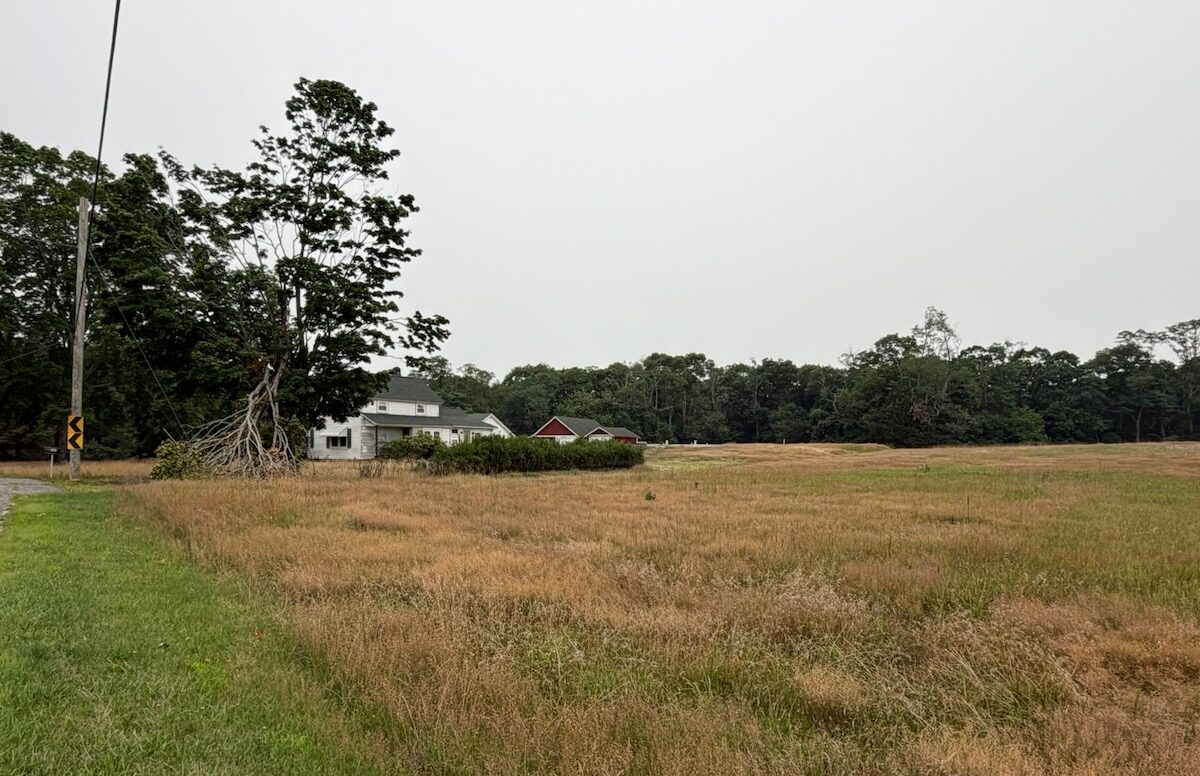
A resolution that would have added a 5.4-acre Calverton property slated for development with a cannabis cultivation facility to a county Agricultural District was tabled by the County Legislature Tuesday.
The legislature held the resolution after Riverhead Council Members Ken Rothwell and Denise Merrifield raised concerns about the property during a meeting with the presiding officer prior to the legislative session. Several neighboring residents spoke against the designation during the public portion of the meeting, held at the county center in Riverside.
The property, at 1458 Middle Road, is the site of a pending application for a 31,782-square-foot greenhouse where cannabis would be cultivated, dried, cured, trimmed and packaged. The proposal is before the Riverhead Planning Board for site plan approval.
The Suffolk County Agricultural and Farmland Protection Board recommended the parcel’s inclusion in Agricultural District No. 1 at its April 16 meeting. County planning documents identify the proposed cannabis operation as a start-up and state that the property was historically farmed but has been fallow for more than 10 years.
The county staff report says the applicant plans to invest approximately $6 million in construction of the greenhouse and related improvements and projects annual gross sales exceeding $50,000.
The resolution before the legislature stated that the county agricultural board found the property to consist predominantly of viable agricultural land and determined that its inclusion would serve the public interest by supporting a viable agricultural industry. Legislative approval would have sent the application to the state Department of Agriculture and Markets for final review and certification.
Riverhead officials maintain that the property does not meet the criteria for designation in an agricultural district.
Residents of Windcrest East, Foxwood Village and other nearby communities have strongly opposed the greenhouse proposal during proceedings before the Riverhead Planning Board and Zoning Board of Appeals. They have raised concerns about noise, odor, lighting, traffic, water use and the project’s proximity to residential neighborhoods.
Several residents repeated those objections Tuesday and argued that the agricultural district program was intended to protect existing farms, not provide additional protections to a proposed large-scale cannabis facility.
One resident described the property as a residential parcel containing a single-family home that has not been farmed for decades. Another said placing the site in the agricultural district could provide the owner with tax benefits while limiting the town’s ability to regulate impacts from the operation.
Inclusion in an agricultural district does not by itself grant an agricultural tax assessment. Such an assessment requires a separate application and compliance with state eligibility requirements. Agricultural district status, however, provides certain protections to qualifying farm operations and requires municipalities to avoid imposing unreasonable restrictions on agricultural practices.
Rebecca Sinclair, a spokesperson for the applicant, said the proposed greenhouse is a permitted use under the town zoning code. It is located in Riverhead’s Agricultural Protection zoning use district (APZ). Cannabis cultivation is recognized as agriculture under state law.
“We are before the Town for site plan review because we are siting a greenhouse,” Sinclair said in an emailed statement Wednesday. “This site is zoned APZ, greenhouses are permitted, and our crop and operation are not only legal but supported by an Ag & Markets opinion.”
The state Department of Agriculture and Markets issued an opinion in March finding that the proposed climate-controlled cannabis cultivation facility, associated equipment and parking areas were “agricultural in nature.”
Sinclair said the agricultural district program does not require that a parcel be actively farmed when an application is filed. Land that has gone fallow and land proposed for a new agricultural operation can qualify, she said.
“The use in consideration is based on the proposed operation, not the crop,” she said.
Rothwell said in an interview Tuesday afternoon he thinks the town should acquire the site for preservation as open space. He said the town’s Open Space Committee and council members Merrifield and Joann Waski support the idea. The town has enough Community Preservation Fund money to make the purchase, Rothwell said. However, the property owner isn’t interested in selling and it is the owner’s right to decline, he said.
In a June 15 letter to property owner Manoj Narang, a copy of which was obtained by RiverheadLOCAL, Rothwell asked whether Narang would consider selling the parcel to the town. Rothwell wrote that acquisition of the property would expand the adjacent Kobylenski Open Space Preserve and could allow the town to preserve historic agricultural features on the site.
The 41-acre Kobylenski preserve borders the property on the north and east. The town purchased that land with Community Preservation Fund money in 2008.
John Anzalone, attorney for the property owner, responded July 6 that the owner was not interested in selling. Anazalone said the owner had already incurred more than $1 million in licensing, engineering, environmental and site plan costs and would face substantial additional expenses and delays if required to relocate the operation.
Sinclair said any town acquisition would have to proceed through the town’s established open-space program, including evaluation of the property’s preservation priority and an appraisal.
She criticized Rothwell’s letter as lacking Town Board authorization and said the applicant has experienced repeated delays during the local review process.
The site plan application remains under review by the Riverhead Planning Board. Town planning staff have raised questions concerning lot coverage, noise, odor controls, wetlands and other aspects of the revised site plan.
At the board’s request, the applicant submitted a neighborhood sound study conducted at a cannabis facility in Maryland, but Riverhead planning staff said the report did not identify the equipment operating at that facility or establish that conditions there were comparable to the proposed Calverton greenhouse.
The Planning Board at its June 18 meeting decided to require an acoustic modeling study. It also requested certain site plan modifications, including notes on the plans identifying the equipment proposed to be located on cement pads outside the greenhouse structure, verification of equipment numbers and details about licensing.
Sinclair said Wednesday the applicant submitted the acoustic modeling study to the Planning Department on July 6 and the updated site plan drawings with additional information as requested by planning staff on July 10.
The survival of local journalism depends on your support.
We are a small family-owned operation. You rely on us to stay informed, and we depend on you to make our work possible. Just a few dollars can help us continue to bring this important service to our community.
Support RiverheadLOCAL today.
