























Groundwater entering the Navy’s new PFAS treatment system at Calverton contains PFOA at 270 parts per trillion — nearly 68 times the federal drinking-water limit. The Navy detected PFAS in groundwater at the former Grumman plant’s southern fence line as early as 2016, but did not release those results until four years later, after a town official asked for them.
Now the Navy has begun an interim action to treat groundwater at the former fire-training area, a major source of PFAS contamination at the former Grumman site. But it still projects that the last of seven PFAS investigations will continue until 2039, before a final cleanup remedy for that site can be selected. Sen. Charles Schumer says the interim treatment is not enough.
“Simply put – waiting until 2039 for remediation is just not acceptable. Moreover, the promise of short-term interim actions while the Navy proposes to radically move back their timeline on a full remediation will not suffice,” Schumer said in a statement sent Sunday.
The stakes extend far beyond the boundaries of the former plant. Long Island relies on groundwater for drinking water. Navy maps have shown PFAS-contaminated groundwater moving off the Calverton property toward the Peconic River system. PFAS has been found in the river, and a state advisory issued in 2023 limits consumption of certain fish caught in part of it. The river feeds the Peconic Estuary. The extent to which contamination from the former Navy site contributes to PFAS in the fish remains under investigation.
RiverheadLOCAL reported in 2020 that the Navy had sampled groundwater at the southern fence line in 2016 and 2017 but did not release the results until Calverton resident Stan Carey requested them at a Restoration Advisory Board meeting. Carey, a career public water supply professional who is a member of the New York State Water Quality Council was chairperson of the Riverhead Planning Board.
A separate Navy investigation identified the former fire-training area as a PFAS release area in 2016. Navy maps later showed contaminated groundwater from that area moving under Swan Pond toward Donahues Pond, part of the Peconic River. RiverheadLOCAL reported on those maps in 2025.
Treatment begins, questions remain
The pump-and-treat system at the former fire-training area, initiated as a pilot study, began treating groundwater Sept. 5. Navy spokesperson David Todd said Monday that it operates at 20 gallons per minute and has treated approximately 23,000 gallons. He said water entering the system contains 270 parts per trillion of PFOA and 150 parts per trillion of PFOS. The federal limit for each chemical in public drinking water is 4 parts per trillion.
Those incoming readings are not the highest the Navy has reported at the fire-training area. A Navy presentation last year listed earlier groundwater readings as high as 1,367 parts per trillion for PFOA and 1,110 for PFOS. The older samples and the new system’s incoming water were taken at different locations and times; they do not establish whether concentrations across the site have risen or fallen.
Todd did not provide measured PFAS levels for water leaving the treatment system, although RiverheadLOCAL requested them. He said the Navy would treat the outgoing water to maximum levels of 10 parts per trillion for PFOA and 6 for PFOS under New York State discharge requirements. Without the measured results, the public cannot yet assess how the operating system is performing.
Todd said the Navy expects to expand the system’s capacity to as much as 90 gallons per minute in December. It will decide in summer 2027 whether another proposed barrier is needed to contain the Site 2 groundwater plume.
The Navy reported $16 million in funding in place for Calverton work in fiscal year 2026, but Todd declined to release projected amounts for future years.
Why wasn’t the board told?
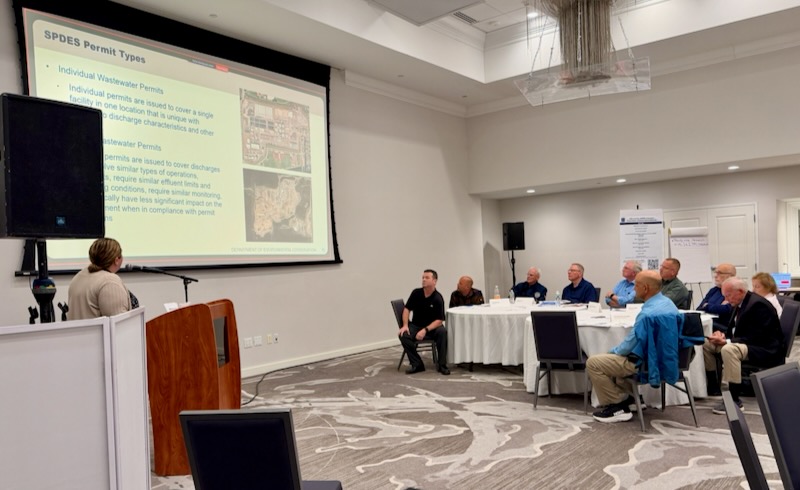
The Navy’s treatment work does not resolve another question raised by the cleanup’s long history: when the Navy knew its projected investigation timeline had changed, and why it did not tell the community board that follows the work.
RiverheadLOCAL reported Sept. 3 that federal records moved the projected end of Calverton’s PFAS investigation and study from 2028 to 2039 in stages. Longtime board members said they had not been informed.
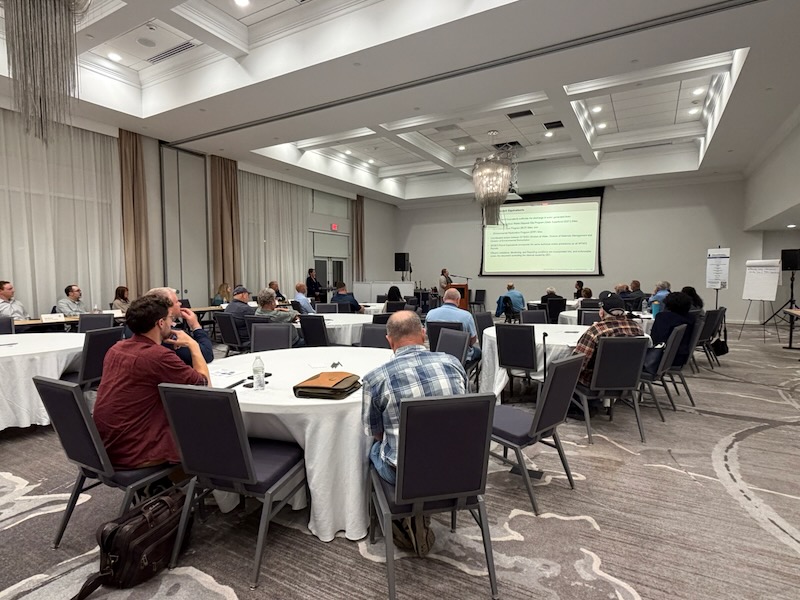
At the board’s Sept. 23 meeting, Navy supervisor Bryan Revell said the original date covered two PFAS sites and that five more were subsequently added to the investigation program. The federal chart gives the projected completion date of the last site, he said. A Navy presentation listed earlier projected dates for the other six sites, including 2029 for the former fire-training area and 2030 for Sites 14 and 19 near the Peconic River. The 2039 date belongs to Site 17.
Todd said the dates raised in RiverheadLOCAL’s questions were established in 2024 in response to regulatory changes. He did not answer when Calverton staff learned of the revised projections or why the changes were not presented to the board at the time. He said the Navy would “proactively provide updates to any future shifts in milestone dates.”
That promise follows a Sept. 9 letter to Schumer from Dale R. Marks, assistant secretary of war for energy, installations and environment. Addressing PFAS cleanup delays nationwide, Marks wrote that the military departments communicate installation-specific schedule updates through restoration advisory boards, public meetings and online resources. The letter did not identify a Calverton meeting at which the changed date had been disclosed.
“The Navy’s new found interest in the EPCAL cleanup in Calverton is welcomed, but more needs to be done to regain the trust of the Riverhead community,” Schumer said in Sunday’s statement. He said he would continue pressing the Navy until the site is fully remediated.
‘We cannot let PFAS get to the bay.’
Former Rep. George Hochbrueckner, who wrote the legislation that conveyed the site to the Town of Riverhead for $1 in the 1990s, attended the RAB meeting last week. “Besides writing the law that gifted the 2,900 acres to the town, I also wrote the law that put Peconic Bay into the National Estuary Program,” Hochbrueckner told Navy officials. “And obviously, I’m delighted that you have your extraction wells going in place. I’m not happy that it’s going to take nine, 10 years to put them all over the place where we need them, but that’s beside the point,” he said.
“The important thing at this point is what are we doing about the migration of the plume off the [site],” he said.
“We already agree based on your own data that it has migrated into the Peconic River… My concern is Peconic Bay. The National Estuary Program only has about 25 bodies of water in the entire nation. Peconic Bay is one of them. We cannot let PFAS get to the bay,” Hochbruecker said.
“So, what I would like to see is you folks doing some quicker sampling and get more extraction wells in place… So my question to you is, how soon do you think you could determine where that plume is and stop it from getting to Peconic Bay ASAP and get some extraction wells in place to stop that?” Hochbreuckner asked.
Navy supervisor Revell acknowledged Hochbrueckner’s was “a valid concern” that has been brought up in the past. “I know that it’s been brought up before about the impacts to the Peconic Bay and the Peconic River,” Revell said. “One of the reasons we’re performing the fish tissue sampling as well as the surface water and the sediment sampling along the Peconic is for those purposes: to understand what that impact is, so then we can make decisions about moving forward.”
Earlier in the meeting, Hochbrueckner, 88, had explained what the cleanup timetable meant to him: “I’d love to see this problem solved while I’m still alive.”
The survival of local journalism depends on your support.
We are a small family-owned operation. You rely on us to stay informed, and we depend on you to make our work possible. Just a few dollars can help us continue to bring this important service to our community.
Support RiverheadLOCAL today.
