






















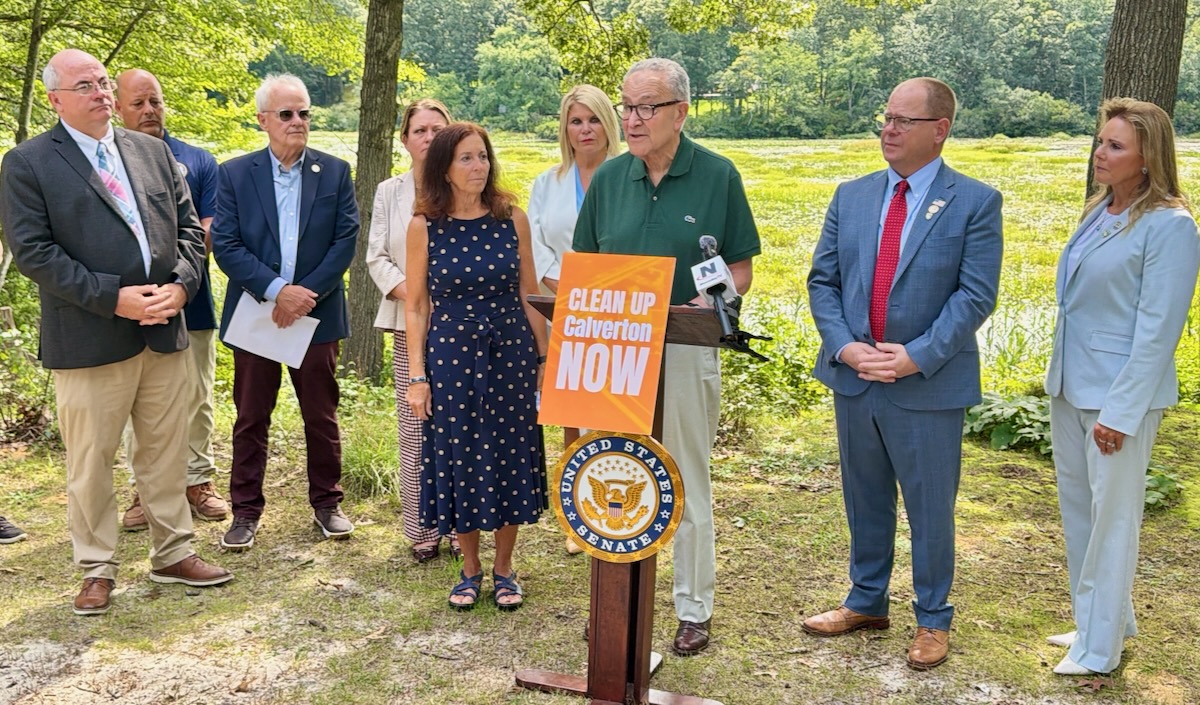
U.S. Sen. Chuck Schumer came to Calverton Thursday demanding that the Navy speed up its cleanup of PFAS contamination at the former Naval Weapons Industrial Reserve Plant, saying the military had pushed the work back by more than a decade.
That news came as a shock to residents and environmental advocates who have spent years pressing the Navy to act faster. The delay has never been mentioned by the Navy at any of its semi-annual Calverton Restoration Advisory Board meetings, even though the DoD began pushing back the target cleanup start date in FY 2023.
A timeline hidden in federal records
Federal records show the delay did not happen all at once. The target start date for cleanup work at the former Grumman site was postponed from June 2028 to April 2039 incrementally, beginning in fiscal year 2023, when it was pushed back to September 2036, according to Department of Defense records. By fiscal year 2024 it had been pushed back to April 2039.
PFAS are a family of synthetic chemicals used for decades in firefighting foam, industrial processes and consumer products. They are often called forever chemicals because they do not break down easily in the environment and can move through soil and groundwater. Exposure to certain PFAS has been linked to health risks including immune system effects, developmental problems, liver impacts and increased risk of some cancers.
What the delayed study means
Under the federal Comprehensive Environmental Response, Compensation, and Liability Act (CERCLA), cleanup work cannot begin until a remedial investigation and feasibility study are completed for a military site like Calverton. The projected end date for the remedial investigation and feasibility study (known as the RI/FS) is what keeps getting pushed back.
The RI/FS is not the cleanup itself. It is the investigation-and-options phase that comes before a final cleanup remedy is selected. In plain English, the Navy’s current federal timeline says it may not finish defining the extent of PFAS contamination and evaluating cleanup options at Calverton until 2039.
USA Today, which on July 26 published an investigation into PFAS cleanup delays at military sites nationwide. compiled prior versions of the Pentagon’s PFAS cleanup status charts.
RAB members say they were not told
Vincent Racaniello, longtime co-chair of the Calverton Restoration Advisory Board, said in a phone interview Thursday afternoon that, as far as he knew, the RI/FS end date was still 2028. He said he was unaware the date had been pushed back to 2036 in DoD records.
“They’re not giving us the information they should be giving us. They often do not give us information in a timely manner,” Racaniello said.
Adrienne Esposito, executive director of Citizens Campaign for the Environment and a longtime RAB member, said today she also had not been aware of the delay in the projected start of cleanup work, incremental or otherwise.
“Changing the timeline in such a hidden and insidious fashion just speaks to the lack of transparency and the lack of good faith that the Navy operates within,” Esposito said in a phone interview after Schumer’s press conference. “We, the RAB, were not aware of this monumental delay once again in cleaning up the site, and in addition, it’s completely unnecessary and unwarranted.”
The former Navy weapons plant, now known as the Enterprise Park at Calverton (EPCAL), was used for decades by Grumman for the development, assembly, testing and maintenance of military aircraft. PFAS, a family of persistent chemicals used in firefighting foams and other industrial applications, has been found in soils, groundwater and surface waters on and near the site.
County data at the center of the fight
Schumer, standing with Riverhead Town officials, New York State Assembly Member Jodi Giglio, environmental advocates and RAB members, said Suffolk County’s testing shows contamination moving toward the Peconic River.
“They move through the soil. They move through the groundwater, and right now they’re moving right towards the Peconic River,” Schumer said.
The senator said county testing found 11 PFAS compounds across 21 samples collected near the site, with some samples far above state drinking water standards. He accused the Navy of questioning Suffolk County’s data instead of using it to guide a faster response.
“You cannot stop what you refuse to measure,” Schumer said.
For years, the Navy has resisted calls to take responsibility for groundwater contamination beyond the former weapons plant’s boundaries, even as local water providers and public agencies have responded to contamination concerns off-site.
The Riverhead Water District and Suffolk County Water Authority have spent millions of dollars extending public water mains to serve homes south of the former Grumman site, where private wells have been affected or threatened by contamination moving through the aquifer. Federal funds procured by Schumer as well as former Rep. Lee Zeldin and Rep. Nick LaLota, as well as state and county funding, have made the public water extensions possible.
Calls for action
Schumer today called for more testing, more transparency and a real cleanup plan. He also criticized the Navy for delaying for an entire year disclosure of PFAS findings in fish from Swan Pond, a point also raised by RAB members and local officials.
“The community has a right to know what is in their water, no more sitting on data, no more hiding it away on the Navy website like a game of bureaucratic chicken,” Schumer said.
Schumer described the Navy’s delay broadly as a roughly decade-long postponement.
For Calverton, the original DoD documents reviewed by RiverheadLOCAL show at least three key public benchmarks: June 2028 in a July 2022 DoD report, September 2036 in a fiscal year 2023 report, and April 2039 in a fiscal year 2024 report.
Esposito said the delay is not justified by the size or complexity of the Calverton contamination.
“What we have here is a sad example of government indifference and irresponsibility,” Esposito said at the press conference. “Truth is this site could have and should have been cleaned up years ago.”
Esposito said the RAB has pressed the Navy to install an extraction well at the leading edge of the PFAS plume from the former firefighting area to stop it from migrating toward the Peconic River. Instead, she said, the Navy has proposed a pilot treatment approach.
“Instead of using a tried-and-true solution, they’re doing a pilot program. That makes no sense to us,” Esposito said.
She also criticized the Navy’s practice of investigating contaminants separately, saying the Navy should test comprehensively rather than addressing PFAS and 1,4-dioxane on different tracks.
“The longer this takes, the more the contamination spreads, the more harm is done to the environment and to public health, and the more the remediation will cost,” Esposito said.
Riverhead Supervisor Jerry Halpin said the contamination threatens not only Calverton but ongoing efforts to protect the Peconic River and Peconic Estuary..
“We need the Navy to do this. We need them to clean up now,” Halpin said.
The local frustration is not new. The former Navy site has been the subject of environmental investigation and public pressure for decades. RAB members and local officials have repeatedly accused the Navy of moving too slowly and resisting responsibility for contamination found beyond the property boundaries.
But the 2039 RI/FS date adds a new dimension to the dispute: whether the public advisory board charged with following the cleanup was ever clearly told that the Pentagon’s own projected investigation timeline had slipped so far.
NAVFAC’s local Calverton RAB materials discuss ongoing PFAS investigations, planned sampling and individual site work. They do not appear to clearly disclose the overall DoD RI/FS end-date changes reflected in the national PFAS status charts.
The Navy did not immediately respond to a request for comment.
Rep. Nick LaLota, in a statement emailed by his communications aide, said, “Senator Schumer’s new interest is welcomed and he can maximize his influence by supporting the House’s FY27 defense appropriations bill that has $3.25 million I insisted on for Calverton remediation.”
LaLota did not respond to a question about whether he knew of the postponement or provide any comment about the postponement. He did not say what the $3.25 million for Calverton remediation would cover or when it would be spent in light of the delayed completion of the study required by CERCLA.
When Schumer was asked what the 2039 date means for Long Island, the senator gave a blunt answer.
“It’s not acceptable,” he said. “It sucks.”
He said the Navy’s legal and financial exposure will only grow if it continues to delay.
“Every season the Navy runs out the clock, the plume gets further, the scope gets bigger, the cost to the taxpayers goes up,” Schumer said. “If that contamination reaches the Peconic River, this stops being a Calverton problem, and it becomes a regional crisis.”
See the USA Today dashboard for its searchable database of military bases
The survival of local journalism depends on your support.
We are a small family-owned operation. You rely on us to stay informed, and we depend on you to make our work possible. Just a few dollars can help us continue to bring this important service to our community.
Support RiverheadLOCAL today.
