
























It’s been an unexpectedly extensive part of my journalistic journey. Because I was deeply involved in reporting about LILCO’s plan to construct seven to 11 nuclear power plants in Suffolk County, I became knowledgeable about atomic energy. I wrote a book titled “Power Crazy” about this scheme to turn this area into what nuclear promoters termed then a “nuclear park.” I wrote many columns and did television reporting on it.
So, back in 1985, with that experience, I was struck by a piece in the U.S. Department of Energy’s publication, “Energy Insider,” saying that DOE and NASA were partners in the sending up in 1986 two space shuttles—one being the Challenger—with space probes onboard fueled by plutonium, considered the most toxic of all radioactive substances.
Once the shuttles achieved orbit, the probes would be released, and the one Challenger carried would survey Jupiter. The plutonium would be in radioisotope thermoelectric generators (RTGs), not for propulsion but to provide electric power for instruments.
In “Energy Insider” there was notice that the government had looked into various sorts of accidents that might happen on the missions. So, I sent Freedom of Information Act requests to DOE, NASA, and the DOE national laboratories involved in these studies asking to learn what was determined.
As the months passed, I began to realize I had hit upon a hot potato. I was denied the information on the grounds it was “technical” which is not a legitimate FOIA exemption. I appealed and won.
Finally, a box of documents arrived, including a government projection that the likelihood of a “catastrophic” shuttle accident was 1-in-100,000. Those were very high odds, so I didn’t do anything.
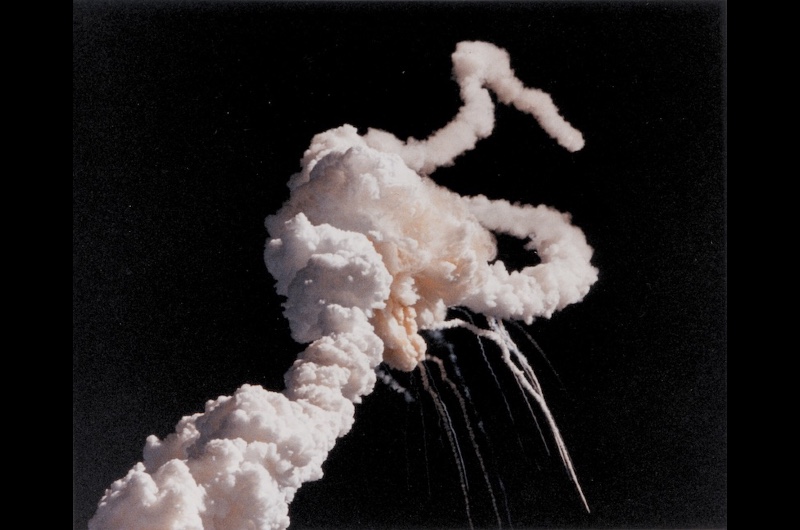
That was until January 28, 1986 when on my way to teach my Investigative Reporting class at SUNY Old Westbury, I heard on the car radio that the Challenger had exploded on launch.
I stopped at a P.C. Richard store and saw that terrible image on TV. I telephoned The Nation magazine to tell them that the next mission of the Challenger, in May, was to involve a nuclear system—and if the accident occurred then and plutonium released as dust, the disaster could have been a massive catastrophe.
The Nation asked me to write a piece, which I did. Other media picked up on it and I was pretty widely interviewed. A publisher called, resulting in my writing a book that he titled “The Wrong Stuff.” Meanwhile, NASA and DOE changed the odds of a catastrophic shuttle accident from 1-in-100,000 to 1-in 76.
And I began to “follow the money” as Bob Woodward’s source “Deep Throat” instructed in the film about the Watergate investigation.
I did, and found the then “Star Wars” program of President Reagan was predicated on orbiting battle platforms with hypervelocity guns, particle beams and laser weapons and, also onboard, nuclear reactors and “super plutonium” systems providing the high energy they needed. The latter would be built by General Electric, manufacturer of the RTGs on the space probe Challenger was to loft.
NASA’s use of nuclear power in space was being done in parallel with the plan for nuclear-powered weaponry in space.
This resulted in another book I authored, “Weapons in Space,” its foreword by Dr. Michio Kaku, and an hour-long TV documentary I wrote and presented, “Nukes in Space: The Nuclearization and Weaponization of the Heavens.” And there have been many articles on this and more TV programs during the ensuing four decades including “Star Wars Returns” (viewable at www.envirovideo.com).
I gave two presentations on this before members of the British Parliament in London, presentations at the United Nations in New York and Geneva, and elsewhere around the U.S. and world.
My most recent articles on it, last month, involved the announcement by the Air Force secretary acknowledging the U.S. has deployed weapons in space.
Last week the lead front page story in the New York Times was headlined: “Superpowers Racing to Put Nuclear Reactors on Moon.” The nations involved: the U.S., China and Russia. And there was a subhead: “Experts Warn of Radioactive Risks From a Rocket Mishap or Lunar Meltdown.”
The reporter, Selam Gebrekidan, wrote: “Failures could cause a chain reaction with dire consequences. Falling reactor debris could scatter radioactive material….An explosion or a meltdown on the moon’s surface could risk turning entire regions into no-go zones.”
The extensive story quoted Edward Lyman, director of nuclear power safety at the Union of Concerned Scientists, saying: “There will always be a space race going on, and if you enter nuclear power into that mix, then it could take a potentially more dangerous turn.”
My journalism on nuclear and weapons in space has been repeatedly listed by Project Censored, a program at Sonoma State University in California, as among the “most under-reported” stories.
In 1992, the Global Network Against Weapons & Nuclear Power in Space was formed and is active worldwide. As Bruce Gagnon, coordinator of the Maine-based organization, said about what the Times reported: “This will move the Earth-bound global war system into the heavens. When they add nuclear power into the equation these people are asking for trouble.”
Meanwhile, websites are proposing solar power devices for the moon. Blue Origin, the company of Amazon owner Jeff Bezos, is advancing “Power Towers.”
Lockheed Martin has a similar system termed “Vertical Solar Arrays” and says: “The moon’s south pole presents unique opportunities and challenges for solar energy capture. Certain locations receive sunlight 80% to 90% of the time, making them ideal for solar power generation.”
There’s an online petition at https://www.thepetitionsite.com/223/416/093/say-no-to-nasas-reckless-nuclear-reactor-on-the-moon/ headed “Say No to NASA’s Reckless Nuclear Reactor on the Moon” with nearly 47,000 signatories.” It says NASA’s “accelerated plans to put a nuclear reactor on the moon, framing it as a race against China and Russia…is nothing more than a dangerous, costly, and shortsighted gamble—one that could leave behind radioactive waste, spark international conflicts and waste billions of taxpayer dollars.” It says NASA “should focus on sustainable alternatives like solar energy.”
The survival of local journalism depends on your support.
We are a small family-owned operation. You rely on us to stay informed, and we depend on you to make our work possible. Just a few dollars can help us continue to bring this important service to our community.
Support RiverheadLOCAL today.
