
























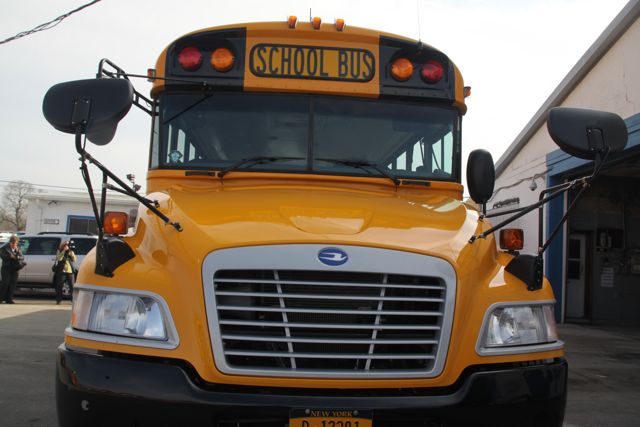
Riverhead is the first school district on Long Island to deploy propane-powered school buses.
Two brand new propane buses hit the road for the first time Monday morning.
“The handling is great and it’s much quieter,” said 15-year veteran bus driver Ted Olsen, assigned to one of the two new vehicles. “The kids can already see a difference in it.”
The school district is running the two propane buses this year alongside two new diesel buses so it can compare the results between them and estimate how much money an entirely propane-powered bus fleet could potentially save the district, whose current fleet numbers 106 buses that log more than a million miles each year.
Not only does the propane itself cost less — $2.35 a gallon of propane instead of $3.03 a gallon of No. 2 diesel — but maintenance costs will also be much less expensive.
“The period between oil changes for propane-run buses can also be extended, further reducing the cost of operating these vehicles,” said school district transportation director Amala Cain. Parts such as fuel and air filters are less expensive, as well, she said at the district’s bus barn Friday afternoon.
Propane-powered buses are not significantly more expensive than diesel-powered buses: a propane bus costs about $102,000, and a diesel bus about $97,000, Cain said.
Propane buses last longer with better performance than diesel buses, too, according to Peter Hayes, a sales representative from Blue Bird, the Georgia-based bus manufacturer.
“In 10 to 15 years from no w, these buses will still run just as well, and with the same mileage,” he said.
A small cluster of school officials gathered around the rear of a running propane bus as Hayes ran a finger inside the pristine tailpipe of the bus, indicating the minimal amount of exhaust it produces.
“You can eat your lunch behind it,” he said to laughter.
Blue Bird has more than 1,000 propane buses on the road across the country, Hayes said.
The new propane buses are also more environmentally friendly than their diesel-powered counterparts. Propane-powered engines don’t produce the toxic emissions that diesel-powered school buses generate. Propane produces up to 60 to 70 percent less smog-producing hydrocarbons than gasoline, according to a press release issued by the school district.
Such toxic emissions can even cause “significantly higher exposures of vehicle-related pollutants” inside diesel-powered school buses, according to a study conducted by the University of California.
Riverhead’s propane buses will be fueled at Amerigas on West Main Street.
The survival of local journalism depends on your support.
We are a small family-owned operation. You rely on us to stay informed, and we depend on you to make our work possible. Just a few dollars can help us continue to bring this important service to our community.
Support RiverheadLOCAL today.
