





















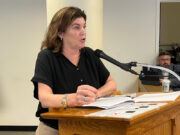


Possessed by a desire to make sure the world understands, never forgets and never repeats the horrors of the Holocaust, Marion Blumenthal Lazan, a 79-year-old German-born Jew who spent most of her childhood in refugee camps and the notorious Bergen-Belsen concentration camp, has traveled all over the world to share her story.
“It is the story Anne Frank might have told had she survived,” she explains in thickly accented English.
The Hewlett resident has carried her message of tolerance, perseverance, faith and hope to more than 1 million school children and tens of thousands of adults across the globe since she first began speaking publicly 31 years ago.
But her visit with inmates at the Suffolk County Correctional Facility in Riverside yesterday was only the third time she’s brought her message inside the walls of a jail — a place surrounded by the kind of tall, razor-wire fencing that still makes the hairs on the back of her neck stand up. It is a grim reminder of the electrified, 12-foot-tall, barbed-wire fence that marked the perimeter of her world as a child inside one of the most horrific Nazi death camps. Lazan recalls the way bodies hung on that fence of her childhood for days following futile — perhaps suicidal — escape attempts. It was one of the sights no one, let alone a child, should ever have to see, Lazan says, closing her eyes against the memory and shaking her head.
Unfortunately, it was one of many gruesome sights whose memory would haunt Lazan for the rest of her life.
Even now, nearly 70 years after her family and the other prisoners at Bergen-Belsen were liberated by the Russian army, even after telling her story countless times over more than three decades, Lazan still finds it painful to talk about it.
But it’s a story that must be told, she explains.
“You are the last generation that will hear it from people who lived through it,” she told the group of mostly young men and women, dressed in drab green prison garb, who were shuttled into the chapel at the jail for her presentation.
Along with Sheriff Vincent DeMarco and Stony Brook University School of Social Welfare Dean Frances Brisbane, they sat in rapt attention for Lazan’s talk.
“We must never let the world forget what happened,” she told them. “And we must never forget the importance of tolerance for people who are different, the importance of perseverance, of faith, and above all, hope.”
“It’s a very important message for inmates, for people who are basically at rock bottom, so that they know it can and will get better,” DeMarco said afterward. “We want them to know there is hope. They can change their lives.”
The expressions on the inmates’ faces softened as they listened to Lazan’s story of life as a small child in the very concentration camp where Anne Frank died of typhus in 1945. The typhus epidemic would claim tens of thousands of lives in the filthy, lice-infested, overcrowded barracks. Among the casualties was Lazan’s own father, who died, ironically, shortly after their liberation.
Her life at the camp was spent on a wooden bunk, sharing a straw mattress and a single thin blanket with her mother. She considers herself fortunate — most bunks were shared by two adult strangers. The unheated barracks, built to hold 100, was crammed with 600 prisoners.
There was no warm clothing to protect them against the brutal German winter, though they were forced to assemble and stand outdoors in every kind of weather for the daily count.
There was very little food to eat. The prisoners were slowly starved to death, Lazan said. They were walking skeletons. When freed from Bergen-Belsen at age 9, Lazan weighed just 35 pounds. Her mother weighed 60 pounds. Those startling numbers elicited loud gasps from her audience.
Lazan recalls seeing a truck carrying what she believed to be wood, driving across the compound during her first winter at Bergen-Belsen. Shivering from the cold, she grew excited, thinking the Nazis were going to build fires for heat.
“Imagine my horror when I realized that what I thought was wood in that truck was actually the emaciated bodies of dead prisoners, piled one atop the other like sticks, being driven to one of the camp’s many mass graves,” she said.
Childhood recreation in a world without toys, books, paper or pencils consisted of playing with the lice that crawled on her body, in her hair, on her clothes and in her bed. She made up a game to occupy her and give her hope. Each day she looked for four perfect, identical pebbles. If she found them, she told herself, it meant that the four members of her family would make it out of the death camp alive.
And if she didn’t?
She kept a stash of a couple of perfect pebbles in a secret hiding place, she said, to supplement what she found from day to day, if need be.
“It was my game, after all, and if I wanted to change the rules along the way, I could,” she says with a twinkle in her eye.
How does one put into words unspeakable horrors such as these?
“It isn’t easy,” said Lazan in an interview after her presentation, while she sat in the sheriff’s office inscribing copies of her memoir, Four Perfect Pebbles, for the sheriff and members of his staff.
 The pert and vivacious Lazan looks back on decades of a life well-lived, a full life in “our blessed United States of America,” where her widowed and penniless 37-year-old mother emigrated in 1948, two children in tow, in search of a new life.
They made the trans-Atlantic voyage on a Holland-America ship, the cruise line honoring tickets purchased by her father a decade earlier, when he sought refuge for his family in Holland on their way to America. That journey was not to be. Just before they were to set sail, the Nazis invaded Holland and they were imprisoned.
“We made port in a place called Ho-BO-ken, New Jersey,” Lazan recalls with a smile. The captain of the ship told us the night before to rise early if we wanted to see the Statue of Liberty welcome us to America.” The immigrants all crowded on the deck of the ship, craning their necks for a glimpse of the shining beacon of freedom in the harbor. It’s a sight Lazan says she cherishes to this day.
Her mother found refuge and work in Peoria, Illinois, where she raised her children and remarried. In Peoria, Lazan met a a college student from Long Island, Nathaniel Lazan. He walked her home from synagogue after services one Friday evening “and he’s been walking me home ever since,” she says. This summer they will celebrate their 60th wedding anniversary.
Her mother would live to be almost 105. She passed away in late December, six weeks before her 105th birthday Feb. 7.
Lazan carries an 8-by-10 laminated color photo of Ruth Blumenthal Meyberg with her, along with a color snapshot of her 14-month-old great-granddaughter — a life that would not have come into being had the Nazis finished the job they set out to do.
“Imagine,” she told the inmates, “six million of us killed… That is double the population of Long Island — wiped out. Can you imagine? And don’t forget another 5 million others killed by the Nazis for a variety of reasons.”
The Holocaust happened because people were willing to blindly follow leaders without questioning their intentions, she said. “Never, ever do that,” she told her audience.
“And never, never give up hope,” she told them, amongst tears and hugs before they were ushered out of the chapel by corrections officers and led back to their cell blocks, the sound of heavy iron gates slamming loudly behind them, echoing in the cement-block hallways.
Lazan watched them file out of the room, motherly concern etched on her face. One young man stopped to tell her what an inspiration she was. She thanked him with an embrace and a pinch of his cheek, eliciting his promise to write to her and let her know how he’s doing.
“I can only hope my message makes a difference in some of their lives,” she said.
Photos courtesy of the Suffolk County Sheriff’s Office.
The survival of local journalism depends on your support.
We are a small family-owned operation. You rely on us to stay informed, and we depend on you to make our work possible. Just a few dollars can help us continue to bring this important service to our community.
Support RiverheadLOCAL today.
