


















As schools open to nearly a quarter-million children across Suffolk County, where the novel coronavirus remains present in the community, it is inevitable that virus cases will be confirmed among students, teachers and staff. How school officials, school families and community members respond to that inevitability will determine whether schools can remain open.
Local school districts, working in conjunction with state and local health officials and the State Education Department, have all developed protocols for handling confirmed positive cases of COVID-19 on school campuses, according to Suffolk County School Superintendents Association president Ronald Masera, superintendent of Center Moriches Union Free School District.
In Riverhead, where more than 4,600 students were welcomed back to classrooms on Thursday and Friday last week, officials had to implement those protocols right out of the gate. The district was notified over the holiday weekend that two students — siblings — at Aquebogue Elementary School had tested positive for COVID-19.
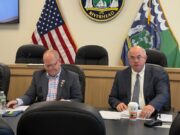
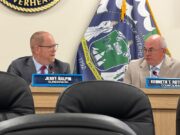
When a district is notified of a positive COVID test, “we immediately initiate the protocols we worked out with the Suffolk County Department of Health Services,” Masera said during a presentation Thursday with Suffolk County Legislator William Spencer, chair of the legislature’s health committee and Suffolk County Commissioner of Health Dr. Gregson Pigott.
The protocols require cleaning and disinfecting all areas of the building used by any infected person, as well as school buses, as applicable.
They also require implementing measures to contain the spread of the virus in the school community and the community at large. That means identifying every person who was in close contact with an infected person. Close contacts must be quarantined for 10 days, Masera said.
“Close” contacts are generally people within six feet of the infected person for more than 10 to 15 minutes at any time during the school day or on the bus, Masera said.
When children are in the same classroom, though not within six feet, even though masked, “we generally err on the side of caution when there has been a positive test in the room,” added Pigott. “We consider those proximate contacts as possible exposures as well,” he said, and they should also be quarantined.
In an elementary classroom, where students are together all day and one tests positive, “all the students in that class should be quarantined,” the health commissioner said.
The importance of measures to contain the virus spread can’t be overemphasized, Pigott said.
That’s where the county’s contact tracing program comes in.
‘Contact tracing works’
Suffolk County has 240 trained case investigators, tasked with determining who every newly confirmed COVID case has been in contact with in the days prior to the positive test result.
“We deploy about 30 staff members per day,” the health commissioner said.
Last week, in the five business days leading up to the holiday weekend, there was an average of 76 new positive tests — or “index cases” — per day in Suffolk.
A case investigator calls the index case and provides them with information about how to properly isolate themselves to avoid spreading the virus to other people, particularly members of their household. The investigator also interviews them: What prompted them to get tested? Have they had recent contact with anyone with COVID — and if so, who, when and where? The case investigator also elicits the names and contact information of people the index case had contact prior to their test.
“The virtual contact tracing team then kicks in,” Jennifer Culp of the county health department told the members of the legislature’s health committee during its meeting Thursday afternoon.
“They will contact the contacts and talk them through their exposure, let them know they now have to quarantine from that date of exposure and assist them with any ongoing needs,” Culp said.
The virtual contact tracing program is run by a subcontractor to the State Health Department. There are 444 contract tracers covering Nassau and Suffolk, Culp said.
The case investigation and contact tracing allows health officials to identify clusters of viral infections, which in turn allows them to deploy teams to a particular area to accelerate testing — a measure the state has implemented in Western New York and in Oneonta.
Effective contact tracing is crucial to stopping the virus from surging, Pigott said.
Overall, the program also helps health officials better understand virus spread.
The county has seen “a shift in demographic” over the summer, Culp told the members of the health committee.
“Early on in the pandemic, it was a much older population,” Culp said. Since July 4, “the demographic is much different,” she said. “It’s the under 30 that we’re seeing the majority of cases.” And there’s been “a little bit of an increase” in the infection rate this summer, she said.
The county learned that the virus was spreading at smaller gatherings, not large parties, Culp said.
“We definitely saw families, you know, kind of had a party, maybe was a graduation party, and then they had a birthday party and then maybe they went on vacation together. So it’s just a lot of time spent together where maybe your inhibitions go down,” Culp said.
“But it showed contact tracing works. We were able to investigate those clusters. We were able to work with the families… and it stopped. So it really shows that contact tracing and quarantining and isolation works, masks work, and washing your hands.”
The survival of local journalism depends on your support.
We are a small family-owned operation. You rely on us to stay informed, and we depend on you to make our work possible. Just a few dollars can help us continue to bring this important service to our community.
Support RiverheadLOCAL today.
