



















Lawmakers and workers stood outside the office of Rise Life Services in Riverhead Tuesday to urge the New York State Department of Health to use federal funds to help finance hiring and wage increases for those who serve vulnerable populations.
According to the Bureau of Labor Statistics, there were 469,370 home health and personal care aides in New York in May 2020, with a mean hourly wage of $15.45. The profession is predicted to have a 34% growth rate from 2019-2029, while the average growth rate of other professions sits at 4%.
But in 2019, jobs for a subsection of these workers who work to serve special needs populations, called direct support professionals, or DPSs, decreased an estimated 36.2%, according to a report by the National Association of State Directors of Developmental Disabilities Services.
Rise Life Services, a nonprofit that serves the special needs of the mentally and developmentally disabled, is funded through New York State, Executive Director Charles Evdos said. He believes more state support will allow the company to raise wages to levels other essential healthcare workers are earning.
“We need to do something now,” Evdos said. “It’s hurting the agencies. It’s hurting the services we provide. We do not want to become another Pilgrim [State] or Willowbrook again and that’s the direction we’re heading if we don’t do something about it.”
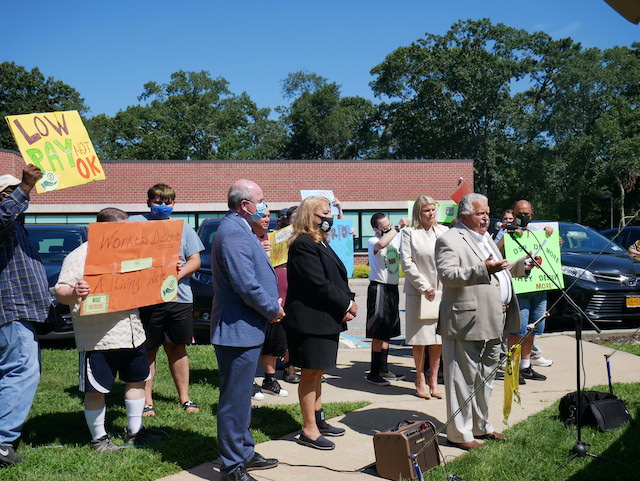
Assemblywoman Jodi Giglio (R-Baiting Hollow) and 34 other members of the Assembly’s minority conference wrote to State Commissioner of Health Dr. Howard Zucker and State Office of Mental Health Commissioner Dr. Theordore Kastner on July 28, requesting that the $1.6 billion that the state received for Home and Community-Based Services as part of the last coronavirus stimulus bill go towards financial support for workers.
“Recruitment and retention of workers who serve our most vulnerable New Yorkers has always been a problem, but the COVID-19 pandemic exacerbated the issue,” Giglio read from the letter. “Now we are facing a staffing crisis that needs to be addressed immediately.”
The American Rescue Plan of 2021 gives a 10% increase in Federal Medical Assistance Percentage (FMAP) funding for state Medicaid programs from April 1 to March 30, 2022. The DOH’s spending plan, dated July 2021, includes proposals for supporting and strengthening the direct care workforce, with specific funding for DSP hiring and retention bonuses, DOH spokesperson Erin Silk said in an email to RiverheadLOCAL. The plan is not yet approved by the federal government.
“In addition to collaborating with our partners in state government and those within the home and community-based services community, DOH looks forward to working with the federal government to ensure New York’s enhanced FMAP spending plan is approved,” Silk wrote.
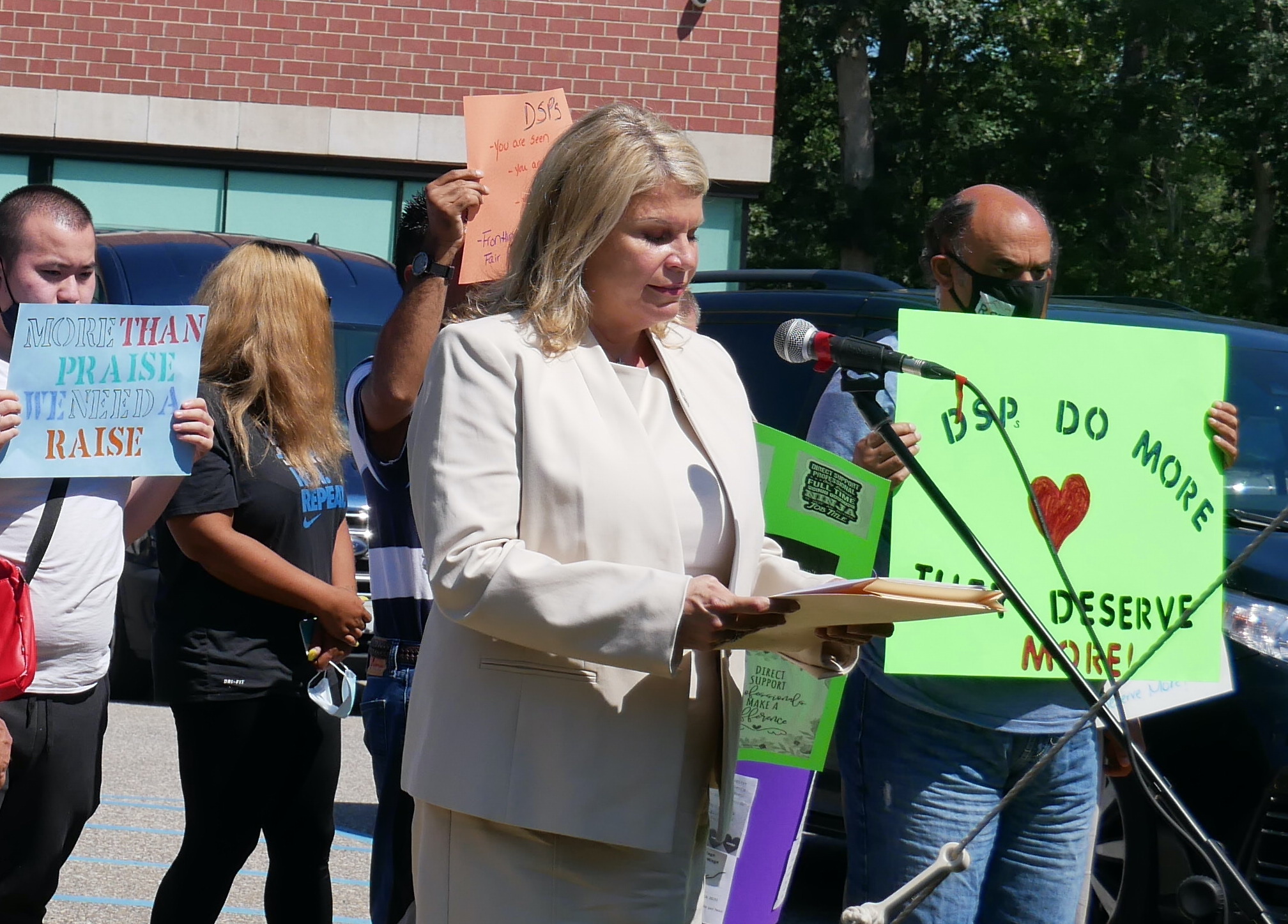
The Assembly members’ letter also says the “immediate wage increases, although necessary, are simply not enough to permanently end this staffing crisis.” The signees called on New York state to do the following:
- Create the New York State Workers with Vulnerable Populations Benefits Fund to support benefit plans for eligible workers. The fund will be financed in part by voluntary public employee and private donations.
- Provide an annual state personal income tax exemption on the first $50,000 for these workers.
- Create a new Optional Retirement Program, similar to the SUNY ORP, for these workers and require the state to pay the employer’s contribution rate on behalf of the employee.
- Establish a base wage for workers with vulnerable populations at 150% of the regional minimum wage.
- Provide tax credits for employers to offset the base wage and incentivize them to provide health benefits to these workers.
- Require the state to study employers with strong employee retention records and make recommendations to improve retention statewide.
Workers and those who they served both rallied for the proposal, with some holding up signs that expressed support for higher wages.
“Hiring qualified, direct support is really the end goal for us. With that we’re able to help them in the home, successfully transition back to the community and live long lasting lives,” said Cherita Brown, the director of Rise’s mental health operations. “So I hope that our message is heard and that it’s taken very seriously because this is a critical message that we’re sending.”
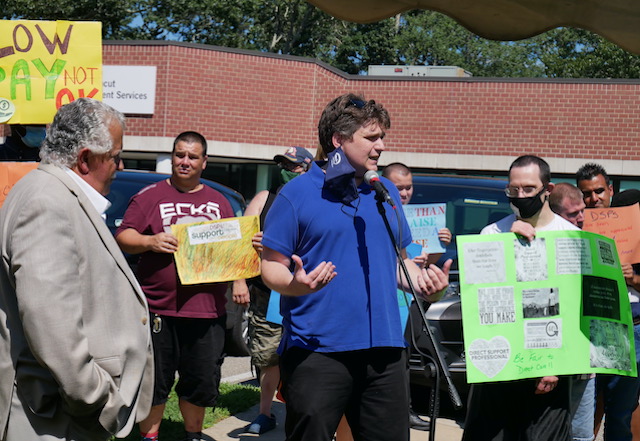
Matthew Kuriloff, the manager of day service at East End Disability Associates, said that when he started as a DSP, he was making more money than people who worked in fast food and retail. He referred to the fact that DSP wages are the same as those positions as a “crisis.”
“We are competing directly with places like McDonald’s and places like Target. People at Target and McDonald’s now make more money than most of our DSPs today,” he said.
Those companies have been raising wages the last few months as an incentive to attract new workers. The minimum wage is set to increase to $15 through state law at the end of this year.
“This is nothing against people who are flipping burgers, but one of the individuals that I support on a daily basis said ‘Matt, aren’t I worth more than a hamburger?’ Of course, absolutely. But that’s not what society is telling us right now,” Kuriloff said. “That’s not what the state is agreeing with right now. “
Supervisor Yvette Aguiar was also in attendance. She said that the town board will make a committee to help address the needs of the disabled in the town. Councilman Ken Rothwell will lead the effort, she said.
“This is a disgrace. These organizations, these disability organizations are constantly being cut as a result of COVID. A lot of the workers and the individuals were put at risk,” she said.
“We are committed here on a local level, to voice to the state of New York, get all the support all the financing that you need — and you deserve a fair wage,” Rothwell said.
The survival of local journalism depends on your support.
We are a small family-owned operation. You rely on us to stay informed, and we depend on you to make our work possible. Just a few dollars can help us continue to bring this important service to our community.
Support RiverheadLOCAL today.
