






















The third round of community meetings on the Riverhead Comprehensive Plan Update is underway and will continue this week at Riverhead Town Hall.
The series of five meetings kicked off on April 12 with a discussion of “Environment, Sustainability and Renewable Energy,” followed by a discussion of “Economic Development: Downtown and Route 58” on April 14. Both of those meetings took place at Riley Avenue Elementary School in Calverton, but the town changed the meeting location for the three meetings in coming week to Riverhead Town Hall. All will start at 6 p.m. in the Town Hall meeting room. They will also be accessible via Zoom.
This week’s meeting topics are:
“Housing and Community Services” on Monday (April 25);
“Transportation and Utilities/Infrastructure” on Tuesday (April 26); and
“Agriculture and Farmland and Historic Resources” on Wednesday (April 27.)
The above links lead to each meeting’s agenda, which includes the Zoom link and credentials for that meeting.
This new round of meetings, organized by topic, includes a review of goals laid out in the 2003 comprehensive plan, a review of comments and concerns expressed by the community in prior meetings and through a community survey, and a draft of new goals for discussion.
‘Environment, Sustainability and Renewable Energy’ meeting recap
The presentation for the April 12 session on “Environment, Sustainability and Renewable Energy” can be viewed and downloaded here.
The draft statement of goals for this topic were:
- Address the effects of climate change and work on completing the Climate Smart Community Program;
- Balance the need for renewable energy with other concerns related to siting solar energy projects (e.g., farmland preservation, visual concerns);
- Battery energy storage guidelines;
- Groundwater monitoring and ensure clean drinking water;
- Define “sustainability” and develop initiatives;
- Reduce solid waste and expand recycling;
- Collaborate regionally on shared environmental protection initiatives.
Kevin McDonald of the Nature Conservancy attended the April 12 meeting and urged the town’s planners to focus more deeply on surface water and groundwater quality and to incorporate the Long Island nitrogen action plan and and Suffolk County’s sub-watershed plan for nutrient load reduction into the goals of the comprehensive plan update.
“I would like to underscore the critical importance of incorporating the really good work that’s already been done,” McDonald said. “This is the best science that exists,” he said. “It is absolutely essential that this very expensive work that’s been done over the last five to seven years be incorporated into your plan.”
McDonald also said it is “absolutely inconceivable” that the Town of Riverhead would not place more focus on these issues, he said.
“You need policies that address the water quality needs that face this community,” he said. “That’s how things get rectified. If you’re not focusing there, you’re avoiding the harder issues… because they’re hard. That’s why they’re hard. You got to go and get the hard issues fixed… These are solvable problems, they require hard choices that the town board must address. Or you’re just gonna do this again in 15 years and say, ‘We’re just really that much further behind, because we never dealt with it,’” McDonald said.
Joyce Novak, executive director of the National Estuary Program in the Peconics, echoed McDonald’s comments urging the need for stronger water quality targets in the comp plan update.
The western Peconics, Terry’s Creek, Meetinghouse Creek, and the lower Peconic are the only impaired waterbodies for nitrogen in the Peconic system, Novak said. “I think it’s really important that this should be noted,” she said, “and to use the updated Suffolk County sub-watershed plan with targets to address a lot of the things in there.”
Novak said “there’s a lot of talk about climate change, which is a very obtuse and not very specific way of saying we have this issue.” There’s not a lot of specific discussion, she said.
“There are tools available that look at a parcel by parcel analysis throughout the town, with recommendations for preservation, whether that is farmland preservation or open space preservation. Looking with that, in concurrence with sea level rise, with flooding, with depth to groundwater… The tools are there. That really does lead to a policy issue, which is, they’re not being used the way they could be,” Novak said.
“The same goes for environmental justice. New York State has a map of proposed environmental justice areas, right now,” she said. There are websites that offer parcel-level information that. “It would behoove the town to use the existing tools… to make decisions going forward,” she said.
Novak said federal and state funding is going to be available over the next couple of years, which she described as “a really fortunate financial time,” and the town should be ready with “a comp plan that is well thought-out, that has specific targets, that delineates necessary areas for a variety of surface water and groundwater mitigations and land preservation.”
She asked the planners to reach out to her organization for information on the tools and resources available that will help them develop more specific goals and specific targets to be incorporated into the plan update.
Novak also urged the town to estimate costs for achieving each target and goal. “Then you are in an even better position if money comes up from external sources to be able to apply for it and develop a 20-year plan for funding specific pieces of your plan.
Jamesport resident Joan Cear asked how the town has assessed its progress in achieving the goals set forth in the 2003 plan.
“Can you tell us which ones you feel you’ve been successful at achieving? And if we haven’t been successful, are these goals going to be carried forward in the new comprehensive plan?” she asked.
Cear said the comp plan update must include specific goals and metrics for measuring whether the goals are being achieved by new policies and actions.
Riverhead Building and Planning Administrator Jefferson Murphree said it’s very important that the town’s comprehensive plan not “just sit on a shelf, waiting for the next 20 years.” He said he’s asked AKRF, the planning consultants hired by the town to complete the comprehensive plan update, to develop “a strategic plan element…that identifies a number of the goals and policies…that have specific years and target dates with what to do,” along with “the means to achieve that objective.”
A comprehensive plan should be “a living, breathing document” that’s reviewed on an annual basis, Murphree said.
Cear suggested that the town have annual public meetings to update the public on the progress of achieving the goals of the master plan.
Greater Calverton Civic Association President Toqui Terchun repeated her previous requests made to the town board during regular meetings that the town provide residents with “an inventory of applications” online, in the form of a spreadsheet. “It can help us know what’s going on and what’s being planned for our hamlets.”
“As building and planning administrator I will commit and promise that we’ll do that for you,” Murphree said. He noted that, for the first time in years, the planning department has three full-time planners.
‘Economic Development: Downtown and Route 58′ meeting recap
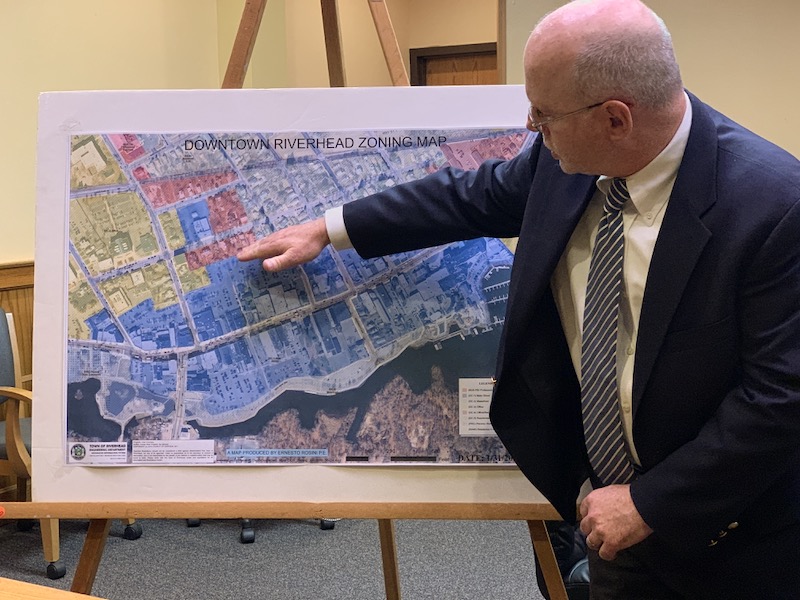
At the April 14 meeting on economic development focused on downtown and Route 58, Community Development Director Dawn Thomas talked about the town’s recent efforts to revitalize downtown Riverhead with a new overlay district for the Railroad Avenue area, the transit-oriented development project and the town square project.
Thomas also spoke about the town’s $10 million Downtown Revitalization Initiative grant from the state and the process for developing a plan for how best to utilize the funding.
The planning consultants reviewed the goals enumerated in the 2003 comprehensive plan, the public survey responses pertaining to economic development topics and draft goals for the comprehensive plan update.
The draft goals for the update were stated as:
- Prioritize the reuse of buildings on the Route 58 corridor;
- Examine current demand for retail and diversifying use mixes including dining, entertainment and recreation, boutique, long- and short-term stay hotels, medical services, and recreational cannabis;
- Allow for use and tenant flexibility and opportunities both Downtown and at Tanger;
- Identify implementation techniques for the above recommendations (e.g., redevelopment analyses, zoning modifications);
- Further the promotion and growth of cultural attractions and tourism-related destinations both Downtown and along Route 58;
- Enhance and promote safe streets program along Downtown Main Street;
- Diversify industrial zoning and special permit requirements to include additional uses by right or special permit (e.g., battery energy storage);
- Balance growth in agritourism with the need to minimize adverse effects such as noise, traffic, lighting;
- Limit destination retail uses east of Route 105;
- Integrate Peconic Bay Medical Center into the long-term social, cultural and economic planning for the Route 58 corridor; and
- Provide for more hotels, affordable housing, townhomes, and parking solutions.
The presentation for the April 14 “Economic Development: Downtown and Route 58” can be viewed and download here.
Residents, as they did during the April 12 meeting, asked for more specificity in the draft goals.
Baiting Hollow resident Janice Scherer asked how the town could implement the goal of prioritizing reuse of vacant spaces on Route 58, since the property is in private ownership. If implementation is going to involve tax incentives, what are the impacts of that to the tax base, she asked.
“We have to try to flush out what are the steps necessary to make that come to fruition,” Murphree said.
“These are very general goals. So as we go forward through the plan, we’re going to further define them and then get implementation strategies, but we’re not quite at that stage yet,” he said.
Scherer, who cochairs the town’s Downtown Revitalization Committee, also stressed the importance of incorporating the transfer of development rights into new development codes, in order to preserve farmland by requiring developers to buy development rights off agricultural land which can be used to increase density in other areas.
“We’re definitely looking into that,” Murphree told her.
Real estate broker Larry Oxman asked if the planners are looking at revising or eliminating the 500-unit cap on new apartments in the DC-1 zoning use district, which covers East Main Street. Since the statutory limit currently applies to the number of certificates of occupancy issued, the limit “could be problematic for two parallel developers that — who gets there first and is the other person who has invested quite a bit of money out of luck.”
Murphree said the planners are very much aware of this issue and are working on it with the community development and town attorney’s offices.
Oxman said the town also should study the possibility of building parallel roadways along Route 58 that connect shopping centers. “It’s more than just cross-access easements, but really more like feeder roads. It could alleviate traffic on Route 58 and Middle Road and in the future could help that corridor expand north and south, rather than east or west,” Oxman said.
Angela DeVito of South Jamesport told the planners not to forget about the Wading River commercial corridor when they are creating goals for the economic development element of the comp plan update. She also suggested having a meeting for users of local bus routes that may be eliminated under a plan Suffolk Transit is considering, so the planners can ask them what their needs are. She noted that “a large portion of our workforce, that many of our businesses such as restaurants and hotels depend upon, are not automobile owners and they use that for transportation.” As for the goal of diversifying career opportunities, DeVito urged discussions with the school district to better understand what the needs are for the town’s youth.
The comprehensive plan update is currently projected to be completed by spring of next year. A first draft of the update will be presented to the town board this summer, according to Murphree. The planners will prepare a generic environmental impact statement for the comprehensive plan update this fall. There will be a public hearing on the draft GEIS this fall, with a final GEIS and the update completed over the winter.
The survival of local journalism depends on your support.
We are a small family-owned operation. You rely on us to stay informed, and we depend on you to make our work possible. Just a few dollars can help us continue to bring this important service to our community.
Support RiverheadLOCAL today.
