


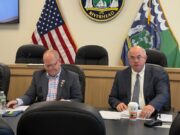













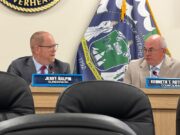

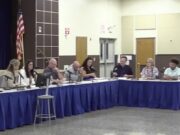









This week is “Sunshine Week,” a week dedicated to the people’s right to know what their government is up to.
It’s a week that spotlights open government, the laws in place to secure it and the efforts of reporters and citizens to use those laws to obtain information the public has a right to access.
The name “Sunshine Week” is a nod to the words of U.S. Supreme Court Justice Louis Brandeis: “Sunlight is said to be the best of disinfectants.”
What is it, exactly, that requires disinfecting? When he wrote those words in 1913 — in one of a series of articles he penned for Harper’s Weekly — Brandeis’s subject was the “money trust,” the large banking houses that colluded with business tycoons to create trusts in America’s major industries.
Brandeis advocated “publicity” as “a remedy for social and industrial diseases.”
That’s because, in simple terms, corruption thrives in the dark. And corruption is the growing medium for those “social and industrial diseases” Brandeis sought to remedy.
The result of all types of cronyism is always higher costs for the little guy — whether it’s higher prices or higher taxes.
The ups and downs of transparency and open government in Riverhead
As a reporter and an attorney who formerly worked as a consumer advocate in the New York City government, I’ve learned the value of the kind of public disclosure Brandeis advocated. I’m passionate about it. For more than 20 years now, I’ve advocated for it and called out public officials who subverted it. I’ve written about illegal closed-door meetings and improper “executive sessions.” I’ve railed against the denial of records requests and various officials who simply ignored the requests — in violation of state law.
In 2012, hoping that maybe local officials would comply with the law if they better understood it, I even brought the executive director of the New York State Committee on Open Government to Riverhead to give a workshop on the subject. The session was well-attended by local officials, but afterward, not much changed. My optimism was misplaced.
Here and there, we’ve seen improvements over the years. Freedom of Information Law requests submitted to the Town of Riverhead in the early 2000s generally went completely unanswered. Back then, the town supervisor was Riverhead’s designated records access officer — a circumstance that was extremely unusual, according to New York State Committee on Open Government Executive Director Robert Freeman. In a 2003 interview, Freeman told me the town clerk — who is by law the legal custodian of the town’s records and charged with their management — is the designated records access officer in 99% of all towns and villages. Riverhead’s unusual arrangement indicates, as Freeman put it, “a desire to maintain a degree of control.” And so it was.
The town’s records access officer is now the town clerk. But requests for records still generally take a long time to be fulfilled —even though in today’s world, public records can readily be made accessible to all online, without the need for a formal request, as the Town of Southold has been doing for many years. Must be that same “desire to maintain a degree of control.”
The town’s website was improved about a decade ago, but is in need of updating again. Town Board, Planning Board and Zoning Board of Appeals meeting agendas are posted online in a timely manner, and in the past couple years the town has finally seen fit to comply (for the most part) with an Open Meetings Law amendment in 2012 that requires documents scheduled to be discussed at meetings to be made available to the public at the meeting and “to the extent practicable” on the government’s website. (Frustratingly, the law contains at least one loophole for every requirement.) Unfortunately, though, other town committees and advisory boards don’t follow suit. In fact, most don’t even have meeting agendas posted on the town website — never mind documents to be discussed or even minutes of past meetings.
Town Board meetings and work sessions, Planning Board, ZBA and Industrial Development Agency meetings are live-streamed and, since the COVID pandemic, participation in public hearings during these meetings is available remotely, via Zoom. Video recordings are archived on the town’s website and available on demand. Meetings of other boards and committees are not.
There seems to be more public discussion of public business during work sessions since Supervisor Tim Hubbard took office in January. But it remains hard to know what is being discussed and with whom outside of these public sessions. As we have seen, sometimes the only way to learn is by reviewing email and other correspondence among board members and applicants, which state law says are public records. Getting access to these documents, however, remains time-consuming and difficult.
Generally speaking, the same holds true for the Riverhead Central School District. Responses to records access requests trickle in, if there’s a response at all. The lack of public discussion at public school board meetings — which always follow hours-long, closed-door “executive session” meetings — indicates that board-level discussion is taking place outside of public earshot or, in the alternative, not taking place at all, which is even worse.
There is a bright ray of sunshine in the district administration right now: Interim Assistant Superintendent for Business Marianne Cartisano. The amount of disclosure she has provided for the formulation of the 2024-2025 budget is almost breathtaking in scope. All we can say is, this is how it ought to be, always. Bravo and thank you!
State laws protecting your right to know lack teeth
Overall, the fundamental problem with New York State’s records access and open meetings laws remains: These laws lack penalties for violations and they lack enforcement mechanisms. Without those two things, the laws on the books have no teeth.
Without teeth, public officials can — and often do — thumb their noses at citizens and news reporters. Because without teeth in the law, the only recourse for violation of these important statutes is a lawsuit — brought by private citizens and news organizations. Private litigation is an extremely costly, inefficient and uncertain way of compelling government officials to comply with a state law. It’s beyond the resources of most private citizens and local news organizations, and that’s why there are so few lawsuits brought. In fact, they’re practically unheard of.
A provision of the law allows plaintiffs in these actions to recover attorneys’ fees. But private citizens are still required to sue. And recovery of attorneys’ fees is not mandatory. It should be. A bill is pending in the State Legislature that would make recovery of attorneys’ fees mandatory in these actions where the plaintiff is successful. It passed the State Senate last June, but stalled in the Assembly. Let’s see if our lawmakers do any better this year. Sadly, their track record indicates it’s unlikely.
We must all be watchdogs
Short of litigation, all we can do is just keep pressing public officials to comply with the law — and keep pressing them publicly. That “we” means all of us. Citizens, civic groups, reporters and good-government advocates. And we must keep at it, not just during “Sunshine Week” but during every week of the year. We must all be watchdogs.
This isn’t easy. It wears you down — especially because, as we have seen, if there’s one thing officials have in common regardless of political party, position, gender or age, it’s thin skin.
As I wrote in a column during Sunshine Week in 2014, “Watchdogs that bark and growl find themselves in the doghouse. ‘Treats’ of story tips and leads are doled out to other pups. Politicians prefer lap dogs.”
Nowadays, we are seeing more and more public officials — including those elected by the people — who are unwilling to be interviewed by reporters who actually dare to challenge them with questions. They are issuing written statements and hiring public relations agencies to help make them look good.
I’m not ready to give up yet. As I wrote 10 years ago, “The older I get, the lower my tolerance for BS.” Ten years later, my BS meter has seen plenty of use, but it’s still going strong.
As the editor and publisher of RiverheadLOCAL, I promise you:
We’ll never trade thorough reporting and hard-hitting questions for “access” to interviews or documents.
We won’t be cowed by threats or name-calling.
We’ll never stop calling out officials who hide behind written statements and PR firms.
We’ll never stop submitting records requests or filing appeals when the requests go unfulfilled.
And we will continue to disclose what we learn to you, the taxpaying public, the voters who put these folks in office, who have a right to this information to begin with.
After all, isn’t that what the whole government of, by and for the people thing is all about, anyway?
The survival of local journalism depends on your support.
We are a small family-owned operation. You rely on us to stay informed, and we depend on you to make our work possible. Just a few dollars can help us continue to bring this important service to our community.
Support RiverheadLOCAL today.
