




























PFAS cleanup at the former Navy plant in Calverton is off the agenda for now, according to the Navy’s project manager for the Calverton site.
The Navy cannot discuss PFAS cleanup at an upcoming community meeting, currently scheduled for Tuesday, because the Navy is waiting for the Department of Defense “to issue policy” on how new federal drinking water standards will be incorporated into the cleanup program for the Calverton site, Navy Project Manager Addison Phoenix said in an email to members of the Calverton Restoration Advisory Board yesterday.
Phoenix advised RAB members that the Navy needed “to adjust” next week’s meeting in light of the new federal standards. Phoenix offered to have a virtual meeting to discuss other topics or to “postpone the meeting to a later date once we have guidance from DoD.”
In response, advisory board members asked the Navy to postpone the meeting but requested only a very brief delay, to a date no later than next month.
[Editor’s note: The May 7 RAB meeting has been postponed, with a new date to be determined, the Navy announced in a press release May 3, several hours after publication of this article.]
PFAS cleanup has been a central topic of discussion — and controversy —at the advisory board meetings for years.
PFAS, known as “forever chemicals,” are harmful substances linked to deadly cancers, impacts to the liver and heart, and immune and developmental damage to infants and children, according to the federal Environmental Protection Agency.
Extensive PFAS contamination exists in the soils and groundwater at the former U.S. Navy-owned manufacturing plant in Calverton operated by the Navy contractor, Grumman Corporation/Northrop Grumman from the 1950s to 1996. PFAS contamination has been confirmed in groundwater at the southern border of the former aerospace manufacturing site, where the Navy has a fence-line monitoring system in place. The chemicals have also been found in private residential drinking water wells south and east of the site, including at levels that exceed the N.Y. State maximum contaminant level of 10 parts per trillion.
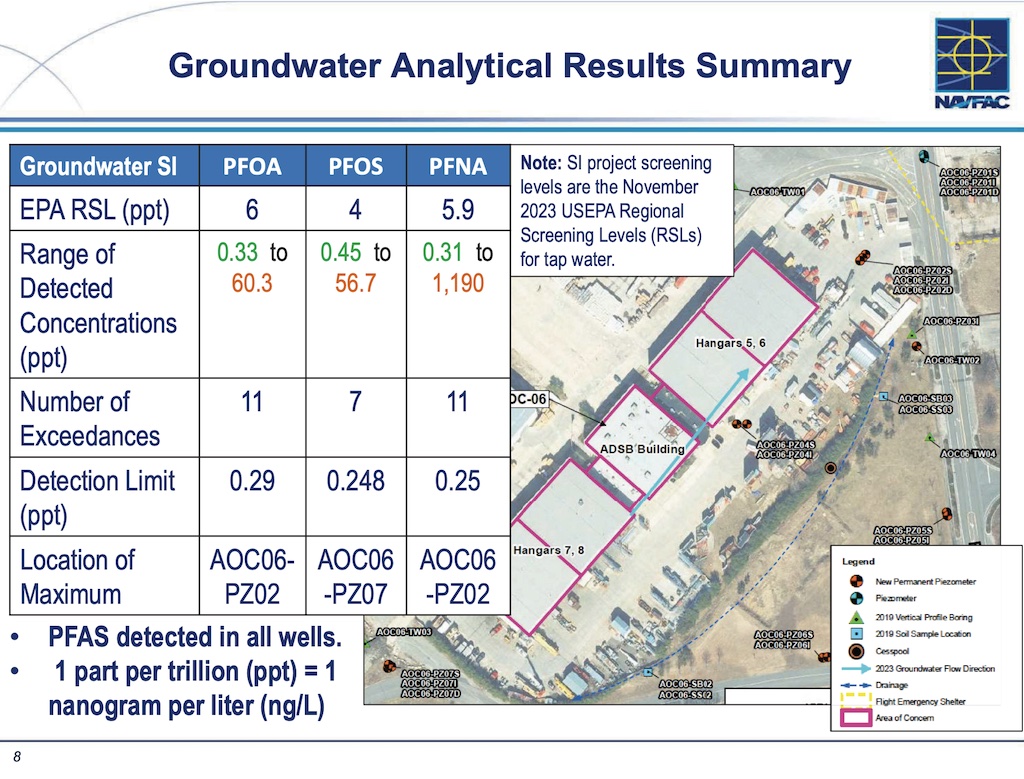
The Navy has refused to take responsibility for cleaning up off-site contamination and has refused to comply with New York’s MCL of 10 ppt, citing the lack of a federal limit. The federal EPA had no MCL for the chemicals, but had adopted a “lifetime health advisory” of 70 ppt — a difficult to quantify lifetime exposure level.
The “lifetime health advisory” of 70 ppt had been the only federal regulatory restriction on PFAS until June 2022. At that point, the EPA abandoned the 70 ppt lifetime advisory in favor of a far stricter lifetime advisory of 4 parts per quadrillion — a level so low it cannot even be detected. The EPA in June 2022 also announced it expected to publish a proposed rule setting the first-ever national maximum contaminant level for PFAS by the end of that year.
The EPA issued a proposed rule in early 2023 and earlier this month issued a final rule setting strict federal drinking water limits for five PFAS chemicals.
MORE COVERAGE: EPA announces strict federal drinking water standard for PFAS contamination
In an email last night responding to the Navy project manager, the Calverton Restoration Advisory Board said its members opted for a postponement of Tuesday’s meeting, but asked that the delay be kept short. The Navy typically holds two public RAB meetings each year, one in spring and one in fall.
“We and the public are anxious to proceed without further delay and are immensely frustrated that you need to postpone this important meeting due to incorporating a new drinking water standard that has been anticipated for a year now,” Calverton RAB member Adrienne Esposito wrote in an email on behalf of the RAB members. “We are requesting that the meeting be rescheduled for no later than June, since July and August are not conducive to public participation,” she wrote.
“In the interim, we are also requesting that any plans to commence testing of private wells DOES NOT use the dangerous, outdated EPA advisory guidance level of 70 ppt,” Esposito wrote.
MORE COVERAGE: Navy won’t change stance on groundwater pollution outside the Grumman fence, despite new EPA health advisory for PFAS
Esposito explained that request in a phone interview yesterday. The Navy has recently discussed testing offsite private wells with state and county officials, she said, and was “inexplicably” still talking about using the outdated 70 ppt lifetime advisory, which was superseded in 2022, as a standard.
Esposito had pressed that point at the Calverton RAB’s last public meeting with the Navy on Dec. 9, but Phoenix said that, with private well investigations, the value that Navy is authorized to use is 70 ppt. In anticipation of the EPA’s new rule, the Department of Defense was evaluating how to incorporate it, Phoenix said at the meeting.
“We’re very disappointed that the EPA’s intention to adopt a strict MCL has been known for more than a year and the Navy is still waiting for policy instructions from the Department of Defense,” Esposito said yesterday. “It’s really unbelievable.”
The survival of local journalism depends on your support.
We are a small family-owned operation. You rely on us to stay informed, and we depend on you to make our work possible. Just a few dollars can help us continue to bring this important service to our community.
Support RiverheadLOCAL today.
