




















The Riverhead Charter School is looking to buy property on the east corner of Middle Country Road and Fresh Pond Avenue in Calverton to site a new high school.
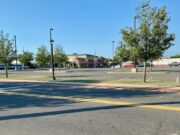
The Riverhead Charter School Board of Trustees has authorized Superintendent Raymond Ankrum to execute a sales contract to purchase property at 4314 Middle Country Road in Calverton for $4.11 million, according to minutes of the charter school board’s July 17 meeting.
The charter school is looking to purchase 13.7 acres of land closest to Middle Country Road for the construction of its high school, Ankrum said in an interview Wednesday. The property on that corner is currently a 111-acre parcel and would need to be subdivided, Ankrum said. While most of the parcel is in the agricultural protection zone, the southernmost acreage, which has 1,175 feet of frontage on Middle Country Road, is in the rural corridor zoning district, which allows as-of-right the construction of schools.
Although approved by the charter school’s board, Ankrum said the contract to buy the land has not yet been executed.
The school building will be able to hold roughly 500 children and include the development of ball fields and other amenities, Ankrum said. The land is a little more than a mile and a half away from the school’s main campus at 3685 Middle Country Road.
The charter school is currently teaching its high school students at the campus of the former Northville School on Sound Avenue, which the charter school renovated in 2022 and is renting. But the schoolhouse is quickly becoming cramped, charter school officials said, and does not have space for other amenities like athletic fields.
The corner of Fresh Pond Avenue and Middle Country Road, which is State Route 25, does not have a traffic signal, although one will be installed just east of the intersection to accommodate the development of a new industrial park being built by HK Ventures.
Several residents of the area, as well as Ankrum, objected to the location of the new industrial park at a public hearing last year, with the main concern being that the development would exacerbate already dangerous traffic conditions at the intersection.
While the charter school continues to plan for the construction of a larger high school — a process officials expect to take around three years — it is looking for the town to green-light a stop-gap measure: the addition of three temporary trailers in the backyard of its current high school to accommodate more students.
Two of the trailers will be used as classroom space, while the third will be an office space for the school’s administrators, which currently operate in the hallways of the old Northville schoolhouse, charter school representatives told the Town Board during a hearing Tuesday. In addition to approvals from the Planning Board, the charter school needs the Town Board’s permission, through the issuance of a special permit, to add the trailers, according to Riverhead Town officials.
| MORE COVERAGE: Riverhead Charter School seeks permit for portable classrooms at high school, as it works to find permanent home for larger facility |
During Tuesday’s hearing, the Town Board grilled Riverhead Charter School officials with questions about how they planned to use the new space, particularly focusing on concerns related to class sizes.
John Farrell, the attorney representing the charter school in the proceeding, said there are currently 154 students and 24 faculty members at the school. “They’re kind of outgrowing their space,” Farrell said.
Farrell said the use of the site was already authorized to be a school. “The special use permit has already been granted at this location for school use, so the board has already made a determination that this is an appropriate location for this type of use,” Farrell said, suggesting that, under the law, the buildings are permitted as accessory buildings by-right.
“Nevertheless, we’re here to seek the board’s approval for the special permit because that is what the Planning Board has determined that we’re required to do,” Farrell said. “To the extent that we need the special permit, I just want to remind the board that the courts have historically held that schools and churches enjoy special treatment with respect to zoning because they are presumed to have a beneficial impact on the community.”
The trailers won’t have a significant impact on the community, Farrell said. There is going to be a “miniscule” increase in bus traffic, and students are not allowed to drive to the school, he said.
“[W]e’re not going to turn away students that have been with the charter schools since the beginning and tell them they have to go start high school at another place,” Farrell said. “This is where they’ve called home. This is where they’re going to finish out their education, at least to the high school level.”
“So it’s a matter of, are they going to do this in cramped classrooms, or are they going to be able to expand and have additional space to provide the proper learning environment for these students?” Farrell said.
“Ideally,” Farrell said, only 130 students would be taught in the main school building, with another 48 students being taught in the trailers. The charter school expects a maximum of 180 students on the entirety of the campus, he said.
Council Member Ken Rothwell said the charter school’s plan would “circumnavigate around the maximum occupancy and add additional trailers.”
Farrell disagreed with that characterization. “I don’t think anybody said anything about circumventing the maximum occupancy at all,” he said.
“That’s what you’re doing. By adding trailers, you’re increasing the capacity of the overall school,” Rothwell said.
“No, we’re adding buildings, which is not increasing the capacity of the existing building,” Farrell said. “That has nothing to do with the fire marshal. The fire marshal would have a separate inspection of these facilities and would determine the capacity of them.”
The comments from the public and from the Town Board during the hearing questioned the apparent failure of the charter school to plan long-term for the increased enrollment of the school.
“I feel very, very sorry for the students that are a part of this,” Council Member Joann Waski said, “because I think the charter school is a great school and a great opportunity for a lot of children — and these children were failed. It was not by this Riverhead Town Board; it was by the charter school.”
Ankrum said the responsibility falls on him for “poor planning.”
Rothwell also asked during the hearing how the charter school would handle the students enrolled if it was not allowed to put the trailers on the site.
Ankrum said he hasn’t thought about that scenario, but that the charter school can make the current space they have “work.” “But having portable access would be a great deal of relief for us,” he said.
Ankrum said the charter school would be amenable to conditions on the special permit that would cap the number of students at the site, or require the trailers to be removed after a certain time period.
Putting the trailers on the site was not the charter school’s original plan and is only a temporary measure, Farrell said. The original plan was to build a new high school on land adjacent to the current school to increase the school’s capacity, but that plan fell through.
Ankrum announced in November that the charter school was purchasing roughly 72-acres of farmland next to the Northville schoolhouse to build a new secondary school campus. The full buildout would have included a high school, a middle school and athletic fields, he said. The plan faced sharp opposition by some local residents, the Riverhead Board of Education and the Riverhead Central Faculty Association, the school district teacher’s union.
The charter school dropped its plans to build on the farmland after stiff opposition and intense debate, including “direct attacks on our students,” which affected charter school students’ “psychological safety,” the charter school board president said in a letter at the time.
After that plan fell through, officials said the school was looking to purchase and develop industrial land adjacent to its main campus in Calverton for the school. However, private schools are not an allowed use on that land, and the school would have needed a zoning amendment from the Riverhead Town Board. The Town Board considered allowing schools in industrial zones to accommodate the private school, but that plan was quickly nixed after a group of residents and Riverhead Central School District officials, led by the RCFA, packed Town Hall and urged the board to remove it from the draft of the town’s master planning document.
| MORE COVERAGE: Town Board nixes code change that would allow Riverhead Charter School to build on industrially zoned land |
The Riverhead Charter School was established in 2001 as a K-6 school and has expanded with subsequent charter renewals. In 2022, the school’s charter was renewed and expanded to allow the school to add grades 11 and 12. The school can enroll up to 1,244 students by the 2026-27 school year — a nearly 400 student increase from its previous charter. Previously, students in grades nine and 10 shared the building with K-8 students at the charter school’s campus in Calverton.
The survival of local journalism depends on your support.
We are a small family-owned operation. You rely on us to stay informed, and we depend on you to make our work possible. Just a few dollars can help us continue to bring this important service to our community.
Support RiverheadLOCAL today.
