



















Riverhead students performed below the county average on standardized tests in the 2023-24 school year, and graduated at a four-year rate similar to the last few years, according to a presentation on the school district’s academic data last week.
The percentage of students from 3rd to 8th grade with English language arts, math and science scores at or above the state’s target level of proficiency sits significantly below the scores of the rest of Suffolk County, according to the presentation.
At the high school level, the rate Riverhead students passed Regents exams is below the county average for most subjects, most starkly in ELA, where only 61% of Riverhead students passed their exams last year. The rate students passed the Regents exams for most subjects decreased compared to the year before, the data shows, with the passage rates of some subject exams drastically below their pre-pandemic levels.
In 2024, Riverhead’s four-year graduation rate was 79%, a slight decrease from its 2023 graduation rate of 82%, but the same as the district’s average graduation rate over the last five years. For reference, the statewide four-year graduation rate for 2024 was 86%, while the rate in Suffolk County for 2023 was 91%. (The county’s 2024 graduation rate is not listed on the state’s website.)
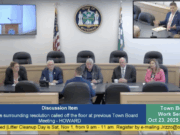
Riverhead school district administrators presented a report on the district’s graduation rates, standardized test scores and strategies to improve target schools at last week’s school board meeting.
Test scores:
Alan Baum, the interim assistant superintendent for curriculum and instruction, started the presentation with the following caveat: While the assessment results “provide valid insights into academic performance…they do not represent or present a complete picture of student success.”
“The results do not measure student engagement in athletics, the arts and other subjects not measured with standardized assessments…nor do they fully represent the cultural diversity and unique strengths of our students and district,” Baum said.
“They also fail to account for the challenges many of our students face, including economic hardships, language barriers for non-native English speakers, and the cultural adjustments that new immigrants experience in a public school setting,” Baum said. “These factors can impact the students ability to perform assessments, yet they do not define their abilities, intelligence or potential for future success.”
Baum said the district is “grappling with increasing financial pressures, rising state and federal mandates coupled with highly strained budgets and inadequate funding create significant obstacles in providing the resources our students and educators need.” Overcrowding is also an issue, he said.
An average of 71% of Riverhead students grade 3-7 participate in state mandated exams. That is higher than the Suffolk County (59%) and Nassau County (68%) averages, but below the state-wide average of 82%, Gretchen Rodney, the executive director for elementary education, said during the presentation.
NYSED separates students between four levels numbered 4 to 1 to assess standardized test performance, Rodney explained. Students who perform at level 4 excel at their grade level; students who perform at level 3 are proficient; students who perform at level 2 are partially proficient; and students at level 1 are well below proficiency.
“When we look at our ELA results for the 23-24 school year, we see for ELAacross all grade levels [from 3-8], approximately 25% of our students met or exceeded the grade level expectation, with little more than 25% partially meeting those expectations,” Rodney said.
Roughly 45% of students scored at a level 1 in ELA — well below their grade level, the data shows.
For math, the graphs presented by Rodney show that more than 50% of students in each grade level performed at level 2 or level 1 — barely better than the ELA results.
For science, which is administered to 5th and 8th grade students only, the scores were also low. Only 19% of students in 5th grade scored level 3 or 4 in science, while 50% of students in 8th grade scored level 3 or 4.
After presenting the high school scores compared to the county average, Emmanuel Hernandez, the school district’s chief information officer, offered a different way to frame the results.
“What I hope to bring out in this presentation is that New York State can’t capture our story as well as we can, and I’m going to show you,” Hernandez said.
Hernandez presented graphs displaying the results of the Regents exams between the district’s general education, disabled and English language learning (ELL) students.
“When you get into max results here, our students, maybe they don’t make it on the first shot, but our students will show, over time, their resilience to pass these exams,” Hernandez said. “We don’t give students just one single opportunity, and we don’t expect them to do their best just once. We give them as many opportunities as it takes to show how great they are.”
General education students are “doing very well,” Hernandez said. Students with disabilities are also “rising to the occasion,” he said, and sometimes surpassing general education students in passage rates.
While English language learners are passing at a rate far below that of the district’s general education and disabled student populations, their passage rate for Regents exams has grown over the last three school years, Hernandez said.
Considering the increased population of English language learners in the district, the district is seeing “resilience and perseverance through exams that might not be the easiest for someone who’s learning a language for the first time,” Hernandez said.
Chronic absenteeism and school improvement:
The district currently has 5,416 students, close to the district’s enrollment in 2017. District enrollment peaked at 5,829 in 2020, according to the data presented by Baum, but dipped the next year back to 5424 and plateaued.
The population of students with disabilities has increased slightly from 10 years ago, increasing from 14% of the district’s population to 18%. The number of English language learners in the district has dramatically increased over that time; it more than doubled from 15% of students to 38%.
A big problem in the district: chronic absenteeism. According to the data in the presentation, 26% of the school district’s students last year were chronically absent, which means they missed at least 10% of the school year.
Before the coronavirus pandemic, the chronic absenteeism rate was at 17%. That number dramatically increased during the 2020-21 school year to 41% in elementary and middle schools and 55% in high school, but has steadily declined over the last few years. Baum said there are “indications that the chronic absenteeism rate has declined during the current school year.”
Chronic absenteeism is one of the biggest contributing factors to three district schools, Phillips Avenue Elementary School, Roanoke Avenue Elementary School and Riverhead Middle School, being listed by the state education department as needing “Comprehensive Support and Improvement” at different levels, according to the presentation.
Those designations make the Riverhead Central School District a “target district” under New York State guidelines. Target districts like Riverhead get additional support from New York State and Title 1 Grants from the federal government to help the district, Rodney said.
In addition to efforts to curb absenteeism, Phillips Avenue will prioritize increasing literacy skills, while Roanoke Avenue school will prioritize professional development and planning, as strategies for improving school standing, Rodney said..
The middle school will prioritize social and emotional learning programs — putting on events that celebrate student achievement, curb bullying, increase tolerance and empathy, and promote social media awareness, Rodney said. It will also implement other strategies to improve overall academic achievement, she said.
“If any of you have had any middle schoolers, we know that is a very important time in a young person’s life,” Rodney said. The school is “using different strategic celebrations, bringing in assemblies for anti bullying, tolerance and empathy, to encourage the students to take care of themselves and one another, and to strengthen [the building’s] PBIS program — their positive behavior intervention system.”
Districtwide, administrators say implementing its diversity equity and inclusion plan, reducing chronic absenteeism and increasing student achievement are priorities. Rodney also said the district will develop strategies to synergize intermediate and secondary courses, and to have elementary and middle school teachers align their English language arts curriculum with state standards. The district will also work to implement its multi-tiered system and support plan (MTSS), which is focused on personalizing a student’s education to their specific needs.
Rodney said the district has filed its comprehensive improvement plan with the New York State Education Department and is awaiting final approval.
The administrators also discussed Advanced Placement exam scores, SAT and ACT scores, and student demographic and enrollment trends. The full presentation can be found on the school district’s YouTube page here.
The survival of local journalism depends on your support.
We are a small family-owned operation. You rely on us to stay informed, and we depend on you to make our work possible. Just a few dollars can help us continue to bring this important service to our community.
Support RiverheadLOCAL today.
