














A program to recycle and reuse oyster shells to improve the health of local waterways may soon come to Riverhead Town.
The Riverhead Town Board is interested in partnering with the Riverhead Rotary Club and the Half Shells for Habitat program to create an oyster shell recovery program. The goal would be to collect discarded shells from local restaurants and put them into local waters to benefit the marine ecosystem and increase water quality.
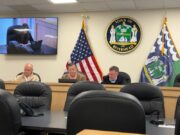
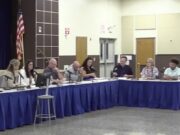
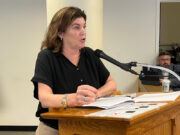
Maureen Dunn, a water quality scientist and the director of Half Shells for Habitat, pitched the program to Riverhead Town Board members at the work session Thursday.
“There are many ecosystem benefits to having oysters in the water,” Dunn said. “They take up nutrients, they clarify the water, they reduce sediment, they provide what we call a micro habitat for clams and crabs and small fish, and they also help to mitigate coastal ocean acidification,” stabilizing the shoreline.
Half Shell for Habitat was started in 2018 as a partnership between the Seatuck Environmental Association and other nonprofit conservation groups, Dunn said. Other Long Island municipalities, including Brookhaven Town, are participating in the program, along with 36 restaurants, Dunn said.
“As a water quality scientist, I was looking for something that I could do to really improve water quality, and I realize this is probably the best method,” Dunn said.
Oysters act as filters and can improve the water quality of their habitat. The oyster shells are made mostly of calcium carbonate, which improves acidic conditions in water; oysters themselves are a “carbon sink” — meaning they absorb more carbon than they release, Dunn said.
Back in the 1800s, the waters around Long Island “were chock full of oysters,” Dunn said. But since then, the population has declined more than 99%, she said. Most oysters consumed in restaurants come from farms, she said.
Half Shells for Habitat is a way to help generate wild oysters for reef restoration programs on Long Island, Dunn said. Oysters grow better when they are near other oyster shells, compared to other surfaces like wood, she said.
The program requires three groups to work: a municipality, a separate nonprofit group and Half Shells for Habitat.
The process works like this: Farmed oysters are sold in a restaurant. When customers are finished eating, the restaurant separates the empty oyster shells from other food waste, putting them in separate containers picked up by volunteers. The shells are then put into a pile and disinfected by sunlight, killing any diseases and “curing” them to the point where they can be put into local waterways.
The shells are donated to other groups to use in local reef restoration programs, Dunn said.
“Right now there’s not enough oyster shells for the programs that are looking to create these stabilization and reef projects,” she added.
Half Shells for Habitat coordinates the program, obtains funding and assists with obtaining permits, Dunn said.
The Riverhead Rotary Club is prepared to help execute the program locally, said Town Board Coordinator Diane Tucci, who is on the group’s board. “I’ve got a group of volunteers ready to go. So kind of no brainer…” she said. Tucci said there are already restaurants in the area ready to contribute their discarded half shells.
Council Member Denise Merrifield, who helped bring the project to the work session, said the town’s Engineering Department is “on board with the project.” There has already been a spot chosen at the town’s yard waste facility on Youngs Avenue where the shells can cure, she said.
Town Board members voiced support for the partnership. “It sounds like an excellent program. I think it’s phenomenal,” Council Member Joann Waski said.
Town Attorney Erik Howard said he is working on a draft agreement to initiate the program.
George Bartunek, a former science teacher and current co-chair of the town’s Climate Smart Community Task Force, said creating a reef project could give high school students the opportunity to get involved in a project that can have a practical impact on the environment.
Officials said the program, in addition to helping the environment, would help inform and connect the greater public about the importance of improving water quality.
“That’s really what I like about it the most — is that it’s outreach at the same time that it’s doing good,” said Dunn. “So it’s kind of a win, win, win.”
The survival of local journalism depends on your support.
We are a small family-owned operation. You rely on us to stay informed, and we depend on you to make our work possible. Just a few dollars can help us continue to bring this important service to our community.
Support RiverheadLOCAL today.
