























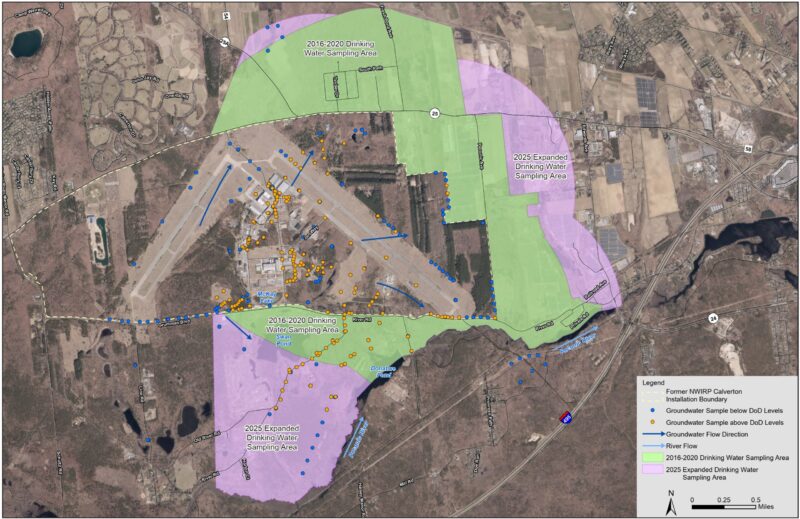
Nearly all private drinking water wells sampled as a part of an expanded testing area surrounding the former Northrop-Grumman plant in Calverton did not contain harmful “forever chemicals” above the limits set by the Environmental Protection Agency, the Navy said this week.
The results, which a Navy spokesperson said were based on 30 private drinking water wells sampled within a mile of the former Northrop-Grumman site, did not contain concentrations of PFAS chemicals over the maximum contaminant levels set by the Environmental Protection Agency, according to the Navy. The EPA’s maximum contaminant level represents the highest allowable concentration of a contaminant in drinking water before there are anticipated adverse health effects through consumption.
The only exception was one well sampled in 2019, which tested “slightly elevated PFAS levels” above the EPA’s maximum contaminant levels, the Navy said. The resident associated with the well opted to decline re-sampling, the Navy said.
For per- and polyfluoroalkyl substances (PFAS) — a group of synthetic chemicals linked to adverse human health effects like cancer and nicknamed “forever chemicals” because of how slowly they break down over time — the EPA has set a maximum contaminant level of 4 ppt for the most common compounds, PFOS and PFOA, and 10 ppt for other compounds. PFAS is found in many different industrial processes and consumer products, including firefighting foam used to extinguish fires involving fuels.
“Although these preliminary results are encouraging, we will carry out a comprehensive quality control review of all collected data and will consult with NYS [Department of Environmental Conservation] and the New York State Department of Health (NYSDOH) before final results are released to the public,” Addison Phoenix, the Navy’s project manager for the remediation of the site, said in a statement. “The Navy remains dedicated to safeguarding the health and well-being of its neighbors and will continue investigating emerging chemicals in and around former [naval weapons plant in] Calverton, as necessary.”
The Navy announced expanded testing of private drinking water wells surrounding the property in January. Contamination of soil and water at the former Grumman site in Calverton, a Naval Weapons Reserve Plant operated by the Navy contractor from the mid-1950s until 1996, was discovered in the mid-1980s. The contamination, including PFAS, has migrated off-site and is suspected to have contaminated private residential drinking water wells and surface waters.
The expanded testing area included more homes south, east and north of the site. According to Navy maps, groundwater previously tested in the expanded area south of the property were found to contain PFAS chemicals above the Department of Defense’s action levels — which are three times more than the EPA’s maximum contaminant levels.
| MORE COVERAGE: ‘Forever chemicals’ are polluting the Peconic River. New data makes strongest case yet that former Navy site is to blame. |
The Navy will continue testing within the sampling area. Residents within the sampling area who have not yet had their drinking water tested can call (800) 906-9339 to request and schedule a sampling appointment, the Navy said. Sampling is not required if the home’s drinking water is supplied by the Riverhead Water District.
In February, Suffolk County Executive Ed Romaine said the EPA should take over the clean-up of the former Navy property and make it a priority site under the superfund program. That announcement came a few weeks after the Navy revealed new data and maps showing groundwater polluted with PFAS migrating off of the former Grumman site towards the Peconic River.
The maximum contaminant levels for PFAS were set in April 2024, during the Biden administration. Since then, EPA Administrator Lee Zeldin and the Trump administration have announced actions to roll back or eliminate environmental regulations with the goal of boosting businesses and “ushering in America’s Golden Age.”
On March 4, Romaine sent a letter to Zeldin, a former congressman for eastern Long Island, urging the EPA to preserve the maximum contaminant levels for PFAS contaminants. “Millions of people on Long Island may no longer be protected if the federal MCLs are weekend or rescinded,” Romaine wrote.
The survival of local journalism depends on your support.
We are a small family-owned operation. You rely on us to stay informed, and we depend on you to make our work possible. Just a few dollars can help us continue to bring this important service to our community.
Support RiverheadLOCAL today.
