



















The Long Island Science Center presented revised plans for its museum on the town square Thursday, in a bid to convince the Riverhead Town Board not to take its property using eminent domain.
The presentation by the science center’s architects and its development consultant at the Town Board work session made town officials optimistic about plans for developing the blighted building at 111 East Main Street, which sits on the west side of the town square.
Jordan Rogove, principal of the Manhattan-based architectural firm DXA Studio, said the science center’s museum would be built in two phases. The building is in “a pretty stable shape right now and ready for the proposed renovation,” he said.
Phase one entails obtaining building permits to renovate the interior of the building at the Main Street level, give it a new facade, entrance and signage, as well as mechanical system upgrades. Science center officials said they have the $800,000 it takes to make that happen and could open the first floor of the museum by August of this year.
Phase two entails relocating the entrance of the building to the town square, adding new windows along the town square, creating a second floor with a 150-seat planetarium, and installing new exhibits and a maker space. The science center has roughly $1.6 million in grants to contribute towards phase two, but would also launch a capital campaign to raise money to complete the project, officials said.
Rogove said the basement space would receive some remedial work to make it more resistant to flooding; it could be used potentially as office or mechanical space, he said. A water retention tank would be used for stormwater collection and stored in the building, he said.
The Town Board last week scheduled a public hearing for May 21 on whether or not to use the town’s power of eminent domain take the science center’s building. Town officials say in documents that the building should be taken and sold by the town to a private developer for demolition and redevelopment. Town building and planning officials say the building is severely damaged and poses a “danger to the public.”
Town officials have so far blocked the permits necessary for the science center to restore the building and build its new museum, science center president Larry Oxman has said. The science center has produced its own reports that say the building is structurally sound.
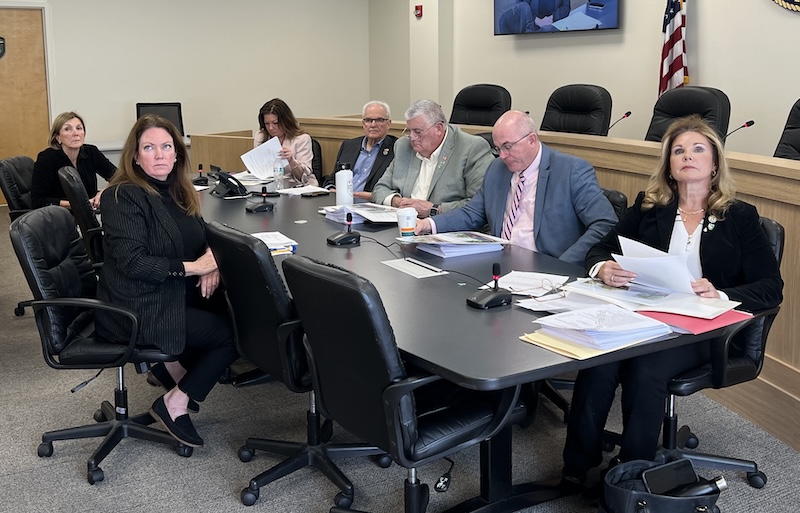
On the Town Board’s mind during Thursday’s work session presentation was the science center’s financial ability to take the project across the finish line.
“What guarantee do we have that you will actually go into phase two and that we’re not going to get stuck looking at just a concrete wall?” Council Member Joann Waski said.
“I agree. That’s a great question,” Council Member Denise Merrifield said. “You don’t have [funding for] phase two yet, right? That requires a lot of funding?”
Chris Kempner, the science center’s development and grant writing consultant, said opening the museum will give the nonprofit the momentum necessary to do fundraising.
The science center currently operates out of a storefront at Tanger Outlets in Riverhead, where exhibits are waiting and “ready to go,” Kempner said. “We have some great exhibits at Tanger. It’s just very small, so we could expand and also host more classroom space.”
“Now, if we’re talking give or take $15 million for the entire project, where is the rest of this money coming from?” Supervisor Tim Hubbard asked. “That worries me for phase two, because you’re talking about capital fundraising, but you’re minus a lot of money to get to that $15 million number.”
The science center has an “extensive business plan” for the museum, Kempner said. The first phase of the museum project would give the science center expanded revenue streams and “wouldn’t need the full $15 million going forward,” Kempner said. The science center has opportunities for additional revenue through grants and fundraising, she said.
“I’ve had this conversation with Larry Oxman when he first talked about buying this building, and in fact, the location of it being right on the town square — there’s no better place for the Science Center, in my opinion, and I felt that way all along,” Hubbard said.
The science center purchased 111 East Main Street in April 2020 for $1.45 million while the town was negotiating to purchase adjacent buildings for the development of town square, which would be the crown jewel of its revitalization efforts.
“But I think we are very concerned about the finances of the science center having the money to actually finish this out, especially in phase two, and that’s concerning for us, and that’s why we’re having this meeting today, and why we’re in the situation that we’re in,” Hubbard said. “So I need some assurances that money is going to be there for phase two, other than you just saying, ‘Well, we have people who are interested, but we got to show them a little something first.”
Kempner said the science center has estimates for how much developing the building might cost. The $15 million number was based on a previous design which is “a much more complicated structure,” Kempner said. The science center had financing opportunities for the museum project, but was ahead of the town square’s development timeline, she said.
Kempner said that while there are concerns about federal funding, “I think the way the federal government is turning interest to innovation and legacy — we’d like to do a Long Island innovation exhibit and something about the Grumman legacy — those are all key objectives that the current administration wants to support, and the federal funding should be there,” she said.
Board members also questioned whether the museum’s phased development — particularly the renovation of the eastern wall of the building — fit within the timeline of the town square.
The museum will work with the town’s engineering consultants to create entrances and windows on the town square. “The goal would not be that we do work after the town square opens on that [side], that we do that together and pace that” with the town square’s construction, Rogove said.
“The goal was never to be that when the town square opens we still have a big, dumb wall there,” Rogove said. He added it would be “impossible” to get custom doors and windows on the town square for the first phase in August.
Council Member Ken Rothwell asked whether the science center would be closed during the second phase’s construction.
Rogove said the goal is for the science center to do structural remediation of the building and prepare the roof for the development of phase two. “That would be important to be not disruptive to the town square, should the phase two happen after that opens,” he said. Part of the science center museum could continue to operate while construction was underway on the roof, Rogove said.
Community Development, Planning and Building Administrator Dawn Thomas, who is in charge of the town’s revitalization efforts, asked Rogove whether the science center will need to demolish the back of the building and then make it flood compliant.
Rogove said DXA did a project with a landmark building and employed a “flood barrier strategy that is highly effective” on a structure that couldn’t be demolished.
“And so I don’t think it’s a black or white choice here. I think there’s a lot of construction technology and building technology that we could apply to maintain that portion of the building and make it flood proof,” Rogove said.
Hubbard said in an interview Friday that he was “impressed” with the plans the science center’s architects put forward.
“I think we still want a little bit more out of them for phase one. I really would like to see the windows and doors done on the side of the building that would go out to the town square,” he said. Doing work on the side of the building after the town square is complete could be “disrupting,” he said.
“I liked what I saw and I liked what I heard, and it’s just nice to see some movement since 2019 out of them,” Hubbard said, referring to the science center. “If this is what it took to get them going, then so be it — then it’s a win-win.”
Hubbard said if the science center comes “back with a really good, solid phase one plan, it’s very possible we would drop the eminent domain…proceedings.”
Thomas, the town’s development administrator, said the science center “made really good forward progress, hiring an architect who is familiar with these types of projects and how complicated they are.”
“And so the question is going to be, I think, if they can do what they say they’re going to do, then it’s a viable option for the board to consider,” she said.
Council Member Bob Kern said he wants the science center on the town square. “It’s not a hope of mine, it’s the direction it’s going,” Kern said. “And I’m going to do everything to keep going that direction.”
“All I think about is younger people — they’re the future,” Kern said. “And anything that we can do for them, I’ll do.”
The survival of local journalism depends on your support.
We are a small family-owned operation. You rely on us to stay informed, and we depend on you to make our work possible. Just a few dollars can help us continue to bring this important service to our community.
Support RiverheadLOCAL today.
