














In the summer of 1964, the Gulf of Tonkin incident prompted Congress to give President Lyndon Johnson the authority to escalate the United States’ involvement in Vietnam without a formal declaration of war — drawing the country further into the conflict and leading to the death of more than 58,000 American troops in the Indochina region.
A few months prior, John McAuliff, then a senior at Carleton College in Minnesota, was writing a paper on the conflicts in Indochina for a seminar. Little did he know the conflict — and what followed — would become a crucial part of his life story.
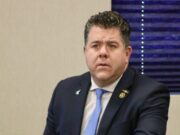
McAuliff, now a Riverhead resident, helped organize anti-Vietnam War protests, became part of the national anti-war leadership, and was arrested three times for non-violent civil disobedience protesting the war. When the war ended in 1975, McAuliff helped pick up the pieces and mend the broken relationship between the United States and Vietnam.
But before all of that, he was a conscientious objector. In September 1966, McAuliff had just come home from two years working in the Peace Corps in Peru. He was 24 years old — or, as he put it, “prime meat for the draft.”
Conscientious objector status would exempt him from military service due to moral or religious beliefs. McAuliff had followed the escalation of the U.S.’s involvement in the war and his experiences up until then — in the Peace Corps and his participation in civil rights demonstrations in Mississippi — “just reinforced my sense that this [war] was not just wrong morally, but a terrible mistake, that it was going to be a disaster for the people there and for us — though at that point, it was just a glimmer of what that would be,” he said.
Vietnam was the first “television war.” News photos and footage of the conflict brought graphic images of the war — wounded and dead soldiers and civilians, burning villages — into American households. College campuses became hotbeds for anti-war protests, strikes and campaigns.
Public opinion of the war worsened over time, according to Gallup polls. In March 1966, just a quarter of Americans thought sending troops to Vietnam was a mistake, while 59% said it was not a mistake.
U.S. casualties in the war spiked in 1966 and peaked in 1968.
By January 1973 — with more than 58,000 casualties recorded and troops mostly withdrawn from Vietnam — the public’s opinion of the war had flipped: 60% of Americans thought sending troops was a mistake and 29% thought it was not a mistake.
McAuliff remembered feeling uncertain about whether he would be granted conscientious objector status. The United States only recognized a conscientious objection if the applicant was opposed to all wars, not just a specific conflict. “I was very explicit that it was a selective objection — that I was against the war in Vietnam — but I would have probably been prepared to fight in the Second World War,” he said.
He also recalled “feeling very convinced that that was the right thing for me to do,” recognizing he would likely be arrested on criminal charges if he refused to serve.
The draft board where McAuliff lived near Indianapolis had not dealt with a conscientious objector application like his, he said. “So they gave me the CO status, even though, on paper, I didn’t qualify,” he said. The draft board initially tried to require non-combatant military service, but McAuliff — “a good-middle class kid who read the handbook of the Central Committee of Conscience Objectors” — knew they couldn’t force him. He won on an appeal, he said, and received full conscience objector status.
From there, McAuliff’s involvement in the anti-war movement escalated. During the summer of 1967, also known as “Vietnam Summer,” he worked “trying to take the anti-war movement from campuses into communities.” He worked in Minnesota on what would later transform into Sen. Eugene McCarthy’s 1968 Democratic primary campaign against Johnson.
McAuliff later landed a job at Institute for Policy Studies, a leftist think tank in Washington, DC, led by Marcus Raskin, a former Kennedy staffer and critic of the war.
On Oct. 21, 1967, McAuliff was arrested for the first time, during the March on the Pentagon, a major protest of the war where he “sat on the steps of the Pentagon and refused to leave.”
“The military came through with the rifle butts and the federal marshals and yanked us, put us in the paddy wagon and took us to Occoquan,” a minimum security prison in Virginia, McAuliff said.
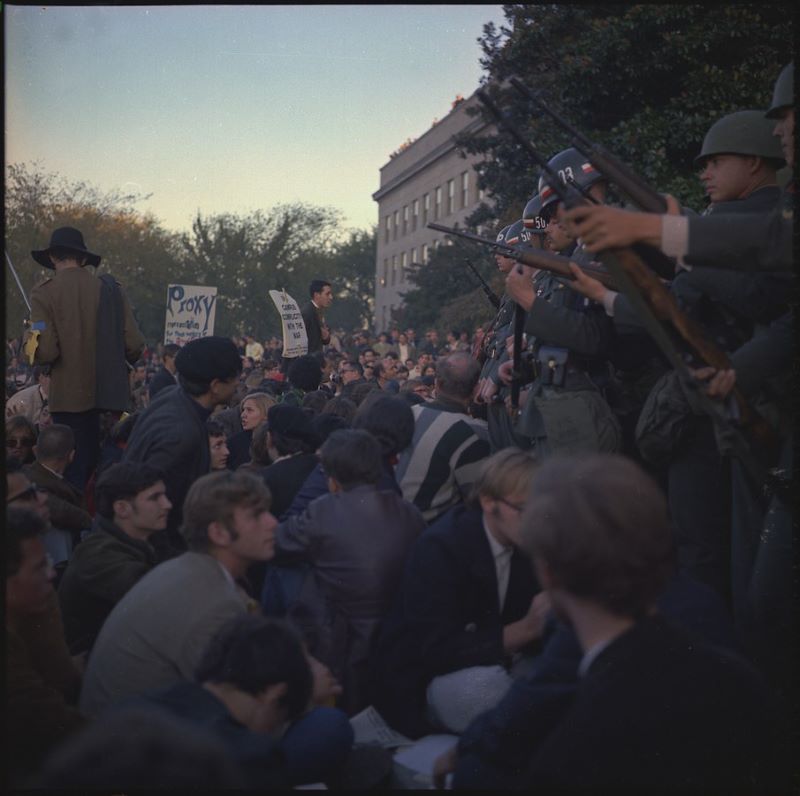
“These are dormitories. This is your classic political imprisonment,” McAuliff said of Occoquan. Spirits in the prison were high and only reinforced his beliefs, McAuliff said.
McAuliff refused to give law enforcement his information after the arrest. “Ultimately, two or three days later, we were released with no charges because they never processed us,” he said.
McAuliff, who had not yet been assigned his alternative service after being granted his conscientious objection, “turned in my [draft] card and said I wasn’t going to cooperate” as a part of the 1967 Call to Resist Illegitimate Authority. The document was distributed by Raskin and four other leaders of the anti-war movement, later known as the “Boston Five,” who were charged and convicted of conspiring to aid others to resist the draft. Their conviction was later overturned.
After leaving the Institute for Policy Studies, McAuliff became president of the Committee of Returned Volunteers, an anti-war group mainly composed of former Peace Corps members. He marched with the group during the 1968 Chicago Democratic Convention protests.
McAuliff was arrested for a second time with the Committee of Returned Volunteers in October 1968 while protesting in New York City against independent presidential candidate and segregationist, George Wallace.
Normally, arrests during protests were routine — “in and out,” McAuliff said. “But instead, it turned out that there was a federal hold order from my turning in my draft cards and I had been indicted.”
McAuliff decided to fulfill his alternative service assignment. He was assigned to work at Goodwill Industries in Indianapolis.
“I get to the Goodwill and they say, ‘Well, we can put you on the sorting lines, or you can work in the print shop,’” McAuliff said. “Now, as a self-identified activist, where would you choose to go? So I went to the print shop.”
There, McAuliff learned printing and used the Goodwill’s shop to produce documents related to his anti-war work. He also served as the editor of an underground newspaper in Indianapolis, writing about the war and local politics.
During this time, he visited Sweden for an international peace conference; it was the first time he met the Vietnamese.
Goodwill eventually discovered his activism and fired him, he said. Afterward, McAuliff began organizing for the People’s Peace Treaty, a document created by U.S. and Vietnamese students proposing a path to end the war, he said.
He also helped organize the May Day 1971 protests in Washington, D.C., during which more than 12,000 people, including McAuliff, were arrested for civil disobedience.
The May 1971 protests were broken up by police and federal authorities in riot gear. McAuliff was held in an emergency detention center set up in Washington Coliseum, he said. The American Civil Liberties Union pursued a class action lawsuit on behalf of detained prisoners for free assembly and due process rights violations, which led to a settlement for those arrested.
“We didn’t get any compensation, because we never existed — as far as their paperwork showed,” McAuliff said.
McAuliff was never assigned another alternative service job. “Selective service was not going to ruin another job placement by putting an activist organizer in it,” he said. When he turned 26, he was classified as ineligible for selective service, he said.
McAuliff said he did not have any antagonism towards people who didn’t fight against the draft. McAuliff’s younger brother, who had two children, volunteered for the war and spent a year at Cam Ranh Bay, a major U.S. air base, McAuliff said. His brother came out of the war with post-traumatic stress disorder, said McAuliff, who later learned his brother was against the war.
“You never assumed by what people were doing what that meant about their own views and values, and how they would engage with the issues,” McAuliff said. “Which was why when people came back and created Vietnam Veterans Against the War, they became, in many ways, the core of the later anti-war movement, because they had an unimpeachable standing to say that it was wrong, a personal experience.”
McAuliff said he believes a national service program is beneficial to a country, “as long as it’s clear that people have choices,” including non-military service.
“But most other people who are involved in that era are totally against [selective service], because they regard they feel that, when push came to shove, the ability to use a draft to mobilize people for the military is an important weapon of war” and they opposed war on principle, McAuliff said.
In 1972, McAuliff was hired by the American Friends Service Committee in Philadelphia. At this time, the U.S. was withdrawing troops from Vietnam, but Washington was being accused of intentionally bombing the North Vietnamese dike system, which would cause the flood of low-lying areas and civilian casualties. (Declassified 1972 CIA documents on the issue, released in 2007, said that while dikes were damaged there had been “no concerted and intentional bombing” of the dike system; the report said the idea the U.S. was bombing the dike system was part of a propaganda campaign from the North Vietnamese government.)
The dike bombing issue intensified the movement to end the U.S. involvement in Vietnam and to end military aid to the South Vietnamese, McAuliff said. Between 1961 and the end of the war in 1975, the U.S. spent more than $141 billion — or more than $852 billion today when adjusting for inflation — in South Vietnam, according to The New York Times. McAuliff became involved with the Indochina Peace Campaign, an organization founded in 1972 by activist Tom Hayden and actor Jane Fonda to advocate for Congressional action to end American involvement in the war, he said.
As the war wound down, McAuliff organized a trip to Vietnam. He said the trip was delayed because of the concern that the South Vietnamese government and military collapse might prompt the U.S. military to jump back into the war.
McAuliff and his group arrived in Vietnam on April 30, 1975 — the last day of the war.
“These five or six Americans are landing in Hanoi at the same moment that Graham Martin, the U.S. ambassador, is fleeing Saigon, and the mass evacuations are taking place,” McAuliff said. His group had been out of touch with the news when they landed, but were soon informed about the end of the war.
“Eight years of my young adulthood had been involved with this — the horror of what the war meant and the deaths on all sides of it,” McAuliff said. He felt relieved and excited, he said.
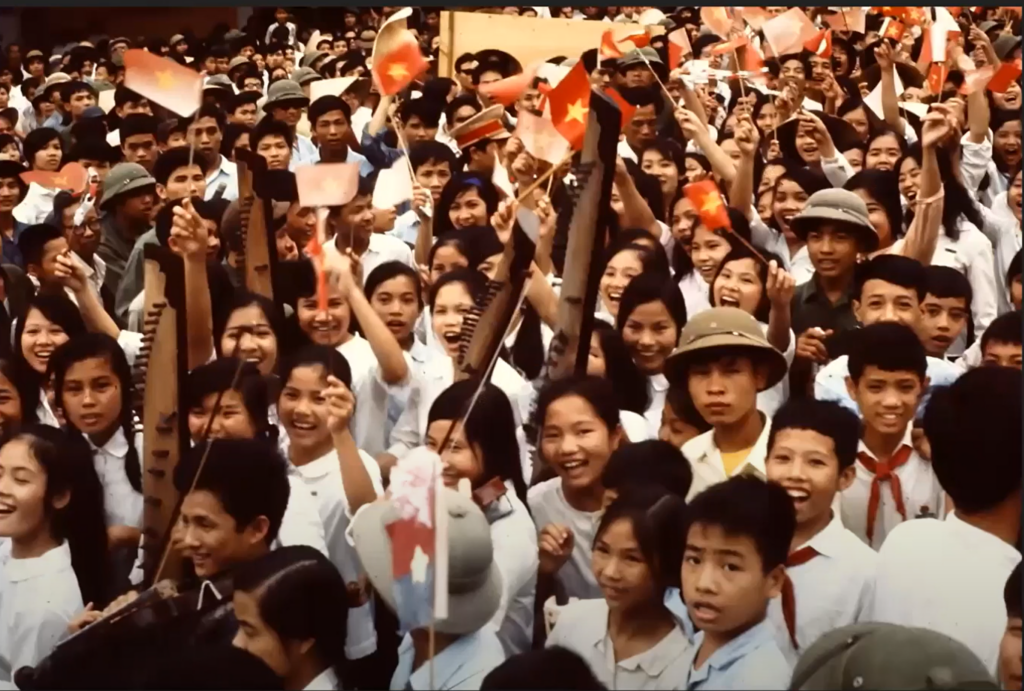
The celebrations of the victory filled his trip’s time. McAuliff and his group sat in a soccer stadium grandstand next to Eastern European diplomats and military officials watching the celebrations. Fireworks also celebrated the victory — “but there were no explosive sounds. It was just the pyrotechnics, the visuals, because of the psychological impact of the bombs,” McAuliff said.
“I was glad the war was over, but because I was there, I knew that the problems of the war were not over,” McAuliff said. The U.S. had already embargoed North Vietnam — and now the whole country was subjected to that economic pressure; U.S. officials also cut diplomatic ties to Vietnam.
McAuliff’s job at the American Friends Service Committee took him back to Vietnam several times in the following years, and for the first time to the south. “The south was both liberated and occupied, depending on whose side you’d been on,” McAuliff said. He worked with the organization until 1982 trying to normalize relations with Vietnam, but the Vietnamese’s invasion of Cambodia, prompted by attacks by Cambodia’s government on Vietnam’s border, made that difficult, McAuliff said.
In 1985, after working as the associate editor of the Irish Edition newspaper in Philadelphia, he was able to raise enough money to establish the US-Indochina Reconciliation Project, now known as the Fund for Reconciliation and Development, a nonprofit organization with the goal of mending the diplomatic and economic relationship between the United States and Vietnam, Laos and Cambodia.
“At that point, the official U.S. attitude was, we want nothing to do with them, they’re the evilest of evil people, and they defeated us, on top of every other sin they committed — the fact that they defeated us was probably the worst one,” McAuliff said. “And part of that was legitimate emotional ties of a lot of American military and foreign service people, who had known [and] worked with people in the Saigon government, who either died or were in re-education camps.”
The program became a “catalytic effort.” People who came on the trips started the first efforts to deal with Agent Orange — the herbicide used by the U.S. military to control vegetation, which has been linked to health issues in veterans and civilians of the war. The group hosted international conferences that connected non-governmental organizations to Indochinese groups, created directories of NGOs, and created a newsletter, McAuliff said.
“That became the focal point for that work on normalization,” McAuliff said.
Through the trips, McAuliff met his wife, Mary.
The U.S. relationship with Vietnam normalized in 1995. Since then, McAuliff has shifted his focus to Cuba — another country whose relationship with the U.S. was damaged by the Cold War. “I’ve gotten absolutely nowhere with that,” he said with a laugh.
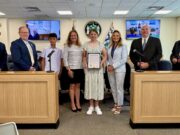
Last year, McAuliff met with the President of Vietnam, To Lam, who presented him with the Friendship Medal for his work building relations between the Americans and Vietnamese.
“It was very nice, and it got written up nicely in the Vietnamese press, and had no recognition here, of course,” McAuliff said.
McAuliff used his speech at the event to continue his work. He encouraged the Vietnamese government to help the U.S. and Cuba “find a path forward, the way the U.S. and Vietnam had.” He said the Vietnamese delegation received the speech positively.
This story is part of RiverheadLOCAL’s coverage of local residents and their connections to the Vietnam War, which ended 50 years ago on April 30. You can read more stories in the series here.
The survival of local journalism depends on your support.
We are a small family-owned operation. You rely on us to stay informed, and we depend on you to make our work possible. Just a few dollars can help us continue to bring this important service to our community.
Support RiverheadLOCAL today.
