












Today marks 50 years since the end of a war so divisive that even half a century later, it remains a source of controversy and pain for those who lived through it, fought in it, or lost loved ones to it. More than 58,000 U.S. service members died in Vietnam, and the scars of that conflict still run deep.
The war in Vietnam escalated at a time of rising unrest in the United States, amplified by growing casualties and the war’s conduct. Of the 2.7 million Americans who served in Vietnam, about 25% were drafted—many of them barely out of high school.
The conflict, often viewed as a Cold War “proxy war” between the United States and the Soviet Union, had its roots in Vietnam’s post-colonial history. After the 1954 Geneva Accords divided the country at the 17th parallel, pending national elections that never occurred, tensions escalated. South Vietnam’s U.S.-backed president, Ngô Đình Diệm, refused to participate in elections, and by 1959, an armed insurgency supported by North Vietnam and led by the Viet Cong was underway in the South.
A turning point came in August 1964, when the U.S. claimed North Vietnamese torpedo boats attacked a Navy destroyer in the Gulf of Tonkin. Though damage was minimal and the second incident was later disputed, President Lyndon Johnson used it to secure the Gulf of Tonkin Resolution, which gave him broad authority to escalate the war without a formal declaration.
Bombing began shortly afterward, and in March 1965, the U.S. landed ground troops in Da Nang, marking the start of full-scale American combat involvement. That same month, the U.S. launched Operation Rolling Thunder, a prolonged bombing campaign targeting North Vietnamese infrastructure and supply lines. Over three years, more than 864,000 tons of bombs were dropped on North Vietnam.
In subsequent campaigns, the U.S. dropped millions more tons on targets throughout Vietnam, Laos, and Cambodia, including the Ho Chi Minh Trail, a vital supply network that wound through jungle terrain and linked North and South Vietnamese forces. In total, the U.S. dropped an estimated 5.4 million tons of bombs in Indochina—more than the Allies used in all of World War II.
Yet the bombing failed to achieve its goals. North Vietnam’s leadership and population were deeply committed to reunification and remained undeterred, adapting quickly with underground bunkers, hidden supply routes, and sheer resilience. U.S. strategies, modeled on industrial warfare in Europe and Korea, proved ill-suited to the guerrilla conflict unfolding in Southeast Asia.
The cost in civilian lives was staggering: Vietnamese government estimates released in 1995 cited more than 2 million civilian deaths. The destruction of villages, civilian casualties, and widespread devastation fueled international condemnation and helped ignite a powerful antiwar movement at home.
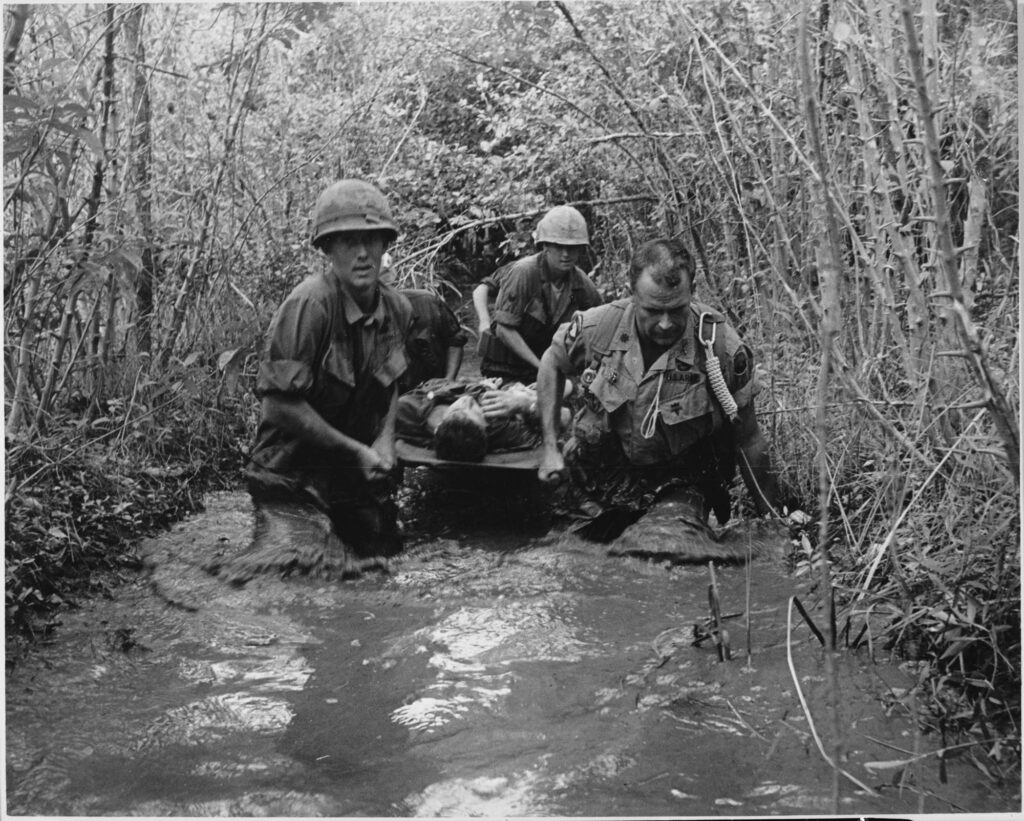
On the ground, U.S. troops faced brutal and disorienting conditions. The dense jungles, sweltering heat, monsoon rains, and lack of clear front lines made every patrol perilous. Ambushes, land mines, and booby traps were constant threats. The enemy, often indistinguishable from civilians, used hit-and-run tactics and elaborate tunnel systems to evade and strike.
Many American soldiers were young, inexperienced draftees unprepared for the psychological and physical demands of guerrilla warfare. Rules of engagement limited their ability to pursue the enemy into Laos and Cambodia, where many Viet Cong forces took refuge.
When they returned home, many veterans were not welcomed as heroes but instead encountered protest, indifference, or hostility. Their sacrifices and trauma were compounded by a public divided over the very legitimacy of the war they were sent to fight.
The war hits close to home
In Riverhead Town, young men who enlisted in the military or were drafted at the height of the war were sent to Vietnam.
One article in The News-Review highlighted the work of George W. Perkins Jr., 19, an Army ammunition storage specialist who was “among the thousands of soldiers working 12-hour shifts, seven days a week in a ‘hostile environment’, to build docks and warehouses for military and peacetime use that will make this the largest port in Vietnam.” Perkins was working in Cam Rahn Bay, where the U.S. military created one of the most tactically significant military bases during the war.
Local groups sent packages to troops and charitable causes in Vietnam. The Suffolk County Council of the Churches, based in Riverhead, collected used clothing and garden and carpentry tools for the United Clothing Appeal of Church World Service, an April 1966 article in the News-Review said. Local Girl Scouts collected soap and toys for children living in the village of Hoa Phat, just outside of Danang.
The Riverhead VFW Post collected packages to send to Riverhead service members in Vietnam in time for Christmas 1966. The Suffolk Red Cross provided families to tape recorded messages and send them to servicemen overseas.
Columns in The News-Review announced when local men were shipped to Vietnam and when they returned from their military service; and announced promotions and commendations received by local soldiers. Occasionally, the newspaper noted when local soldiers were involved in heavy combat.
Four of those soldiers died.
Richard Thomas Pinta, 21, of Riverhead died on July 29, 1967. He was an aviation hydraulic mechanic on board the USS Forrestal in the Gulf of Tonkin. He was one of 134 men killed in a fire and series of chain-reaction explosions after a rocket was discharged on the flight deck due to an electrical power surge, RiverheadLOCAL previously reported.
“Richard was a very serious and hard working young man. He often worked three part-time jobs while still in high school,” his half-brother, Robert Olson, recalled in a 2014 interview.
At the same time Pinta was reported dead, another young man, Navy pilot Lt. Commander Charles Zuhoski of South Jamesport, was reported missing in action. Zuhoski’s F8 Crusader was shot down in July 1967 and he parachuted from his plane. He was captured by the North Vietnamese and held prisoner for almost six years, withstanding brutal torture.
After spending 2,054 days in captivity, Zuhoski was released during Operation Homecoming on March 14, 1973. His motorcade was greeted by thousands of people, most waving flags and signs with welcome messages, lining Route 25 from Calverton to Jamesport. The following week he was honored with a ceremony and parade in his honor in downtown Riverhead. The parade drew more than 2,000 people.
As part of the ceremony, Zuhoski snuffed out the eternal flame on the World War I Memorial that stands on the corner of Court and West Main streets. The flame had been lit a month after he was shot down and was to burn until every Riverhead member of the armed services returned home, according to a Newsday article about the ceremony.
In an editorial on Aug. 10, 1967, The News-Review wrote of the casualties, “The recent double tragedy has brought the home vicinity into closer rapport with the Vietnamese War in which so much American manhood, and so many American ideals, are involved. Hopefully it may serve also to bring into sharper focus for local people the necessity for that involvement; the demand for a forceful and practical approach to its execution; and most particularly, the need for total awareness of its aftermath.”
Franklin D. Tinsley, 21, of Riverside was killed in action on Oct. 6, 1968. He was an infantryman who was killed in action in the Hau Nghia Province by gun or small arms fire, according to the Vietnam Veterans Virtual Wall.
“Frank Tinsley was just like a brother to me,” Thomas Gallo Sr. of Riverhead said in 2014. “He was my friend and will remain my friend for the rest of my life. Good friends never die.”
Garfield M. Langhorn, 20, of Riverhead died on Jan. 15, 1969 during a rescue mission in search of two downed American pilots. A radio operator, Langhorn was in the Pleiku Province when he threw himself on a live grenade to save the lives of wounded soldiers he was attempting to rescue from an enemy attack. For his act of valor, Langhorn was posthumously awarded the Medal of Honor — the highest military decoration awarded by the U.S. government.
A fellow soldier reported that Langhorn’s last words before throwing his body on the grenade were: “Someone’s got to care.”
Langhorn has several honors around town, including a bronze bust in front of the former Town Hall on Howell Avenue erected in 1993. Other honors in his name include the United States Post Office on West Main Street, the library in Pulaski Street School, the veterans wall in Riverhead High School, a road in Calverton National Cemetery, and Maple Avenue, the road where Langhorn lived in Riverhead.
MORE COVERAGE: Lessons in heroism: the life—and death—of Riverhead’s Medal of Honor recipient
Students at Pulaski Street Intermediate School in Riverhead — the same building Langhorn attended high school in — learn about Langhorn’s service every year during a memorial ceremony and essay contest.
James F. Walters, 21, of Riverhead was killed in action on May 13, 1969 while on a medivac mission in the Thua Thien Province. Walters was the crew chief of an Army rescue helicopter that evacuated downed fliers and wounded soldiers; his helicopter crashed during the medivac mission.
Lowell Wayne Meyer, 24, of Riverhead was killed in action on May 17, 1969 in the city of Rach Gia. A petty officer in the Navy, Meyer died from multiple fragment wounds trying to remove an explosive charge from a mortar launcher.
Meyer and Walters “brought the Vietnamese conflict closer” to home, the Riverhead News Review wrote in a May 29, 1969 editorial.
“In our rurally oriented area, sorrow of this kind spills into the community and is felt by all,” the editorial said.
“Wayne Meyer and James Walters died heroically, bringing honor to themselves, their families and their country,” the editorial added. “Why our young men must die fighting in Vietnam is not important at this moment, the fact that the entire community is drawn closer and offers solace to the Meyer and Walters families, is.”
While the war brought demonstrations to college campuses and cities, there were few recorded in Riverhead, according to a review of articles printed in the News-Review from 1963 to 1970.
In September 1967, 75 people attended the “Vigil for Peace in Vietnam” in front of Rep. Otis Pike’s office in Riverhead, the News-Review reported. “The line of people began at Rep. Pike’s office and stretched the length of the street to Main Street in Riverhead.” The protest would be repeated that Saturday and was not sponsored by a “particular established group,” the paper reported.
Pike, a Democrat from Riverhead who served in Congress from 1961 to 1979 and was a veteran of the World War II pacific theater, was generally supportive of Johnson’s Vietnam policy, but disagreed with certain military tactics, according to a Feb. 1, 1969 article.
One participant in the vigil in front of Pike’s office was Mrs. George Parzen, who wrote a letter in The News-Review opposing the war a few weeks later. She had attended the vigil in front of Pike’s office for “the past nine Saturdays” and promised to continue the vigil “indefinitely,” the letter said.
“I feel empathy for the young men here who must go out to Vietnam to kill or be killed. I feel that the public expression of concern of many thousands of people in this country might help to change the policy of our country,” Parzen wrote. “I do not believe that war and violence can solve the problems that face the peoples of the world.”
“I know that as long as this war in Vietnam continues, the world will make little progress in its search for alternatives to violence in the solution of its problems,” the letter continues. “I do not believe that we in this country will make much progress toward solving the problems of minority groups as long as this war goes on, since the $30 billion a year spent in Vietnam is badly needed to tackle the problems here at home.”
Riverhead students held an anti-war demonstration at the high school on Oct. 15, 1969, according to The News-Review. It was a part of a massive nationwide demonstration known as the National Vietnam Moratorium.
“Assisted by two adults from Stony Brook University, the students, carrying placards, marched on the school grounds and area close to the school,” the paper reported. “Their ranks swelled gradually until approximately 400 students became involved. Branching out into the street they asked watching merchants if their actions were approved and indicated another march later in the week.”
“At the end of the sixth period, Principal N Shaffran informed the demonstrators that if they did not return to class they risked suspension and if they continued on the school grounds, they were subject to arrest,” the paper reported.
“Stating ‘this is so new to us but we are deadly opposed to the war,’ the students peacefully withdrew,” The News-Review wrote.
Another insight into Riverhead resident’s opinions of the Vietnam War was The News-Review’s Quizzing Lensman column, which asked people in public places questions submitted by readers. A few of these man-on-the street-style interviews were about the Vietnam War.
In the March 13, 1969 edition of the paper, five Riverhead men who were asked whether there should be an early pullout of U.S. troops from Vietnam voiced support for the war or the Nixon administration’s position on it.
James Stark of Riverhead, who would later become town supervisor, was one of the men. “No, I don’t,” the column quotes Stark as saying. “If we had an early pullout, we would leave South Vietnam at the mercy of the Communists.”
A few months later, the Quizzing Lensman would ask five different men whether they supported Nixon’s withdrawal of 25,000 U.S. troops from Vietnam. All five men supported it, with one saying, “I think if we have a withdrawal we should withdraw all the way. To me, this seems sort of a half measure.”
As it became clear in April 1975 that South Vietnam was about to be overrun by the North, President Gerald Ford said in a speech it was time “to unify, to bind up the nation’s wounds…and begin a great national reconciliation.”
As documentary filmmaker Ken Burns observed in the introduction to “The Vietnam War: An Intimate History,” (2017) which he co-authored with Geoffrey C. Ward, “It’s been more than forty years now, and despite President Ford’s optimism, we have been unable to put that war behind us. The deep wounds it inflicted on our nation, our communities, our families and our politics, have festered.”
The book was based on a documentary series produced 10 years earlier. “Nothing,” Burns wrote, “can make the tragedy of the Vietnam War all right. But we can, we must, honor the courage, heroism, and sacrifice of those who served, those who died and those who participated in the war against the war.”
In upcoming profiles of four local residents who fought in the war and one who fought against it, we hope to honor their courage, heroism and sacrifice as we do our best to tell their stories.
Joe Edler: ‘Somebody up there is watching over me’: ex-Riverhead VFW commander recalls service in Vietnam
Fred McLaughlin: One of the lucky ones in ‘a stupid war’
Ronnie Smith: Vietnam? ‘It’s complicated.’ War, race and morality through the eyes of a Riverhead G.I.
Gary Joyce: Vietnam vet recalls life on the edge: ‘Every day you’re living on a red line’ — and he thrived on it
John McAuliff: From draft resister to diplomatic bridge-builder: One man’s journey from Vietnam War protest to peace advocacy
This article was updated to include links to stories published after initial publication.
The survival of local journalism depends on your support.
We are a small family-owned operation. You rely on us to stay informed, and we depend on you to make our work possible. Just a few dollars can help us continue to bring this important service to our community.
Support RiverheadLOCAL today.
