
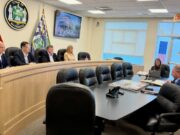











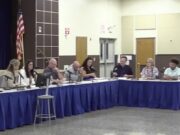






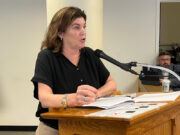


Proposed changes to New York’s State Environmental Quality Review Act, or SEQRA, dominated the discussion during State Sen. Anthony Palumbo’s annual “environmental roundtable” Monday at Suffolk County Community College Culinary Arts Center in Riverhead.
The proposed SEQRA amendments drew skepticism from environmental advocates and several elected officials at the roundtable. The proposed changes are part of Gov. Kathy Hochul’s push to streamline development in the name of housing affordability, but multiple participants at the roundtable argued the changes risk weakening one of the state’s core environmental review and public-participation laws — while failing to ensure any resulting housing is actually affordable.
At the roundtable — attended by a long list of representatives from environmental and civic groups, local governments and institutions — Palumbo asked whether there are ways to expedite reviews of actions involving smaller parcels “and not diminish… the importance” of environmental quality review.

Bob DeLuca, president of the Group for the East End, responded that SEQRA’s central value is not just the environmental analysis itself but the process. SEQRA “guarantees transparency, public participation and a hard look,” he said. “The problem is, when those things don’t happen, you can end up with a project that extends forever and ever, and you don’t get to the core issues.”
DeLuca said there exists “a huge list of Type II actions… 40 or 50 of them … that already are not subject to SEQRA.” But “on larger projects, this is what a comprehensive review is for,” he said.
DeLuca noted that if a municipality believes a particular large project has such public benefit and, in the balancing of equities in the project —the environmental, community and economic impacts — the municipality can decide not to require an in-depth environmental review. It can issue a negative declaration, or a conditioned negative declaration, and allow the project to proceed without an environmental impact statement.
“You can do it now. You’ve been able to do it since 1977 when they put that language in,” DeLuca said. “So all of this … weeping and wailing and crying about ‘we can’t get through the process, and it’s so long’ — You can get through the process, if you will do it properly,” DeLuca said. “If developers will not withhold information and not finish environmental impact statements and stop crying and carrying on about doing another alternative, things would move more quickly,” he said.
DeLuca said changes like this shouldn’t be “shoved into a massive budget bill so that nobody knows what it is, and everybody’s focused on the numbers, and it just pops out the other end, leaving us for the next 20 years to figure out what it meant,” DeLuca said. A rulemaking process exists that provides the opportunity for public input, allowing everyone to take a look at it and have a discussion about it.
“Chances are the folks that are looking to exploit these holes will have better resources than the people looking to protect the environment,” he said.
When the law was written, DeLuca said, the legislature said every citizen has a responsibility to preserve and enhance the environment. “So that’s all of us. It invited us into this process. We should stay in this process, and when we’re excluded from it on major projects, no good can come of that,” DeLuca said.
Adrienne Esposito, executive director of Citizens Campaign for the Environment, said her organization supports looking at ways to “tweak” or streamline SEQRA but is “against weakening it.”
“The current language definitely appears to be insufficient and anemic in things. For instance, it raises the number of housing units from three to 100 which would not require a SEQRA review,” Esposito said.
The amendments would dispense with in-depth environmental review for land that has been previously disturbed. “But the definition of ‘previously disturbed’ is very unclear,” Esposito said. “This process needs to be done in a judicious, thoughtful way,” she said.
“We reject the whole premise that SEQRA is the reason we don’t have affordable housing. That is ridiculous,” Esposito said. “When SEQRA is used properly, it safeguards our environment. That’s the premise and the role of SEQRA, the only law we have that requires a full and thorough environment to review,” she said. “So for us to want to chip away at that now and create a fictitious friction between affordable housing and SEQRA… We reject the premise.”
Kevin McDonald of the Nature Conservancy said his organization shares some of the concerns articulated by DeLuca and Esposito.
“The most important consideration for all of it is, there’s really no guarantee at all that it actually addresses the so-called affordability issue that is facing so many people on Long Island in terms of entry housing and things like that,” McDonald said. Housing affordability is a national problem and a global problem, he said, “emanating from the financial crisis of 2007, ‘08 and ‘09 and the lack of investment in housing and related infrastructure from that period. So the origin of this problem is not New York state’s environmental laws and how they’re applied,” McDonald said.
First District Assembly Member Tommy John Schiavone later echoed that concern, telling the room he was “disappointed” the issue was being framed as a fight between environmental and housing interests, adding that their staff was reviewing the details and that the “majority conference” — fellow Democrats in the Assembly — would be hearing from them. 
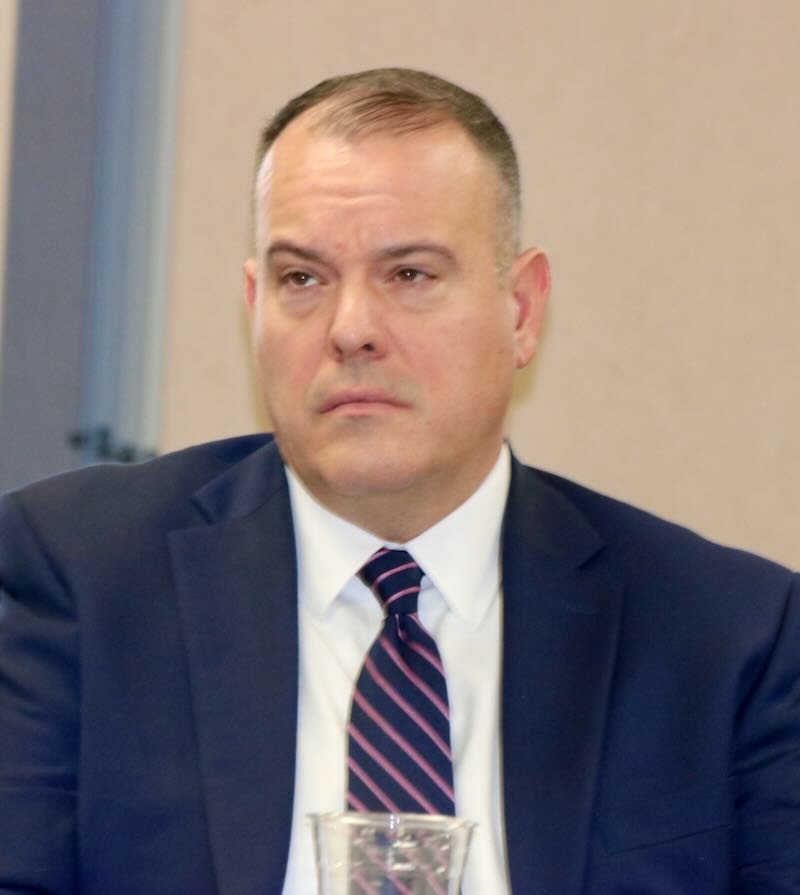
“SEQRA isn’t the issue why you have troubles with housing,” Brookhaven Town Supervisor Dan Panico said. “It’s the lack of sewer infrastructure. And I find that, in general, the state … should worry less about creating new programs and new types of initiatives, and [instead] try to fund the basics that are the responsibility of government, like the roads, the infrastructure, preservation of open space and developing a regional solid waste plan,” Panico said.
The discussion of SEQRA unfolded amid a broader roundtable agenda that also included solid waste, clean water, renewable energy and Long Island infrastructure.
Suffolk County Executive Ed Romaine spoke about the importance of developing renewable energy and the existing infrastructure constraints, namely limits created by electrical substations that lack capacity to handle electricity generated by solar arrays. Romaine urged more progress on solar and wind energy and related capacity issues.
Palumbo’s environmental roundtable, initiated by his predecessor in the First Senate District, longtime state senator Ken LaValle, is held annually and allows environmental and community groups and local elected officials to discuss issues of concern with state lawmakers.
Second District Assembly Member Jodi Giglio attended the meeting, as did County Legislator Greg Doroski, County Legislator Ann Welker, County Legislator Steve Englebright, Riverhead Supervisor Jerry Halpin, Southold Supervisor Al Krupski and Southampton Supervisor Maria Moore.

The survival of local journalism depends on your support.
We are a small family-owned operation. You rely on us to stay informed, and we depend on you to make our work possible. Just a few dollars can help us continue to bring this important service to our community.
Support RiverheadLOCAL today.
