





















Riverhead school district residents Wednesday night got a first look at the superintendent’s proposed 2026-2027 budget: a $218.88 million spending plan that would increase overall spending by about $7.45 million, or 3.52%, while keeping the tax levy increase within the district’s state-calculated tax levy cap of 2.91%.
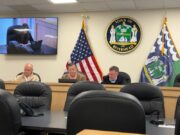
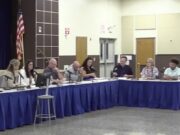
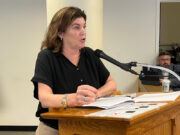
Interim Assistant Superintendent for Business Marianne Cartisano gave the first presentation of the 2026-2027 budget at the middle school. See presentation document below.
The proposed budget is “a little tight, but very doable,” Cartisano said, emphasizing that the district began building the spending plan by setting a firm boundary on the revenue side: the district would not pierce the tax levy cap.
“You’ve heard me say it before, we start with revenues,” Cartisano said, explaining that the district’s first step was calculating the tax levy limit under New York’s property tax cap law and working from there.
The tax cap is often misunderstood as a flat 2%, she said, when in reality it is a formula that produces different caps for different districts each year. The formula takes into account a limited number of exemptions, including growth in the district’s full taxable property, certain contributions toward employee pensions, expenditures for some court orders and the local portion of capital expenditures.
Riverhead school district’s tax levy cap for 2026-27 is 2.91%, up from 2.16% in 2025-26, Cartisano said.
Once the district sets its tax levy ceiling, she said, it turns to state aid and other revenue streams to determine how much spending can be supported. For Riverhead, that includes an estimated $89 million in state aid under the governor’s proposed budget, plus what Cartisano described as a tentative additional $1 million the district hopes to see in state support tied largely to special education costs.
Other revenue streams include: PILOT payments [payments in lieu of taxes]; out-of-district tuition; income from services to other districts and the sale of equipment; unemployment, workers comp and pension reserves; and the application of fund balance.
Total anticipated revenues for 2026-2027 is $105.6 million. The difference between anticipated expenditures and anticipated revenues is the amount to be raised by the tax levy: an estimated $113.3 million.
Special education pressure is the throughline
Cartisano told the board that the most difficult pressure point on both the revenue and spending sides of the budget remains special education — an area she said has been escalating as more students arrive in kindergarten with established needs and individualized education programs (IEPs).
Early intervention services can be a big benefit for students and families, she said, but the reality for districts is that services follow students into the school system, and districts must provide and pay for them.
That dynamic shows up in the spending plan.
The district’s spending is typically grouped into five broad budget categories: general support, instruction, transportation, community service and “undistributed” (a category that includes employee benefits and debt service). In the proposed 2026-27 plan, instruction is the largest piece, at roughly $129.9 million, and it is also the biggest driver of the year-to-year increase.
Within instruction, the largest single increase highlighted in the presentation is programs for students with disabilities, up nearly $2.7 million. Cartisano described it as a roughly 7% increase in program costs.
Transportation is another area where special education is driving unusually large growth. The proposed transportation budget is about $12.1 million, up roughly $1.75 million, or 16.9%. Most of that increase is tied to transportation provided through BOCES for students with disabilities, which is projected to rise by about $1.4 million — a jump of more than 100%, according to the presentation. Cartisano told the board that just a couple of years ago, the district budgeted about $100,000 in that line. It is a cost she described as having “very little flexibility” because it is driven by students’ IEPs.
Benefits and pensions: the other big driver
The third major cost driver Cartisano highlighted is employee benefits — a contractual, non-discretionary portion of the budget that includes pensions and health insurance.
In the proposed plan, employee benefits rise by about $2.16 million. One of the standout items: the district’s state retirement (ERS) cost, which Cartisano said is increasing because the state’s contribution rate is rising from about 16.5% to 17.6%, producing an estimated increase of roughly $800,000.
Meanwhile, teachers’ retirement (TRS) costs are projected to decrease. Cartisano credited that, in part, to a retirement incentive and the resulting change in salary structure as veteran staff retire and lower-salaried employees are hired into vacant positions.
Health insurance also continues to climb. Cartisano said the projected increase in the district’s health insurance line is about $1.5 million and noted that the district’s health insurance spending in the “undistributed” category now exceeds $25 million.
Charter tuition: ‘I just don’t like the funding formula’
Cartisano also pointed to another growing cost that is largely outside the district’s control: charter school tuition.
The budget presentation lists a $918,013 increase for charter school tuition. Cartisano told the board that the district’s charter tuition budget alone is projected at $17.5 million for 2026-27 and said she has long warned the district could be on a path toward $20 million.
“I understand the charter school concept,” she said. “I just don’t like the funding formula,” adding that her concern is about how charter tuition is calculated and charged back to districts, not about parent choice.
Cartisano said the district has been working to better track the “true” charter-related costs, including transportation, nursing, special education and textbooks, and that she plans to return on March 17 with a clearer picture.
Other pressures: insurance and home-to-school transportation
The presentation also highlighted increases in property insurance and home-to-school transportation, separate from special education transportation.
Property insurance is projected to rise by about $254,539. Cartisano said insurance costs have been rising broadly and noted the district’s scale — a large geographic footprint with multiple buildings and significant contents — as factors that shape the cost.
Home-to-school transportation is projected to rise by about $354,499, another of the “major increases” cited in the presentation materials.
Audit and construction updates
Before turning to the budget overview, Cartisano opened with an update on audits and construction projects.
She said the district’s fiscal year 2025 financial audit was completed and filed on time, “which is a very big deal for us to show again the community and the financial community that we are back on track, and we have been since 2023.” The federal single audit was completed and filed on time. The comptroller’s audit has also been completed and filed, she said. “I am very happy with the results,” she said. Work continues on education stabilization fund reporting tied largely to COVID grants. Cartisano said the state and federal governments have requested additional documentation and that the district’s goal is to complete that process by the end of March.
Cartisano also said the district has maintained its Moody’s Aa2 rating — “the highest rating our school district can receive in the financial marketplace, which is extremely important, because when we go out and borrow our TANs, our tax anticipation notes, or our bonds, we are looked at very favorably in the financial community.” That has a positive impact on interest rates the district must pay.
On construction, Cartisano said the district is moving ahead with three major projects that will begin over the coming months, including kitchen renovation projects at Riley Avenue Elementary School (about $1.2 million) and Phillips Avenue Elementary School (about $1.7 million), both funded through cafeteria capital reserves. The third project, a $27.5 million energy performance contract, includes solar and infrastructure improvements and is projected to be funded through energy savings. None of these projects impacts the tax bill, she said.
Key dates and voting location
Cartisano said the board is scheduled to revisit budget expenditures in more detail on March 17. The board is expected to adopt a final proposed budget and the property tax report card on April 1, followed by a budget hearing on May 6.
The budget vote and board trustee election are scheduled for May 19, with voting from 6 a.m. to 9 p.m. at Riverhead High School. Cartisano reminded the public that the district moved last year to a single polling location at the high school, citing safety, security and efficiency.
She also said budget materials and supporting documents are being posted on the district website, including a “key facts” handout intended to give residents an at-a-glance view of the most important numbers and dates.
Watch the budget presentation here.
View/download budget documents on the district website.
The survival of local journalism depends on your support.
We are a small family-owned operation. You rely on us to stay informed, and we depend on you to make our work possible. Just a few dollars can help us continue to bring this important service to our community.
Support RiverheadLOCAL today.
