





















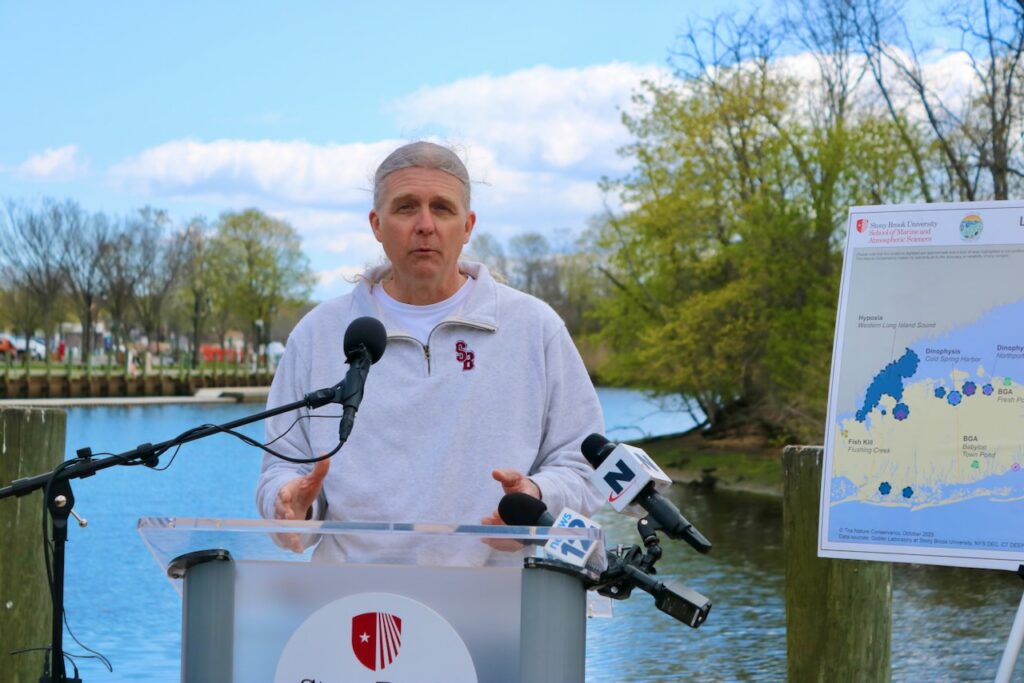
New scientific findings presented Tuesday in downtown Riverhead point to worsening threats in Long Island’s coastal waters, including harmful algal blooms, low-oxygen zones and environmental conditions that promote dangerous bacteria, according to Stony Brook University coastal ecologist Christopher Gobler.
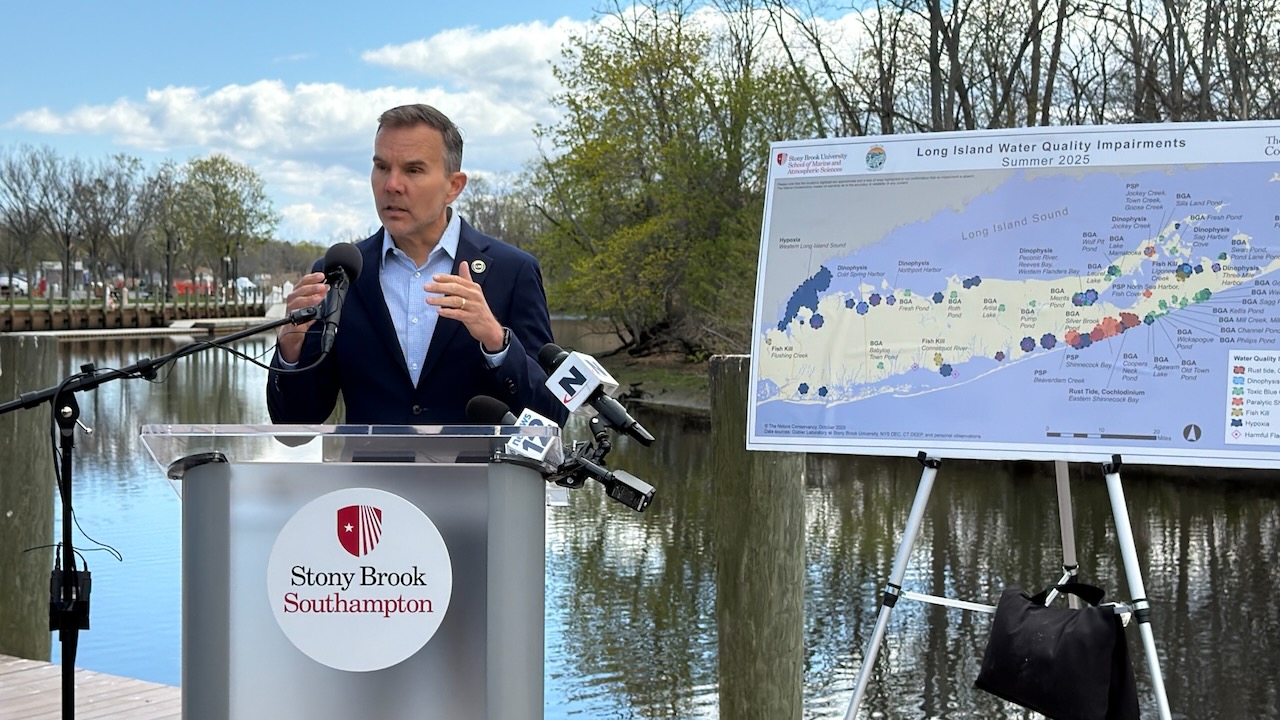
Speaking on the Peconic River boardwalk in Riverhead, ahead of Friday’s annual State of the Bays symposium to take place at Stony Brook University in Southampton, Gobler said water bodies across Long Island failed to meet state and federal water quality standards last year and that 2026 is already off to a troubling start. He had a map of the island on display depicting “dozens and dozens of locations in our estuaries and our harbors and our bays and our lakes and our ponds” that didn’t meet water quality standards in 2025.
Among the most serious concerns, Gobler said, are harmful algal blooms in both freshwater and marine waters, shellfish closures tied to paralytic shellfish poisoning and low-oxygen “dead zones” that harm marine life. He also said researchers are tracking Vibrio vulnificus, the bacteria sometimes referred to as flesh-eating bacteria, in local coastal waters.
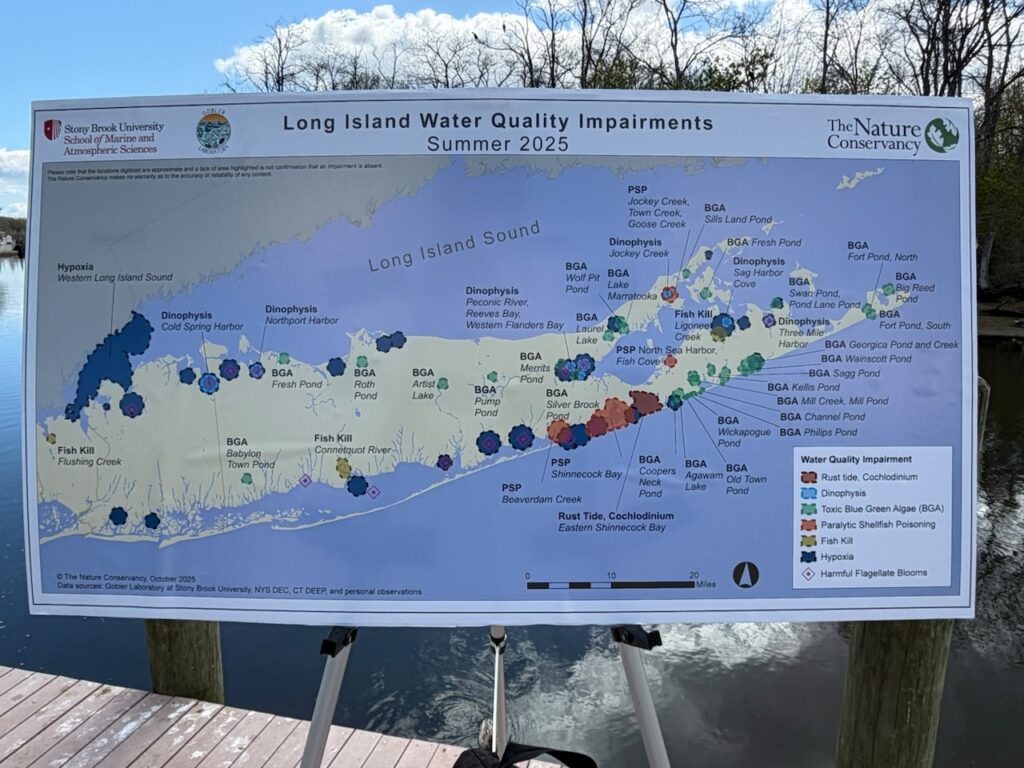
Gobler said three Southold water bodies are currently closed to shellfishing because of paralytic shellfish poisoning and that the western half of Shinnecock Bay is also closed.
Five locations last year were closed to shellfishing because of Alexandrium blooms and the saxitoxin they produce, he said. Saxitoxin is a neurotoxin that is 1,000 times more potent than cyanide and can get into shellfish, which, if consumed, can cause extreme illness or even death, Gobbler said. One location in Southold last year had toxin levels in shellfish high enough to be lethal if eaten, he said, adding that no one became sick because the state Department of Environmental Conservation closed the area proactively.
Gobler said nearly three dozen Long Island locations are also experiencing hypoxic conditions, with dissolved oxygen levels below the state standard of 3 milligrams per liter.
“Every hour that a water body spends below three milligrams per liter is an hour that is doing harm to marine life,” he said.
The area of the river where Gobler gave his briefing Tuesday regularly experiences hypoxia during the summer, according to data published by the U.S. Geological Survey.
Gobler identified nitrogen pollution from land-based sources, especially on-site septic systems, as the primary driver of many of the region’s water quality problems. He said climate change is accelerating those problems and contributing to the spread of Vibrio vulnificus.
The briefing also focused on mitigation strategies, including advanced wastewater treatment systems and aquaculture.
Michael Doall, associate director for aquaculture and restoration at Stony Brook, said shellfish and seaweed farming helps remove nitrogen from the water while also supporting the coastal economy.
He described shellfish and seaweed as “zero input crops” that require no fertilizer, feed, fresh water or pesticides and said they remove nitrogen from the water as they grow. Harvesting them removes that nitrogen from the marine environment, he said.
Doall said aquaculture is not a stand-alone fix, but an important near-term tool while the much longer process of replacing cesspools and septic systems moves forward. He said about 50 farms across Long Island are already contributing to that effort.
Gobler said a recent study found aquaculture could address about 20% of the nitrogen reduction needed in Northport Bay using just 1% of surface waters.
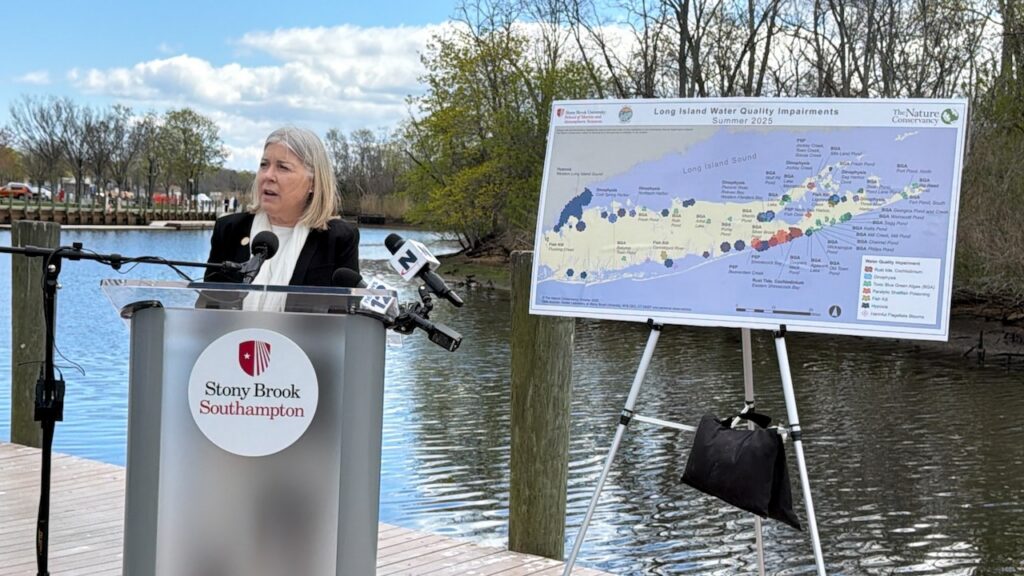
Deputy Suffolk County Executive Jennifer Juengst said Suffolk County has built what she described as the nation’s most aggressive septic upgrade program after years of lagging badly behind.
She said the county is undertaking a 35-year effort to replace 360,000 cesspools and failing septic systems and is using revenue from the county’s one-eighth-cent sales tax surcharge, approved by voters, to help fund the work.
Juengst said the county’s Septic Improvement Program can provide up to $20,000 toward an eligible system and that state funding can add up to $25,000 more, bringing many homeowners close to full reimbursement.
“We are the only county that we know of in the United States that is nearly funding 100% of the cost of these systems for folks who apply,” Juengst said.
She said Suffolk expects to launch a simplified online application within the next month for residents seeking access to the funding.
Asked whether new Stony Brook-developed nitrogen-removing systems would significantly lower installation costs, Gobler said those systems are currently performing as well as commercial innovative/alternative units and are removing not only nitrogen but also pharmaceuticals and personal care products. He said costs remain roughly in line with other systems for now, though additional systems under development may be more affordable.
Gobler also said fertilizer runoff remains the second-largest source of nitrogen pollution flowing from land to sea and said more action is needed there as well, including possible state-level regulatory changes.
On Vibrio vulnificus, Gobler said the bacterium was once associated mainly with the Gulf of Mexico but has moved northward this century. He said three people died in 2023 from exposure in Long Island Sound and that local hot spots now exist on parts of the South Fork and North Shore.
He said the bacteria pose the greatest risk to people who are elderly, immunocompromised or have open wounds, especially during warmer months.
Friday’s State of the Bays symposium will be held at Stony Brook Southampton’s Avram Theater at 7 p.m. The event is free to attend and open to the public. For more information and to reserve free tickets, visit the Stony Brook Southampton website.
The survival of local journalism depends on your support.
We are a small family-owned operation. You rely on us to stay informed, and we depend on you to make our work possible. Just a few dollars can help us continue to bring this important service to our community.
Support RiverheadLOCAL today.
