























The Riverhead Town Board heard mixed public comment Wednesday night at a sparsely attended hearing on the site plan and special permit applications for the proposed Peconic River Hotel, a five-story, 94-room hotel planned for East Main Street next to the town square.
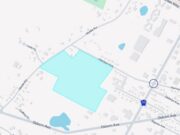
The project, proposed by J. Petrocelli Riverhead Town Square LLC, calls for a 69,738-square-foot hotel building on a 0.42-acre site at 117-127 E. Main St. The building would include a first-floor restaurant, coffee shop, retail space, hotel lobby and amenities, with hotel rooms on the upper four floors and nine parking spaces on the lower level for hotel staff.
No action was taken Wednesday. The board kept the written comment period open for 10 days, until June 20.
Hotel plan and parking
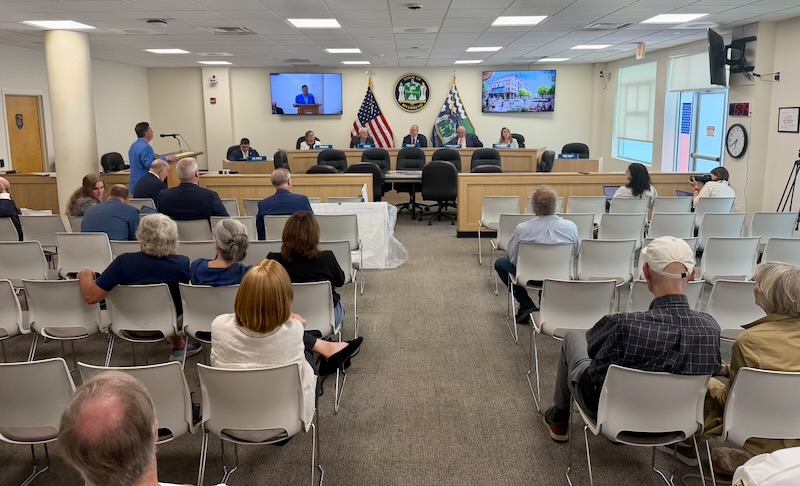
The special meeting, called solely for the hotel hearing, drew about a dozen members of the public to Town Hall, though several people also spoke via Zoom. The small turnout became a point of discussion during the hearing, which at times was marked by sharp exchanges between board members and some speakers.
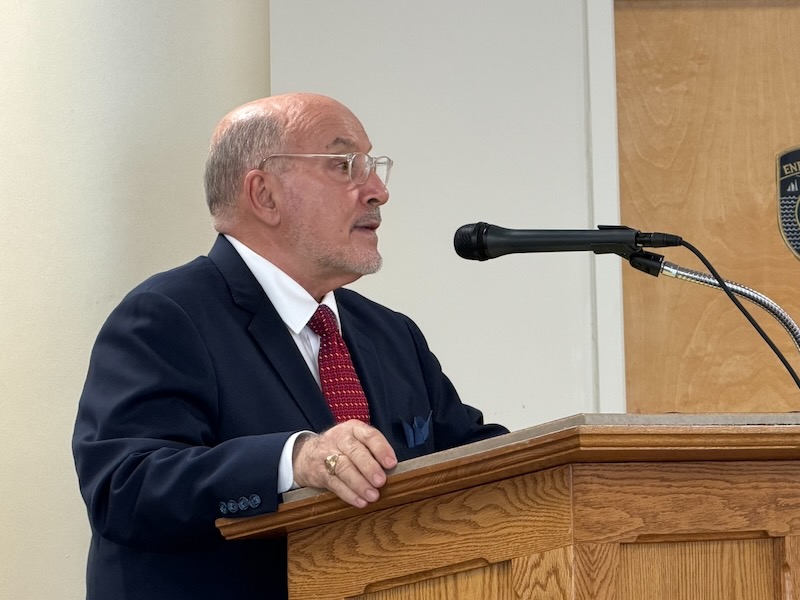
Attorney Eric Russo, representing the applicant, said the hotel would be a Tapestry by Hilton brand hotel, with 80 guest rooms and 14 suites. The first floor would include a roughly 5,100-square-foot restaurant and bar with terrace seating, a coffee shop and retail space, he said.
Russo said the project complies with the zoning requirements for the Downtown Center 1 Main Street district, including lot area, frontage, building coverage, height and floor-area ratio.
VHB engineer Angelo Leno said the hotel would front East Main Street, border the planned town square to the west and south and abut existing commercial property to the east. The adjoining property on the east is owned by the town and leased to the East End Arts and Humanities Council. It is developed with five historic buildings.
The main hotel entrance would be on Main Street, with valet service for hotel guests and patrons. Entrances to the first-floor restaurant and retail spaces would also open onto the town square, he said.
A 12-foot-wide accessway on the east side of the building would serve back-of-house functions including utilities, loading, deliveries and refuse collection, Leno said. Access to the lower-level parking area would be from Heidi Behr Way through the proposed town square parcel, under an agreement with the town.
Leno said the southern portion of the site is within a FEMA AE flood zone, with a base flood elevation of 7 feet. Habitable space must be at least 3.5 feet above that elevation, and the proposed finished floor elevation for habitable space is 13.5 feet, he said.
Stormwater from the hotel would be directed to 25 leaching galleys on the adjacent town square property under an agreement with the town, Leno said.
The hotel’s water and sewer service would connect to the Riverhead Water District and Riverhead Sewer District, respectively, he said. The applicant is working with the town’s consultant, H2M, on plans to provide both services.
Russo and VHB environmental planner Kristiana Kastalek reviewed the special permit criteria in the town code, saying the site is particularly suited for a hotel because of its downtown location and the town’s plans for increased tourism, visitor accommodations and economic development.
Kastalek said the hotel would be consistent with existing downtown development and surrounding commercial, hospitality, retail, restaurant, civic and multifamily residential uses. Although the hotel would be near the Suffolk Theater and the planned town square, she said the project is expected to stimulate economic development by bringing a name-brand boutique hotel, restaurant, bar and retail uses to downtown.
Traffic engineer Patrick Lenehan of VHB said the hotel’s downtown location would reduce traffic impacts compared with the same uses in a less walkable location, because hotel guests would be expected to walk to other downtown destinations after arriving.
Lenehan said the hotel would use a valet area on East Main Street, long enough to accommodate about seven vehicles. Cars would be parked in the public parking lot north of Main Street behind the Suffolk Theater until the planned parking garage is built, he said. After that, hotel parking would shift into the garage under an agreement with the town.
For drivers arriving from the east, Lenehan said the applicant would try to direct guests to approach the hotel eastbound on Main Street, using McDermott Avenue, Heidi Behr Way and Peconic Avenue to reach the valet area from the west.
“I know it’s not the easiest intersection to navigate,” Lenehan said of the Main Street-Peconic Avenue area, “but I think an arrival from the south is better than routing them around the north side.”
Architect Andrew Giambertone said the hotel design has been developed over roughly four years with input from the town’s consultant, Urban Design Associates, as well as the Landmarks Preservation Commission and Architectural Review Board.
“This did not happen overnight,” Giambertone said.
He said the building is designed to be in keeping with the spirit of downtown Riverhead and the town’s downtown pattern book, including a “wedding cake” design that steps back the upper floors along Main Street and the east and west sides of the building.
Giambertone said the building is intended to look like an adaptive reuse of an older commercial building that might have existed on Main Street. The upper stories would be primarily brick, with exposed steel elements at the lower level, he said.
The west side of the building, facing the town square, is designed to create activity along the public space, he said.
Joe Petrocelli, managing member of the applicant company, said the project has taken years of effort and revision.
“I’m very proud of where we are tonight,” Petrocelli said. “Took a lot of effort for us to get here.”
Petrocelli said the town has momentum on downtown redevelopment that needs to continue.
“We have to move on this as a town,” he said. “We’ve got to keep going.”
Council Member Robert Kern praised Petrocelli’s prior work with the town, including moving town offices from the former Town Hall on Howell Avenue to its current location on West Second Street and working with Kern on plans for renovating the former Town Hall site for use as the town’s justice court.
Council Member Ken Rothwell said the project had been shaped by years of collaboration between Petrocelli, town officials and the public.
“This project is a project that’s not about your own business, but it’s about bettering the welfare of every restaurant, retail store, the Suffolk Theater, the Vail-Leavitt Theater,” Rothwell said. “It’s about bringing foot traffic downtown.”
Public comments focus on parking, process and public costs
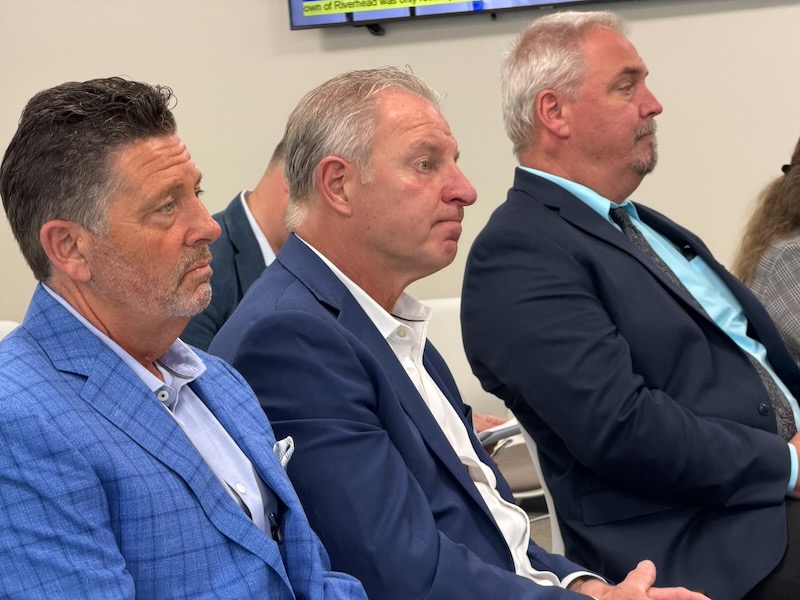
Public comments focused largely on parking, the environmental review, the site plan process, public costs and the relationship between the hotel and the broader town square redevelopment plan.
Martin Sendlewski, chair of the Riverhead parking district advisory committee, said he was speaking for himself and not on behalf of the committee. He urged the board to take a closer look at the parking impacts of both the hotel and the town’s Main Street improvement plans.
Sendlewski said the current Main Street improvement plan would reduce parking on Main Street between Roanoke Avenue and East Avenue from 40 spaces to 21 spaces, and the hotel’s valet area would eliminate several more public spaces. He said the parking committee had previously recommended changes that would preserve eight additional spaces on Main Street.
Sendlewski also questioned how the town can move forward with the hotel approval before completing the parking agreement referenced in the application materials.
He said the First Street parking lot belongs to Riverhead Parking District No. 1, not the town generally, and argued that any agreement allocating public parking spaces for hotel use should be reviewed by the parking district trustees, who are the members of the Town Board.
Kathy McGraw of Northville questioned whether the town was following its own site plan review process. She said the town code sets up a two-step preliminary and final site plan process, and said the hotel application appeared to be treated as a final site plan while being processed like a preliminary plan.
“This public hearing tonight appears to be about a final site plan application, not a preliminary one,” McGraw said. “I don’t think it is legal.”
Community Development Administrator Dawn Thomas later responded that the town has long used a single site plan application process, with one public hearing, followed by approval with conditions and later final signoff once conditions are met.
“There’s no document demarked preliminary site plan application,” Thomas said. “An applicant makes an application, provides all the documentation, that gets reviewed by the planning department. It comes for one public hearing.”
Former supervisor Laura Jens-Smith said she supports downtown revitalization, but argued the hotel application should not be reviewed as a standalone site plan because it is tied to the master development agreement for the town square.
Jens-Smith called for a cost-benefit analysis showing the total public investment associated with the project, including public land being conveyed, easements, parking commitments, infrastructure improvements and future maintenance obligations.
She also questioned the change from the earlier concept that included residential condominium units to the current hotel-only proposal, asking whether the town evaluated the difference in assessed value, property tax revenue, school tax revenue and long-term economic impact.
“This is not an argument against development, it is an argument for accountability when public land, public money, public parking, public infrastructure are being used to support a private project, the public has the right to know what is going to cost them, the benefit and return on their investment before approvals are granted,” she said.
The town should provide a “statement identifying all infrastructure costs to be paid by the developer and all costs that may ultimately be borne by the taxpayers,” Jens-Smith said.
Political exchange interrupts hearing
After Jens-Smith finished her statement, Council Member Denise Merrifield asked Jens-Smith whether she was the chairperson of the Riverhead Democratic Committee.
Jens-Smith declined to answer.
“I think that the public has a right to know that,” Merrifield said. “You stated several times, taxpayers have a right to know. I think the taxpayers of this town have a right to know that Mr. Jerry Halpin is the candidate the Democrat Party has put up for election this year,” Merrifield said, referring to the town supervisor.
Halpin, running on the Democratic line, narrowly won an upset victory in November, defeating Republican incumbent Tim Hubbard. He was elected to a one-year term rather than the standard two-year term for Riverhead supervisor because of New York’s Even Year Election Law. Halpin is seeking re-election this year and is being challenged by Republican Council Member Ken Rothwell.
“I believe the taxpayers have a right to know that you are the chairman of the Democrat Party of Riverhead, and Mr. Halpin is your candidate,” Merrifield said. “And I’m simply asking, are you speaking as the chair of the Democrat Party when you speak to this Town Board and Mr. Halpin specifically, or as a resident—”
Jens-Smith interrupted Merrifield and the two spoke over each other. Jens-Smith said if speakers are expected to identify political party roles or affiliations, the same standard should apply to other speakers, board members, the town attorney and town officials.
“If you want me to identify myself, then the board should identify themselves, the attorney should identify themselves,” Jens-Smith said. “Anybody else who comes up here and speaks should have to identify their political party. I think that’s against the democratic process.”
Merrifield disagreed.
“I think people simply have a right to know where you are in relation to your remarks,” she said.
“You need to know what color underwear I’m wearing as well?” Jens-Smith asked.
That prompted Halpin, who chairs Town Board meetings, to intervene.
“All right, all right,” he said.
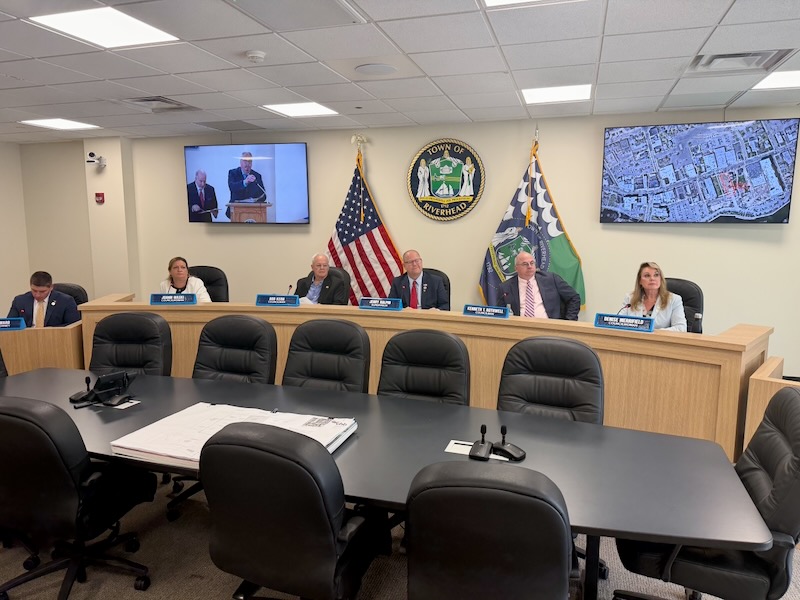
After Jens-Smith left the podium, Rothwell asked Thomas to respond to questions about public investment in the project and the benefits expected from it. Thomas outlined grant funding obtained by the town for the town square project and discussed the cost-benefit analysis performed and strategic investment plan developed during the state Downtown Revitalization Initiative planning process.
Thomas said the proposal grew out of years of public engagement and planning, including studies dating back decades, the downtown activation plan, the state Downtown Revitalization Initiative and its strategic investment plan, all of which called for a stronger connection between Main Street and the Peconic River.
Thomas also said public grant funding is paying for relocation of the East End Arts buildings and related preservation work, not the town’s taxpayers. She said the hotel itself is not being built with taxpayer money.
“The entire town square project, the cost benefit was created by the Perkins Eastman Group as a part of that strategic investment plan,” Thomas said.
Peggy Kneski, owner of Riverhead Flower Shop on Main Street, spoke in support of the hotel.
“I just want to say how wonderful it is that the hotel is coming to Main Street,” Kneski said. “I know there’s a lot of talk on social media that we don’t need any more hotels in Riverhead. That simply is not the case.”
Kneski said downtown business owners know firsthand that the area needs more foot traffic.
“The town square is going to be phenomenal,” she said.
Council Member Joann Waski said she has spoken with downtown business owners who want the hotel and town square project to move forward. She pointed to the small number of people in the meeting room as evidence that opposition to the project was not widespread.
“There are only 11 people here that are not staff, press or Petrocelli’s team — 11 people out of a town of over 36,000 people,” Waski said. “Where is all of the ‘we don’t want this’?”
Waski said it seems like the same people “that come to every single meeting” are “negative about anything that this board tries to do, and they’re always trying to point a finger and say that we’re doing something wrong, our pockets are being lined,” Waski said. “There is nothing more upsetting to me to have somebody insinuate that over and over and over. How dare you,” she said. “I am a member of this board. I’m a resident of Riverhead, a lifelong resident of Riverhead” and a downtown business owner, she said. “I’m invested in this, and I’m tired of what’s been going on. Eleven people. Remember that.”
Desmond Wong, speaking by Zoom, urged the board not to close the hearing until the record includes additional environmental analysis, a parking plan that does not depend on an unbuilt garage and water and sewer availability letters.
“A private Hilton is not flood mitigation,” Wong said. “Your own 2025 determination promised a second review of this component when its site plan arrived. A memo concluding that the changed building changes nothing is not that review.”
Cindy Clifford of Riverhead thanked Petrocelli for his investment in downtown and praised the building’s step-back design, but questioned whether the town was moving too quickly under a negative declaration.
She asked whether the 94-room hotel would have no impact on parking, traffic or the original town square goal of opening Main Street to the river.
Mike Foley of Reeves Park, speaking by Zoom, said parking is his biggest concern. He said he recently had difficulty finding parking downtown at lunchtime and warned that insufficient parking could hurt existing businesses.
“Parking is an absolute must for this town,” Foley said. “It is lacking now, and we’re about to lose more spaces.”
Foley also asked whether Petrocelli would seek benefits from the Riverhead Industrial Development Agency for the hotel.
Russo said the master development agreement allows the applicant to apply to the Riverhead IDA, and the developer has filed an application which is currently being reviewed by RIDA. He said the applicant is seeking sales and use tax, mortgage recording tax and real property tax exemptions. The property tax benefits would be the subject of a payment-in-lieu-of-taxes agreement with RIDA.
Russo said the total project cost is estimated at approximately $35.1 million. He said the applicant expects to seek about $19.6 million in conventional mortgage financing, has received a $1 million Restore New York grant, and expects an owner contribution of about $14.5 million.
John McAuliff of Roanoke Landing urged the board to reject the site plan and special permit, saying the process has been flawed and the hotel would have a negative impact on the town square and downtown Riverhead.
McAuliff said the hotel would dominate the planned town square, block views and sunlight and rely too heavily on public parking.
“It will have a terrible impact to town square and downtown Riverhead,” McAuliff said.
Developer Wayne Steck, who has a pending application called Landmark of Riverhead slated for the former West Marine site on East Main Street, urged the board to approve the hotel. Steck is also a partner in Summerwind Square, the first mixed-use, multi-story workforce housing apartment building in the downtown district developed under the DC1 zoning. That project broke ground in 2011 and tenants began moving in two years later.
“This hotel is a huge benefit,” Steck said. “The location is perfect. It is going to bring people to this town who are going to use the other businesses downtown,” he said.
Steck said the board needs to look at the big picture and allow downtown redevelopment projects to move forward. He said his current development proposal has been pending for several years and, citing the town’s pattern book study, has been delayed by town reviews.
“The building is great, it looks beautiful, the architecture is nice, it’s designed well, it’s placed well,” Steck said. “I think it’s a great use.”
Supervisor Jerry Halpin closed the meeting, with the record held open for written comment for 10 days.
The survival of local journalism depends on your support.
We are a small family-owned operation. You rely on us to stay informed, and we depend on you to make our work possible. Just a few dollars can help us continue to bring this important service to our community.
Support RiverheadLOCAL today.
