


























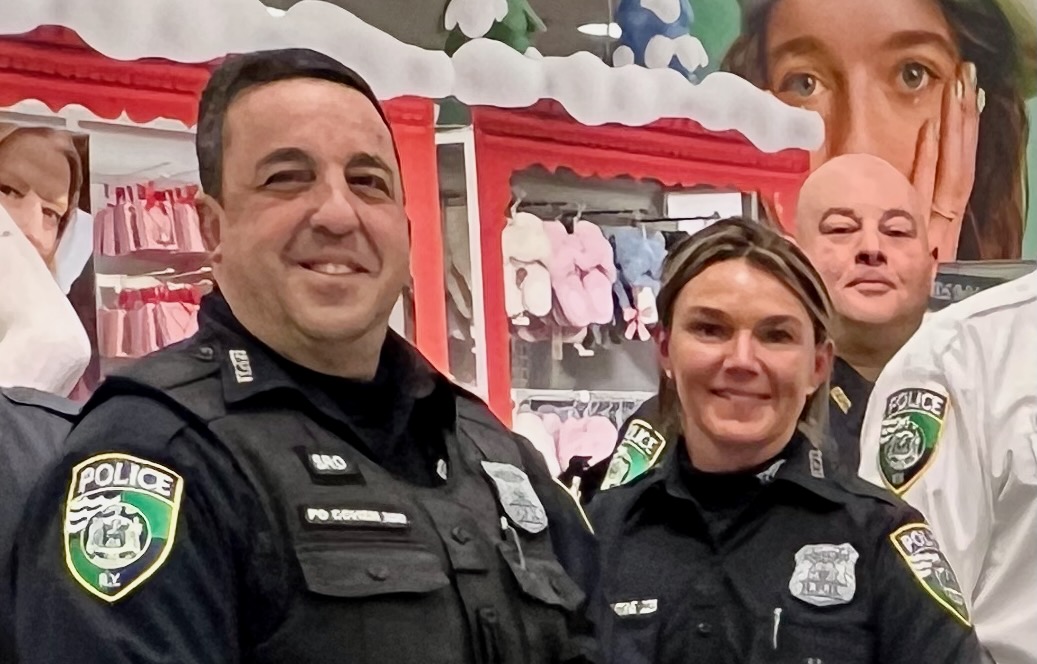
The Riverhead Town Board on Tuesday tabled a resolution authorizing Supervisor Jerry Halpin to sign a renewed agreement with the Riverhead Central School District for two school resource officers, prolonging a dispute over who should pay for police officers assigned to the district’s high school and middle school.
The vote to table the resolution was unanimous.
The two uniformed Riverhead police officers assigned as SROs are continuing to work in the schools while the town and district continue discussions, Riverhead Superintendent Bob Hagan said Wednesday. Hagan said the district remains in discussions with town officials and he is hopeful the two sides will reach a positive resolution.
The decision came less than a week after Town Attorney Erik Howard told board members at a Sept. 10 work session that the school district had agreed to pay the $200,000 it budgeted for the SRO program for the 2026-27 school year. Howard said the district also agreed to pursue meetings between the Town Board and school board before the district begins budget planning for the 2027-28 school year.
But board members Tuesday said the proposed agreement still left too many questions unanswered, including how costs would be covered in future years, how overtime would be authorized and whether the cost should be borne by town taxpayers at all.
Council Member Denise Merrifield has been the board’s most vocal opponent of town taxpayers sharing the cost of the program. Her central objection is that the agreement shifts part of the cost of a school district program onto the town budget, requiring Riverhead town taxpayers who live outside the Riverhead Central School District to help pay for officers assigned to Riverhead school buildings.
Merrifield and Council Member Ken Rothwell also argued that putting the SRO cost in the town budget rather than the school budget denies eligible taxpayers a STAR-related offset on that expense. The state STAR program, however, is not a line-item reimbursement for particular school expenses. Eligible homeowners receive the STAR benefit on their school taxes according to a state formula based on the STAR exemption or credit, the school tax rate and statutory caps.
Rothwell raised concerns about overtime for events such as athletic games, concerts, hearings, proms and homecoming. The contract before the board Tuesday states that “overtime is at the discretion of the superintendent or his designee, which I don’t think is appropriate,” Rothwell said. He said the police chief should have a role in determining overtime and questioned the financial impact.
Furthermore, he said, the resolution and contract documents were not ready for approval.
“I just would like to really have seen the entire contract put forth,” Rothwell said, adding that changes should be marked with deletions and additions, as they are in other formal contract changes.
Rothwell said he does not want to disrupt the SRO program.
“I fully support the SRO program. I want it to go forward,” he said. But he said the agreement should not leave the town in the same position next year.
The contract should include a stipulation that the district would pick up the cost in the following year, Rothwell said. “Otherwise we’re back here next year,” he said.
Merrifield pointed to a pending state Senate bill that would establish a statewide school resource officer program and create a grant program to reimburse school districts. Merrifield said that was significant because the grant would reimburse school districts, not towns contributing to SRO programs.
“So I think these are all things that should be taken into consideration when we review this,” she said.
Council Member Joann Waski said she wants to ensure money remains in the police budget for reinstating the department’s juvenile aid bureau in schools, including elementary schools and parochial schools.
“I would like to speak with the Chief of Police, and I would like to see the Juvenile Aid Bureau reinstated throughout all the schools,” Waski said. “I think that their presence is needed, elementary all the way up,” she said.
It might not be on an everyday basis for the youngest students, she said, but the officers could come in and out of schools and advocate for students, including students in parochial schools. Waski expressed concern that continuing to support the SROs would make it difficult to fund having a Juvenile Aid Bureau presence in schools.
Under the now-expired agreement reached in 2024, the district paid 50% of the cost of one officer during the 2024-25 school year and 50% of the cost of both officers during the 2025-26 school year.
After that agreement expired, the district proposed paying $200,000 toward the program this year. At an Aug. 27 work session, district attorney Greg Gillen told the Town Board that the district had budgeted $200,000 and proposed paying 50% of the base salaries for two officers, rather than half of the full salary-and-benefits cost. If the town would not accept that, Gillen said, the district could afford to pay half the full cost of one officer.
Town officials pushed back, saying the district should have budgeted for the full cost of the program.
The draft before the board Tuesday, did not commit the district to paying any portion of the cost in the future. It did not obligate the town, either, Howard pointed out.
The SRO arrangement dates back to 2018, when the town and school district first agreed to split the cost of one Riverhead police officer assigned primarily to the high school. That officer did not return after school buildings reopened following the COVID-19 pandemic shutdown.
Calls for increased security grew louder in 2023 after incidents involving weapons at Riverhead High School and Riverhead Middle School. In 2024, the town and district agreed to place two Riverhead police officers in the secondary schools for two school years.
Under that agreement, Officers Eric Cohen and Kaley Castantine were reassigned from the police department’s Community Oriented Policing Enforcement unit to serve as SROs at the high school and middle school. The agreement said the officers would enhance security, assist in emergencies and emergency planning, teach specialized classes, refer students and families to community resources and help build relationships between students and law enforcement.
The agreement also said the SROs were not to act as school disciplinarians or participate in student searches conducted by school officials.
The survival of local journalism depends on your support.
We are a small family-owned operation. You rely on us to stay informed, and we depend on you to make our work possible. Just a few dollars can help us continue to bring this important service to our community.
Support RiverheadLOCAL today.
