
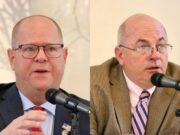























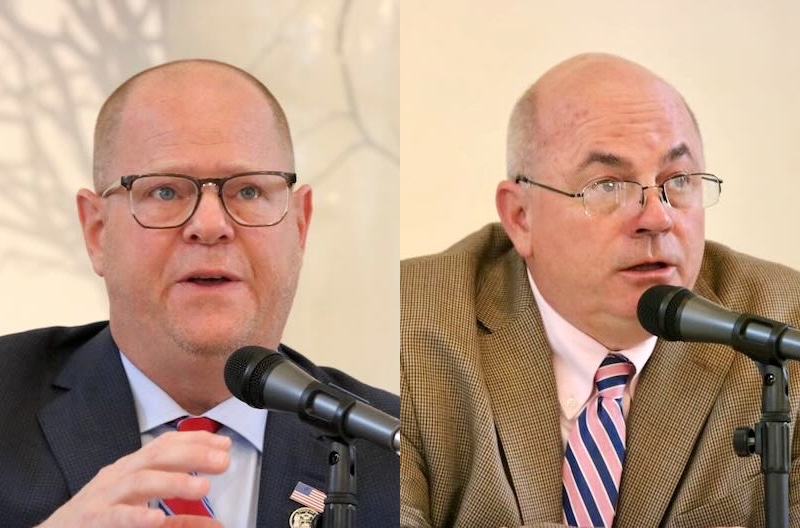
Riverhead Supervisor Jerry Halpin and Council Member Ken Rothwell both committed to preserving the 4-H property and pursuing studies to guide development in the town’s eastern hamlets, while offering different approaches to EPCAL, tax incentives and communicating the costs of major town projects at a Greater Jamesport Civic Association candidates forum.
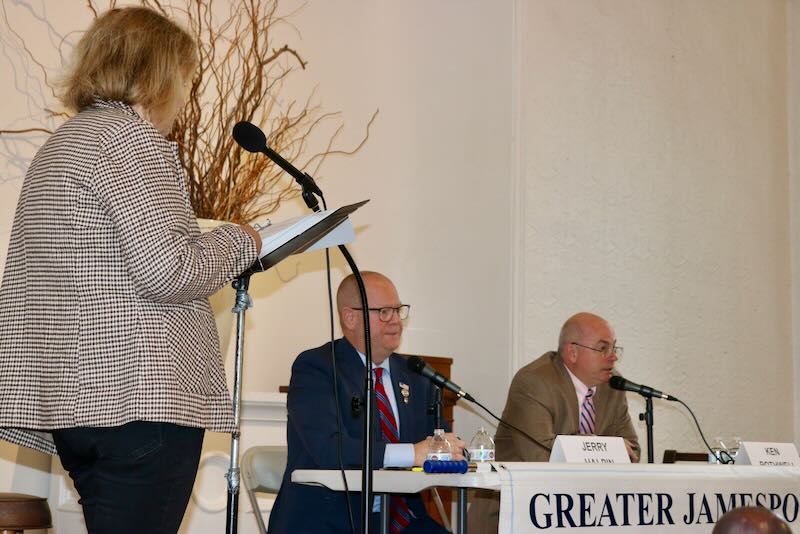
The Oct. 17 forum at the Jamesport Meeting House featured questions read by civic association Vice President Patrice Dobies, including a rapid-fire round addressing reassessment, veterans’ exemptions and other issues. Questions were submitted by civic association members and area residents.
The candidates’ responses are summarized below, with a paraphrase of each question.
Completing preservation of the 4-H property
The candidates were asked what assurance residents had that they would complete preservation of the 4-H property on Sound Avenue.
“I will definitely see it through,” Halpin said, describing continuing work toward an agreement.
Rothwell said earlier concerns involved clarifying the town’s financial responsibility and cited approximately $19 million in CPF money.
“It will get done,” he said.
Both committed to completing the preservation effort. Neither gave an acquisition timetable.
Rural character east of Route 105
The candidates were asked for their vision for land use east of Route 105 and along Sound Avenue, and how they would protect those areas’ rural character.
Rothwell supported a Jamesport hamlet study incorporated into the comprehensive plan through an amendment. He emphasized the community’s historic significance, resident participation and preservation of properties along Main Road and Sound Avenue.
“We do not want overdevelopment,” Rothwell said.
Halpin supported reviewing overlapping zoning in Jamesport for consistency with the comprehensive plan, design guidance and residents’ wishes.
“I don’t live in Jamesport. I live right west of 105, not very far, and so I know that you know your community best,” Halpin said.
He also discussed commercial-property buffers, emergency access and a year-round ambulance presence east of Route 105. Both supported a hamlet study, with Rothwell emphasizing historic character and Halpin emphasizing resident input and supporting infrastructure.
Housing and development over the next decade
The candidates were asked what kinds of housing, commercial development and tourism attractions they envisioned over the next 10 years, and where development should occur.
Halpin said Riverhead has contributed to affordable housing and continues to do so, while emphasizing that development must protect residents’ quality of life.
“Development is more than just buildings and brick and mortar,” he said.
He described a broader downtown extending through Polish Town and West Main Street, development at EPCAL and attention to traffic and aircraft noise.
Rothwell expressed opposition to additional housing complexes, arguing that residential development brings added police and school costs. He said Riverhead should not be expected to meet neighboring towns’ affordable housing needs.
“I think we do our fair share,” Rothwell said.
Both favored economic development at EPCAL. Rothwell more explicitly framed that development as an alternative to additional housing complexes.
Downtown revitalization, flooding and parking
The candidates were asked how they would address flooding, parking shortages and business closures downtown, and when the Town Square project would be completed.
Rothwell defended the Town Square project and related property acquisitions as necessary steps toward revitalization. He estimated completion was approximately two years away and discussed temporary parking during construction.
“I want to see this project through,” Rothwell said.
He also defended purchasing the former Long Island Science Center property on the west side of the Town Square, a purchase he said Halpin had opposed.
Halpin emphasized flood mitigation, police presence and support for existing businesses.
“We need to go to those businesses. We need to shop there,” he said.
He acknowledged parking shortages and construction disruption, calling for continued attention to business owners and residents. He did not give a Town Square completion date or directly address the Long Island Science Center property purchase.
Both supported continued downtown investment, with Rothwell emphasizing the construction program and Halpin emphasizing ongoing business support.
Developer compliance and enforcement
Citing compliance problems at the Summerwind project in Aquebogue, the moderator asked the candidates what regulations, safeguards and penalties they would use to ensure developers follow town requirements.
Halpin supported consistent standards and penalties, saying “it needs to be harder to ask for forgiveness than it does permission in our town.”
He praised town employees and said residents’ reports can help identify violations.
Rothwell said the developer referenced in the question had paid a $20,000 fine and signed a release the previous day. He cited two additional code enforcement officers and a $1.2 million investment in building-department technology.
“But what we also need to do is we need to invest in our building department,” he said.
Both supported stronger enforcement and departmental capacity. Rothwell emphasized proactive inspections rather than depending on neighbors to report violations. Neither proposed a detailed new penalty schedule.
EPCAL’s future
The candidates were asked how they would develop EPCAL if the town regained control of the property involved in the disputed sale.
Rothwell emphasized high-tech, high-paying jobs, including potential defense-related computer work. He also suggested pairing recreational facilities with medical services such as orthopedics and physical therapy.
“We’re not going to spend millions of taxpayer dollars to bring in a rail spur that doesn’t provide services to anywhere,” Rothwell said.
He opposed using EPCAL for waste transfer and emphasized limiting impacts on surrounding neighborhoods.
Halpin described discussions with New York & Atlantic Railway, advocated rail electrification and discussed shipping local agricultural products off Long Island.
“We need to create the opportunity for us to take goods off of Long Island,” he said.
He also described efforts to attract Newlab and work with Empire State Development on infrastructure that could help businesses establish operations and reduce the need for tax abatements.
Both wanted EPCAL to produce jobs and tax revenue. They differed over rail’s role and how to prepare the property for development. Neither presented a detailed financing plan.
Taxes, spending and the budget
The candidates were asked how they would stabilize taxes and identify two ways to reduce recurring expenses or increase recurring revenue without relying on additional development.
Halpin defended his proposed budget, saying it remained within the state tax cap. He cited retirement-incentive savings, debt reduction and closer attention to investment earnings and budget estimates.
“You have to work every day to maintain that budget,” he said.
He said the retirement incentive saved $819,000 this year and would produce continuing savings, while cautioning against underfunding town operations.
Rothwell defended earlier tax increases as necessary to improve police staffing and employee compensation. He said six amendments reduced the proposed increase from 2.79% to 1.79%.
“You gave our taxpayers through my amendments a 35% reduction in your tax hike,” he said.
He also advocated higher building and planning fees and continued pursuit of grants. His percentage comparison concerned a reduction in the proposed increase, rather than a reduction in existing tax bills.
Both emphasized limiting increases, with Halpin focusing on management and personnel savings and Rothwell emphasizing amendments, fees and outside funding.
Elected assessors or an appointed assessor
The candidates were asked whether they would replace Riverhead’s three-member elected Board of Assessors with a single appointed assessor.
Rothwell explicitly supported retaining the elected board. He said the members divide responsibilities and defended their work despite adverse outcomes in assessment litigation.
“So I’m very proud of the work that our assessors have done,” he said.
Halpin also praised the assessors’ expertise and emphasized working within the current structure.
“I work within that system to make sure that we’re doing the best we can for our taxpaying citizens,” he said.
He discussed residents’ ability to seek structural changes but did not clearly endorse replacing the board. Neither supported an appointed sole assessor in his response, though Rothwell’s commitment to retaining the existing structure was more explicit.
IDA effectiveness and reform
The candidates were asked whether the Riverhead Industrial Development Agency serves the town’s and taxpayers’ interests, and how they would improve it.
Halpin supported retaining a local IDA but called for changes to the rules governing incentives.
“I believe the IDA reform needs to come from the state down because they deal within the rules that they’ve been given to govern us,” he said.
He opposed including fire-district taxes in benefits, questioned apartment incentives and favored projects producing continuing industrial employment.
Rothwell defended the agency’s economic record. He said there are “a lot of misconceptions about the Riverhead IDA.”
“It does overall benefit our residents,” he said.
Rothwell cited property tax base growth and new jobs. For the IDA’s 21 pilot projects, he said, “prior to them going before the IDA, they were only paying $720,000. After those projects were completed, they were paying $2,932,000,” he said. Prior to IDA assistance those properties were responsible for creating 39 jobs, he said. After IDA assistance they are providing 1,400 jobs, Rothwell said.
He supported limits on benefit amounts and shorter incentive periods, suggesting approximately five years rather than 20.
Both supported local control. Halpin emphasized eligible projects and protecting fire district revenues; Rothwell defended the agency’s performance while proposing limits on benefits.
Public accounting for capital projects
The candidates were asked whether they would support comprehensive public presentations of major projects’ total costs, including the ice rink, Town Hall, ambulance facility and Town Square.
Rothwell disputed the suggestion that the projects had not been adequately presented, saying “all of those projects have absolutely been brought before the public.
He cited hearings, private fundraising for the rink and ambulance facility, and ambulance billing to cover remaining facility costs. He acknowledged rink operating expenses and encouraged residents to follow public proceedings.
Halpin said the town should communicate repeatedly until residents understand the information.
“And if one person feels like they haven’t heard it, we need to say it again, no matter how many times it takes,” he said.
He described regular departmental meetings and plans to strengthen public communications in 2027. He also cited $18,000 in rink revenue and more than $100,000 in electricity costs.
Both endorsed disclosure, but differed over whether existing communication was sufficient. Neither supplied a consolidated accounting of the projects’ full costs during the forum.
Accomplishments in office
The candidates were asked to identify one land-use, preservation or fiscal decision they personally initiated that produced a measurable benefit.
Halpin cited initiating a review of Community Preservation Fund debt repayment and supporting preservation opportunities.
He also described seeking a CPF transfer-tax exemption for qualifying first-time homebuyers serving in local fire districts, presenting it as a way to retain volunteers.
“Because I believe in not only preserving land but preserving the right people to live in this land,” he said.
Rothwell cited approximately $70 million in grants during his tenure, fundraising for the ambulance facility, budget amendments and a drinking-water project serving 64 homes.
“Those are the projects that you really want to look at when you’re going forward,” he said.
Their answers emphasized different periods and types of work. Halpin highlighted initiatives during his first months as supervisor, including a proposed exemption; Rothwell cited projects across his longer Town Board tenure.
Decisions they would handle differently
The candidates were asked to identify a significant decision or vote they would handle differently today and explain what they learned.
Rothwell discussed abandoning an agritourism proposal after public opposition, describing it as an example of responding to residents. He defended investments in police staffing and compensation and did not identify a specific vote he would reverse.
“And that’s what we’re supposed to do, vote according to the residents’ outreach,” he said.
Halpin initially discussed missing his daughter’s birthday, then said he should communicate his support for school resource officers more clearly.
“And I guess I need to be a little bit more vocal about that,” he said. He said he wanted the program to grow while acknowledging continuing financing discussions. Neither identified a substantive vote he would reverse.
Property-tax exemptions for fully disabled veterans
The candidates were asked whether they supported adopting a complete property-tax exemption for veterans permanently and totally disabled as a result of military service.
“Yes, yes, absolutely,” Halpin said.
He said consideration had been postponed because the assessor’s office could not attend a work session.
“I wrote the legislation, and we fully support it,” Rothwell said.
Both supported the exemption.
Townwide reassessment
The candidates were asked whether they supported townwide reassessment, with the question citing court-ordered refunds to commercial property owners who challenged their assessments.
Rothwell supported reassessment to improve fairness between residential and commercial properties, particularly development along Route 58.
“We need to make sure that those development projects are paying their fair share,” he said.
Halpin also supported reassessment, subject to funding.
“It’s making its way up the ladder, and we will be doing that hopefully by the end of 2028,” he said.
Both supported the goal. Halpin offered a conditional target; Rothwell did not give a timetable.
Protecting school taxes from IDA abatements
The candidates were asked whether they supported pending legislation to prevent IDAs from abating school-district property taxes.
Halpin reserved judgment and reiterated his support for state-level reform.
“I’d have to look closer at what exactly that legislation holds,” he said.
Rothwell supported protecting school revenues.
“I would support that the school districts be exempt from it,” he said.
Rothwell endorsed the proposal; Halpin did not take a definitive position.
Funding and implementing a hamlet study
Returning to development east of Route 105, the candidates were asked whether they would commit to funding and implementing a comprehensive hamlet study to clarify zoning and strengthen development and design guidelines.
Rothwell agreed, reiterating his support for incorporating a study into the comprehensive plan.
“There’s a lot of historic value right here in Jamesport,” he said.
Halpin also agreed and offered a timeframe, while emphasizing affordability.
“We need to do it in the next two to three years,” he said.
Both committed to a study. Rothwell did not specify when it would be undertaken.
The survival of local journalism depends on your support.
We are a small family-owned operation. You rely on us to stay informed, and we depend on you to make our work possible. Just a few dollars can help us continue to bring this important service to our community.
Support RiverheadLOCAL today.
