

















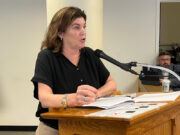


New food safety regulations may make it more difficult for smaller produce farmers to compete with the big boys, according to local farmers and the Long Island Farm Bureau.
The federal Food and Drug Administration recently extended by 120 days — to Sept. 16 — a deadline for comments on a report outlining the implementation of new federal food safety regulations, some of which could change the way local produce is grown, harvested, packed and stored.
These regulations fall within the Food Safety Modernization Act, signed into law Jan. 4, 2011 — the “most sweeping reform of our food safety laws in more than 70 years,” according to the FDA website.
The regulations outline standards and measures in farming, such as standards for agricultural water quality, spreading manure, record-keeping and developing approved food safety plans for processing facilities.
But some believe these regulations are designed to make it more difficult for independent farmers to compete with large corporate producers, as Aquebogue farmer Lyle Wells says they have begun to do, thanks to the “buy local movement.”
“Because of $5 diesel, the local movement started because it became difficult to ship produce across the country. People were encouraged to buy local and reduce their carbon footprint, so growers on the East coast were able to tap into some of the local supermarkets,” Wells said. “But the large growers on the West Coast were losing money and my major concern with the [FSMA] regulations is I think we’ve adopted something here in this country that’s based on the political agenda of larger entities. Dole and all those corporate outfits are counting on a grower my size not being able to comply.”
Joe Gergela, executive director of the Long Island Farm Bureau, despite giving credit to the FDA for visiting the area last year to field comments so legislation written would not impact small farms, agreed with Wells the legislation was “driven by big agriculture in California and other places” and could still place a large burden on some local farmers in its current form.
“It’s going to be very hard for the Lyles and a lot of the real vegetable farmers who don’t have the money to invest to meet FSMA demands,” Gergela said. “Let’s suppose everything has to be washed. That’s very time-consuming and costly because you need drainage and cesspools. The big guys know smaller farmers will have a hard time complying.”
Gergela and Brookhaven farmer Bob Nolan added they feel small farmers will end up paying for issues historically caused by larger growers.
“My feeling is that since the local market farms are not the problem, there is no reason to apply these regulations to us,” Nolan told RiverheadLOCAL. ” My fear is that small local market growers are going to get swept away by regulations for problems they didn’t create.”
The good news, Nolan said, is FSMA contains the Tester-Hagen Amendment, which provides exemptions for some local market growers.
“Growers with less than $250,000 in annual gross receipts are exempt from these regulations,” he said. “In addition, growers with less than $500,000 in annual gross receipts are eligible for partial exemptions in certain cases if their sales are within 275 miles of the farm.”
But Gergela said current income-based exemptions are too low at $500,000.
“We want the threshold higher so the small farmers truly could be exempt,” he said. “Let’s suppose Lyle Wells farmed 50 acres and his income gross exceeds $500,000, but an identical farm next door to him is making less than $500,000. Why should Lyle have to comply when it’s the same size farm? It’s not fair.”
Wells, whose family have been farming in Riverhead for centuries, said what bothers him most about FSMA’s current draft is the amount of documentation that would become necessary to get produce out the door.
“The documentation of every sanitation compliance – Whether it be testing your water, washing your hands, who does this, who does that, hair nets,” he said. “You’d think we were working in a lab.”
{loadposition tab1}
The survival of local journalism depends on your support.
We are a small family-owned operation. You rely on us to stay informed, and we depend on you to make our work possible. Just a few dollars can help us continue to bring this important service to our community.
Support RiverheadLOCAL today.
