



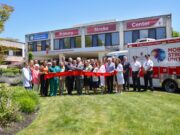

















Students, faculty, and state and local officials gathered today at the Stony Brook Southampton campus to celebrate the opening of the new Marine Sciences Center. The 15,000-square-foot, two-story building features classrooms, teaching labs, conference rooms, an outdoor wet lab and a computerized 2,500-square-foot indoor seawater lab.
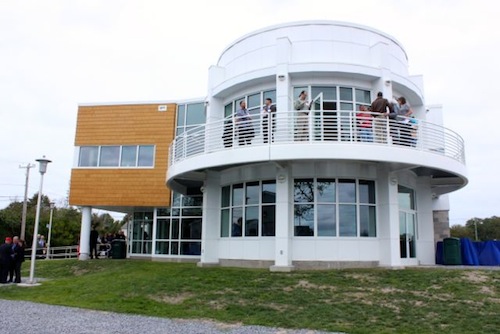 The center is part of the School of Atmospheric Sciences at the Stony Brook Southampton campus, which is the only academic institution in New York that offers undergraduate and graduate marine science degree programs.
“Every student that gets their degree in marine science in New York will be coming here to take classes, using this facility and the boats that come along with it,” said Dr. Christopher Gobler, lead researcher at the Gobler Laboratory at the Stony Brook University School of Marine and Atmospheric Sciences.
The facility will be used for courses that explore the natural flora, fauna and habitats of the East End, as well as to conduct research on climate change, nutrient pollution, and harmful algal blooms, which are especially relevant today due to the rust tide that is plaguing Peconic Bay waters.
Rust tide is a algal bloom that can be lethal to marine life, particularly shellfish. It is caused by human waste, fertilizers and other pollutants, and can kill fish within just a few hours of blooming. This summer marks the tenth year that the algae has been detected in Peconic Bay Waters.
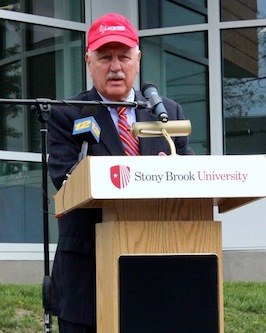 “I’m hoping that good research will happen here to help us with marine life on Long Island,” said Senator Kenneth LaValle, referencing the recent struggle with the rust tide. LaValle, along with Assemblyman Fred Thiele, secured $6.9 million in the New York State budget that was used to construct the new facility. “Marine life is a big part of our economy; we need to protect it. People want to know that they’re swimming in good water and fishing in good water.”
“This center is going to be dealing with what is probably the most important part of science today: the degradation of our waterways,” said Anna Thorne-Holst, Supervisor of Southampton Town. “This is a great addition to the town.”
The new building is part of an effort to expand the waterfront marine sciences facilities at the Southampton campus. It overlooks Old Fort Pond, a small body of water that opens up into the Shinnecock Bay.
Students will use three research vessels – the Paumonok, Peconic and the Shinnecock – to access regional waters, harbors and the Atlantic Ocean. But the central feature of the new facility – the indoor seawater lab –will allow students to study marine life in virtually every ecosystem.
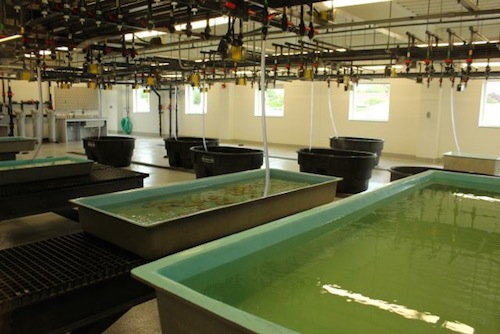 “[The seawater lab] allows us to investigate any organism in a marine environment, and in any season,” said Gobler. The seawater lab, which pulls water from the Shinnecock Bay, is able to adjust the temperature and salinity of water to mimic any marine ecosystem on the planet.
“The new marine science center will play a key role in augmenting the School of Marine and Atmospheric Sceinces’ ability to perform groundbreaking studies in a variety of issues facing Long Island and the world today,” said Samuel L. Stanley, President of Stony Brook University. “Students will get a top-of-the-line, hands-on education at the most affordable price.”
RiverheadLOCAL photos by Courtney Blasl
The survival of local journalism depends on your support.
We are a small family-owned operation. You rely on us to stay informed, and we depend on you to make our work possible. Just a few dollars can help us continue to bring this important service to our community.
Support RiverheadLOCAL today.
