


















Climate change is making adjustments to Long Island’s agricultural economy, and more are in store in the coming years and decades if current trends continue, a Cornell University scientist told Long Island Farm Bureau members last week.
“Business will no longer be as usual,” said Mike Hoffmann, director of the Cornell University Agricultural Experiment Station. Hoffmann, who grew up on a farm, said his purpose was to share information.
“When I see something, I think it’s important to say something. That’s my job,” he said.
What Hoffmann is seeing is a situation that promises global biological changes that mean major changes for Long Island and the East End’s agricultural economy, and he said it’s happening far too fast to believe it is any natural fluctuation of the planet.
“The level [of greenhouse gases] was flat until the Industrial Revolution. This year we passed 400 parts per million, whereas it was 270 to 280. The point is, it’s caused by humans,” Hoffmann said.
Natural fluctuations do exist, he said, but in the past they have always been at reasonable levels. The sun’s temperature fluctuations have an impact but it is currently in a cooling period. There is no isolated set of circumstances that explains the rapid changes occurring in all aspects of the Earth’s climate, Hoffmann said.
“We as humans haven’t ever been challenged with something like this, ever. We’re programmed to respond to immediate danger. Distance is hard to grasp, and this is too big for a lot of people to accept. And there are ideologies where people just won’t accept it,” said Hoffmann.
While he is rarely openly challenged when he gives talks on climate change, he said he tries to impress upon people that an overwhelming scientific consensus exists that necessitates action. He compared the scenario to considering several doctors’ opinions that a patient has cancer.
“If I’m hearing the same thing from a number of doctors, I’m going to do something about it,” Hoffmann said.
What it means for this region is a climate that is warming year over year, allowing insects and plant diseases that traditionally thrived in the South to push north.
 The corn earworm is one of them. It feeds on sweet corn. Hoffman said it used to show up late in the growing season, which indicated it was being carried in on storm fronts. Now it is presenting itself early in the spring, indicating that it is surviving the milder winters of recent years and breeding here.
New species of mosquitos, “vectors of human disease,” as Hoffmann said, can also be expected.
He said changing weather patterns are another symptom, though he warned attributing any single event such as Hurricane Sandy to climate change – “It may or may not have been” – is not sound science, but the ocean being eight to ten inches higher is a sure sign of a global crisis.
“Weather is short-term. Climate is trends — it’s long-term,” said Hoffmann.
Hoffmann’s message wasn’t all negative, at least not for the short-term. He said a warming climate might carry some advantages. Plant hardiness zones have moved north one position, which can lead to new crops for the area. Long Island’s access to water insulates it from the sort of problems that threaten geographic locations more inland. But prolonged heat places stress on animals and plants, making them more vulnerable to disease and other challenges.
“The next few decades will be ok for us, then not so good after that,” said Hoffmann. “By the end of the century, New York will be more or less like Georgia.”
A Marine who served in Vietnam, Hoffmann is familiar with being exposed to things most people haven’t experienced. He said he’s worked with federal intelligence officials on the topic of climate change.
“They take it quite seriously. The military is watching sea levels to see how it will effect population movement,” he said, saying that social instability and unrest are of primary concern.
Hoffmann was invited to speak by LIFB executive director Joe Gergela. Gergela said farmers could have made for a tough audience for Hoffmann’s message.
“A lot of farmers over the years have questioned climate change. They tend to have a distrust of government,” Gergela said. “I think a lot of them had their eyes opened by the data.”
He said Hoffmann’s presentation was “very well-done and very well-received,” and that the speaker was a “highly respected” researcher regarded as having a good degree of credibility.
Kevin McAllister, the Peconic Baykeeper, said he’s been seeing evidence of the kind of long-term climate change Hoffmann described for some time now. The bays and tributaries he monitors have expanded considerably since he was a child, enough so that in places he finds mature oak trees on submerged land — places they never would have been able to sprout and grow had such water saturation been present.
Short-term fixes aren’t just ineffective, McAllister said, they’re creating their own problems. Shoreline hardening is a major contributing factor, and years of stringing revetments together from neighbor to neighbor has affected water quality and does not address the threats posed by rising sea level.
“I see homeowners clearing buffers – removing natural vegetation in favor of lawn building. It’s important to minimize the erosion process and to provide a transition zone as the sea level rises,” he said. “We have to recognize that this is happening. People don’t want to hear about this, but the notion that we can keep putting structures out there to stem this is ridiculous.”
Wetlands provide an important transition zone between land and water, but when walls are built at land’s edge, wetlands erode away. McAllister said the problem is one advanced enough that “in some instances we need to retreat, but that’s a bitter pill for people to accept.”
McAllister is adamant that town government needs to grapple with a reality he said will be unforgiving as it unfolds. He said the Peconic Estuary Progra
m’s recommendations about preventing net increases in shoreline hardening have gone unheeded, and before sea level rise becomes the most imminent threat, he expects worsening pollution will wreak havoc on the East End lifestyle people are accustomed to.
“When these bays sour, it’ll be our economic lifeblood that will suffer,” he said.
McAllister blames elected officials. See “Rising sea level predictions: ‘This isn’t Chicken Little,’ says Peconic Baykeeper,” July 16, 2012.
“It’s the status quo, and the status quo is going to flatten us. Get ready people, because regular flooding like I see on Dune Road is going to be the norm,” McAllister said. “The big ocean is the most powerful force we will ever encounter, and we will lose.”
Supervisor Sean Walter said from a town perspective, there isn’t much to be done because the state Department of Environmental Conservation is the authority on waterfront issues. He said the federal and state governments stand to have the greatest impact on issues pertaining to the waterfront.
He addressed climate change with some skepticism.
“I don’t know one way or the other. There’s a natural ebb and flow for the climate. When I was in college in the ’80s all they were talking about was global cooling, now it’s global warming. So which is it? I’m not a scientist so I’m not in a position to say,” Walter said.
A recent response at the state level was a law signed October 23 by Gov. Andrew Cuomo specifying climate change as a reason towns can use Community Preservation Fund money to purchase shoreline property for preservation.
Hoffmann said it’s important for ordinary people to become informed as much as possible and share their knowledge.
“A social movement is needed where enough people understand what’s happening so we can affect policy, and be better local and global citizens. I use this quote: ‘To live is to roll up your sleeves and embrace trouble.’ That’s from Zorba the Greek. I connect that to climate change,” said Hoffmann.
“We will be judged by our children.”
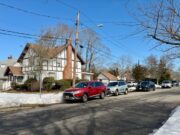
Photo caption, above: Downtown Riverhead before the arrival of SuperStorm Sandy last October. RiverheadLOCAL file photo by Emil Breitenbach Jr.
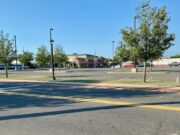
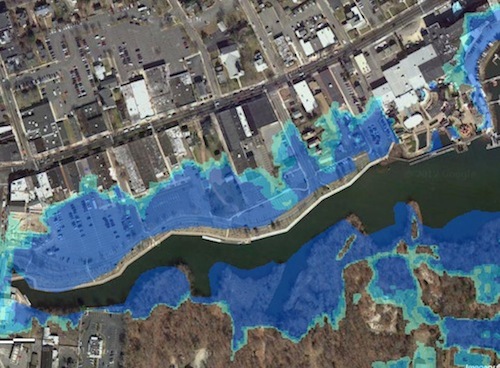
Photo caption, below: The entire parking lot on the south side of East Main Street will likely be under water 70 years from now, as will much of the town’s coastline along the river and bay, according to a coastal resiliency mapping tool developed by The Nature Conservancy using USGS forecasts.
The survival of local journalism depends on your support.
We are a small family-owned operation. You rely on us to stay informed, and we depend on you to make our work possible. Just a few dollars can help us continue to bring this important service to our community.
Support RiverheadLOCAL today.
