















He saved 36 plane crash victims when he plucked them from the freezing waters of Flushing Bay after their airliner crashed on its way in to LaGuardia.
He fought in one of the most dangerous front-line regiments of the U.S. Navy during World War II, invading island after island in the Pacific to construct temporary runways and bridges, all while under constant fire from the enemy.
He is, by anyone’s definition, a hero – but you might not know it when you first meet him.
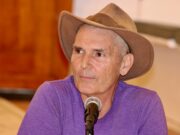
Wally Smith lives alone in a mobile home in Glenwood Village, a senior community off Mill Road in Riverhead. He turned 88 last month, but he goes to the gym twice a week and keeps his tiny home completely pristine – a responsibility that is now all his own since his wife passed away in 2012.
“She would be proud of me,” he says. “I keep it so clean in here, people ask me if I can clean their house for them!”
It was Lucille, his late wife of 60 years, who decorated the sitting room at the front of the house with framed photographs and medals from Smith’s time in the Navy.
His eyes light up as he looks over each one, listing names of faraway places – Korea, Japan, London.

It was 1943, and Smith’s dream was to fight in the war. Both of his older brothers were fighting in the Army, and Smith didn’t want to wait any longer.
But he was only 16 years old, and the Navy did not accept recruits younger than 17. With the help of his parents, he forged his birth certificate so that he could enlist a year early.
“I wanted to get in in the worst way,” he says.

He got his wish. In just a few months, Smith was on the front lines of the war on the Japanese islands, fighting with the Seabees – a special Navy construction regiment that fought its way through heavy gunfire to build military structures on the islands.
Smith was unfazed. “I was just a kid,” he says. “It was like cops and robbers to me.”
He befriended a fellow soldier, Harry Trotter, whose father owned a candy store in Brooklyn. Harry had grown up not too far from Smith’s hometown in College Point, and they became fast friends. “We always stuck together.”
Except for the day they didn’t.
When they came ashore on Saipan Island, they found themselves surrounded by enemy fire. As they ran up the beach, Smith went one way and Harry went another. When Smith looked to see where his friend had gone, he turned around just in time to see a grenade land in the sand right next to Harry, some distance away.
He watched as Harry picked up the grenade to throw it – and he watched as it exploded, taking his friend’s head with it.
“I looked down at him and said, ‘I’m sorry, Harry, but I’m glad it’s not me,’” Smith says today, more than 70 years later. “That’s all you could say to yourself. ‘I’m glad it’s not me.’”

Despite the violence and loss all around him, Smith wanted to stay on the ground, where the action was. Buoyed by a youthful sense of immortality, Smith regularly volunteered for dangerous missions, recalling how he once allowed another soldier to lower him by the ankles in front of the mouth of a cave so that he could toss two hand grenades inside, where Japanese soldiers had camped out for the night.
“If you asked me to do that today, I’d say, ‘What are you, crazy?’” Smith laughs.
When at the end of World War II he was sent to London to serve as a Navy photographer, he was taken aback. “They told me, ‘We’re going to give you a good job because you’re the only one with war experience,’” he says. “They thought they were doing me a favor.”
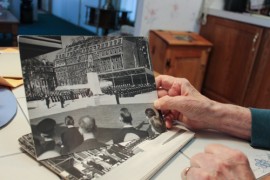 Smith at the time knew nothing about photography, which in 1946 was a great deal more complex than taking pictures with a digital camera today. “I have no idea why they picked me.”
But it was behind a camera that Smith would make his true mark in the Navy, photographing everything from dramatic helicopter rescues in the Korean jungle to the aftermath of the atomic bombings of the Japanese cities of Hiroshima and Nagasaki.
He taught himself how to take pictures in London, where he spent three years shadowing a four-star admiral, photographing everything he did.
The admiral’s frequent encounters with huge historical figures like Winston Churchill and Eleanor Roosevelt meant that Smith was often photographing the very people who were shaping world history. During one ceremony, Eleanor Roosevelt even introduced Smith personally to King George VI, who shook Smith’s hand.

“You’re not supposed to touch royalty, but he stuck his hand out, so I shook it,” Smith says today. “I didn’t wash my hand for two years!”
Once the Korean War started in 1950, Smith was shipped off to an aircraft carrier in Korean waters, where he was one of a handful photographers tasked with documenting special missions and photographing any aircrafts that landed and took off from the carrier.
There were many astounding pictures of fiery crashes during that time. But it was the pilot who didn’t crash that would make for the most astounding photograph of all.

Frank Soberski, a 23-year-old battle pilot, was flying over the Korean Coast when anti-aircraft fire struck the canopy of his single-seat plane. The impact knocked Soberski unconscious, and when he came to, he could no longer see. The plane’s canopy had exploded open, the plane was still hurtling through the sky at 200 miles per hour, and Soberski was covered in blood.
Miraculously, fellow pilot Pat Murphy heard his friend’s call for help through his radio. Bringing his plane alongside Soberski’s, Murphy instructed his friend to bail out into the ocean below. But with the water’s temperature hovering just above freezing, plunging into the ocean would mean almost certain death for the wounded pilot.
The only way Soberski would make it out alive was if he could land his plane – completely blind.
So Murphy lent him his eyesight instead. Speaking calmly over his radio, Murphy mapped out the skies for Soberski, flying alongside him the entire way.
Back on the U.S.S. Princeton aircraft carrier, Smith was on deck when the call came in.
“We got word that a pilot was making a blind landing,” he remembers today. “I had to stay as the photographer, but they cleared as many people as they could off the deck, in case he crashed.”
But Soberski didn’t crash. With Murphy’s instructions directing him in his earpiece, the blind pilot guided his damaged plane safely to the carrier.
Soberski would eventually regain his vision in both eyes. Later on, Smith made a large print of the photograph he took that day and sent it, framed, to the pilot.
“He was thrilled,” Smith says.
It wasn’t until after the Navy, however, that Smith found himself starring in a heroic episode all of his own – and saving the lives of three dozen people in the process.

On the day of the plane crash, a thick fog had settled over Flushing Bay. The water was so still, there was not a single ripple – a stark contrast from the brutal January winds of the day before, when Smith had needed a blow torch to open the frozen doors of the barge where he worked.
Smith, now 24, had found a career at a company that manufactured sonar equipment for the Navy. It was his job to ferry engineers back and forth from the company’s plant to a barge, where they would lower the sonar equipment underwater for testing.
On that still, January morning in 1952, Smith had just been untying the lines on his boat when he heard an airplane flying overhead. College Point is right outside LaGuardia Airport, so the sound was not uncommon – but something was wrong this time. The plane was too low. It was headed right for the water.
Smith watched as the airliner crashed right into Flushing Bay.
Perhaps it was his constant exposure to plane crashes as a Navy photographer that enabled him to act so quickly. Smith dashed up the dock and got the attention of the two engineers he had been tasked with transporting that day. “Get in the damn boat!” he remembers yelling. “There’s a plane in the water out there!”
When Smith and the engineers got to the plane, they could see passengers scrambling to exit the plane through its hatchway, spilling out into the bay. People were clutching to the plane’s side, which was rapidly sinking beneath the freezing water. Smith guided his boat onto the plane wing so that it wouldn’t float away and together, the three men began picking people up out of the water.
“It was freezing,” Smith says.
When everyone was out of the bay, Smith grabbed an ax from his boat and urged the pilot and co-pilot to follow him. Climbing on top of the sinking plane, he chopped a hole in its fuselage with the ax.
In a scene reminiscent of his days in World War II, when his fellow soldiers would lower him by the ankles to hurl grenades into Japanese caves, Smith had the other two men grab hold of his legs and lower him inside.
“I wanted to see if anyone was trapped in there,” Smith says. “But there was nothing. I didn’t see a thing.”
That’s because Smith and the two engineers had rescued every single person on the plane. Thirty-six people, including the plane’s pilot and crew, were saved that day, thanks to Smith’s quick thinking and bravery.
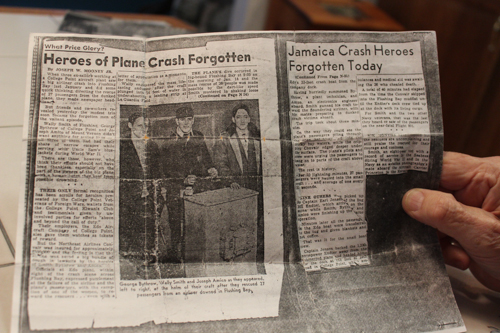
Although he’s approaching 90, Smith still speaks about the memories, many decades old now, with great animation and vigor. As he thumbs through the stacks of photographs, sitting in his fastidiously tidy kitchen, he seems to understand how fantastical many of his stories are, himself astonished at all of the things he’s lived through.
“Isn’t that something?” he says, again and again, as he pulls out another picture.
Though Smith lives alone, he is visited every day by his children, who bring him dinner (“I clean, but I don’t cook,” he says, laughing). His walls are covered in photos of his late wife, who he first met working at the sonar equipment company, and their children and grandchildren. In spite of the magnificent things he’s seen and experienced while serving in the Navy, Smith talks about his family with just as much wonder and awe as his memories from the war.
“I’d say I’ve lived a pretty full life,” he says, smiling.

Editor’s Note: This story has been amended since its initial publication to correct an error in the name of the pilot who landed blind aboard the Valley Forge, whom Wally Smith photographed. It was Frank Soberski, not Kenneth Schechter. RiverheadLOCAl regrets the error.
The survival of local journalism depends on your support.
We are a small family-owned operation. You rely on us to stay informed, and we depend on you to make our work possible. Just a few dollars can help us continue to bring this important service to our community.
Support RiverheadLOCAL today.
