












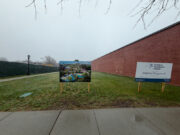














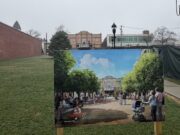

A Sound Avenue farm dating back to about 1873 has been added to the state and national registers of historic places.
The Harrison Downs house (c. 1874) and farm was one of 19 sites added to the registers, Gov. Andrew Cuomo announced last week.
The 34-acre farm, which has been in the has been in the Downs-Wines family since 1873, is now owned by David and Elizabeth Wines. David and his son Christopher are the fifth and sixth generations of the family to live on and operate the farm, according to the historic register nomination document filed with the state.
The farm’s has been named “Ty Llwyd” (pronounced “teek-klu’-id), which is Welsh for “brown house.” David’s wife Elizabeth is the daughter of Welsh dairy farmers.
When Harrison Downs built the Italianate home, its design was considered unusual in the Sound Avenue farming community, but reflected Harrison Downs’s exposure to contemporary styles in New York City, according to the nomination.
“The interior has 10-foot ceilings — probably considered stylish by Harrison Downs, but considered wildly impractical by Mary Downs forty years later. No other farmhouses like it were built in the community. Indeed, most local farm families continued to build the vernacular two-story side-hall house that had become common in the area earlier in the 19th century, although sometimes with a a little Italianate ornamentation and always with lower, more practical ceiling heights,” the nomination states.
The nomination was prepared by the owner’s brother, Richard Wines, a local historian and chairman of the Riverhead Landmarks Commission.
Out-buildings on the farm include a three-seater outhouse (now used to store chicken feed) built in 1862 that originally stood behind the George Mitchell Terry House on Sound Avenue where David Wines grew up. It was moved to its current location in the mid-1970s. Another building on the farm was originally part of a horse stable built at the World War I army training facility, Camp Upton circa 1917.

Listing in the state and national registers can assist property owners in revitalizing buildings, making them eligible for various public preservation programs and services, such as matching state grants and state and federal historic rehabilitation tax credits, the governor noted in his announcement. Spurred by the state and federal historic rehabilitation commercial tax credits administered by the State Historic Preservation Office, developers invested $550 million statewide in 2015 to revitalize properties listed on the National Register of Historic Places, while homeowners using the New York State Historic Homeowner Rehabilitation Tax Credit invested more than $12 million statewide on home improvements to help revitalize historic neighborhoods, Cuomo said.
The survival of local journalism depends on your support.
We are a small family-owned operation. You rely on us to stay informed, and we depend on you to make our work possible. Just a few dollars can help us continue to bring this important service to our community.
Support RiverheadLOCAL today.
