



















Dozens packed out the Riverhead Free Library conference room Monday night to attend a reception celebrating African-American culture and history as well as check out a special exhibit honoring local African-American ‘ancestors.’
The African-American Educational and Cultural Festival — a nonprofit organization that “honors, embraces, celebrates and pays tribute to African-American culture and its history by promoting diversity, multiculturalism and unity” — organized the reception and exhibit in partnership with the Riverhead library, and the Friends of the Riverhead Free Library.
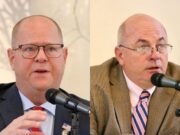
Riverhead Town Supervisor Laura Jens-Smith and town councilwoman Catherine Kent, the AAECF town liaison, attended the reception and presented the group with a proclamation honoring Black History Month and the contribution of the black community to the town of Riverhead. Black History Month is a month-long national celebration that starts on Feb. 1 and ends on Feb. 28.
“To be able to celebrate African-American culture and history as a community is very important,” Jens-Smith said. “It’s events like these that bring people together that really, truly show who we are, one community, all connected and all intertwined together.”
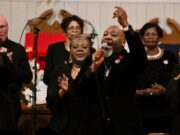
The event also featured performances from local community members, to the delight of the audience, who cheered and clapped through the evening. There were several poetry readings that reflected on the African-American experience and identity, such as a poem by Sarah Bullock, “What reason was I born to be?” an emotional liturgical dance ministry performance called “Necessary” by Friendship Baptist church member Gloria Moore, and a lively African drum and beaded gourd presentation by Edwina Lee Tyler.
The Black History Month exhibit, on display since early February, is entitled “Honoring the past, inspiring the future” and features black-and-white portraits of several local families — such as the Hatcher, Anderson, Bell, Gray and James families — people who migrated from the South to Riverhead at the turn of the 20th century and their descendants.
The portraits, taken in 1986 and 1987, are a part of the Black History and Folk Life Project by acclaimed photographer Toba Tucker.
The display also featured art from AAECF artist-in-residence Tonia Williams, informational posters about prominent African-Americans like abolitionist and women’s rights activist Sojourner Truth and author and abolitionist Frederick Douglass, as well as a wide-raging selection of items such as books, African clothing, local African-American veterans memorials, photographs and more. All items were community donations, AAECF president Marylin Banks-Winter said.
Professor James Banks, a Suffolk County Community College coordinator of multicultural affairs and AAECF co-chair, was the evening’s master of ceremonies, starting the event with an impassioned speech that reflected on the African-American experience and touched on issues like slavery, and the subsequent decades of discrimination and oppression, as well as talking about what he called “post slavery stress disorder.” He also made several references about family separation at the southern border, saying it “was not acceptable.”
“Too many of the current initiatives around the country feel like, look like, and even smell like discrimination again,” he said.
He said that “the time for social justice was now” and urged elected officials and leaders to make America “truly great for all of us, not only some of us.” He ended his remarks in a hopeful note, talking about the values of America like freedom and equality and highlighting the diversity and unity of the audience.
Other speakers included educator Lawrence Street, the Rev. Mary Cooper of the House of Praise Christian Revival Center, who provided a special invocation, library director Kerrie McMullen-Smith and library board president Louise Wilkinson.
The evening concluded with a speech from Banks-Winter. She highlighted the contribution of national and local African-Americans from a historical perspective and how those contributions have impacted the Riverhead African American community of today.
Banks-Winter talked about her sister, Maryeta Cooper Booker of Riverhead, who has roots from the Bell family and whose photo is on display, as an example of someone local who is a “beacon of law, light and hope.” Booker had always dreamed of practicing law before the Supreme Court since she was a child, a position that is considered highly prestigious in law practice, and after much perseverance, she finally achieved this goal in 2018, Banks-Winter said.
“This exhibit shows the history of a progressive and proud community,” Banks-Winter said. “It shows the powerful, deep and lasting contributions to the African American story, American history, which is our history,” she said.
This is the second year that AAECF partnered with the library to showcase African-American culture and contributions through an exhibit during Black History Month, and the first time that a reception has been held at the library.
The first African-American Festival was held outdoors in 2003. The next festival is scheduled for July of 2020, Banks-Winter said.
RiverheadLOCAL photos by Maria Piedrabuena


The survival of local journalism depends on your support.
We are a small family-owned operation. You rely on us to stay informed, and we depend on you to make our work possible. Just a few dollars can help us continue to bring this important service to our community.
Support RiverheadLOCAL today.
