
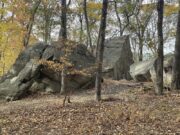






















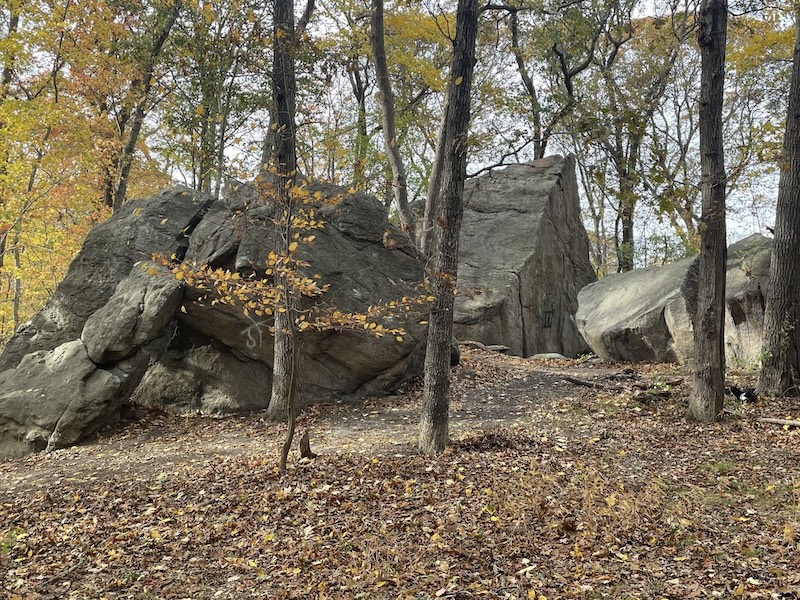
Deep in the woods surrounding the former Shoreham Nuclear Power Plant, a massive formation of glacial boulders holds a history far older than the abandoned reactor, the fight over its opening or the decades-long effort to preserve the forest around it.
Known as Split Rock, the formation consists of gneiss, a rock with mica and what naturalist John Turner describes as “this beautiful purple and gray flecking” in it. A geologist he consulted estimated the rock itself to be about 450 million years old, Turner said. Much later, a glacier plucked the rock from beneath what is now Long Island Sound and carried it to the site.
For Harry Wallace, former chief of the Unkechaug Nation of the Poospatuck Territory, the formation’s significance goes beyond its geology. It is part of a sacred landscape where Indigenous people practiced spiritual ceremonies for thousands of years, he said.
Wallace described it as “one of the most sacred and precious sites on Long Island.”
“That rock formation is more than just a rock formation, it was a spiritual formation that we use in our ceremony. There are a number of them on Long Island, but this is one of the biggest and one of the oldest of all the sites that exist,” Wallace said.
The forest, shoreline and wetlands surrounding the former nuclear plant are now publicly owned, following New York State’s $28.25 million purchase of nearly 750 acres from National Grid. Gov. Kathy Hochul announced the acquisition Oct. 15, calling it the largest Long Island land purchase in the history of the state Department of Environmental Conservation.
For local residents and conservationists who spent years seeking its preservation, the purchase secures a rare stretch of undeveloped North Shore coastline and creates an opportunity for public access. For Wallace and others concerned about Split Rock, it also raises a question: How will the land’s new stewards protect its spiritual and cultural importance?
Sid Bail, president of the Wading River Civic Association, said the response to the purchase on the association’s Facebook page had been enthusiastic.
“It’s not only good for our community. I think it’s good for Long Island in general,” Bail said in a phone interview Monday. “It’s a beautiful piece of property, and it took a long time to preserve it.”
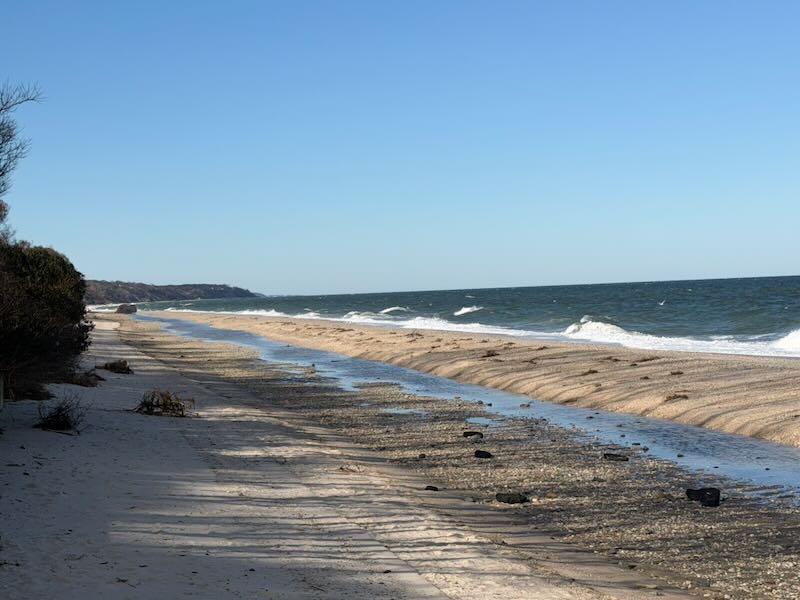
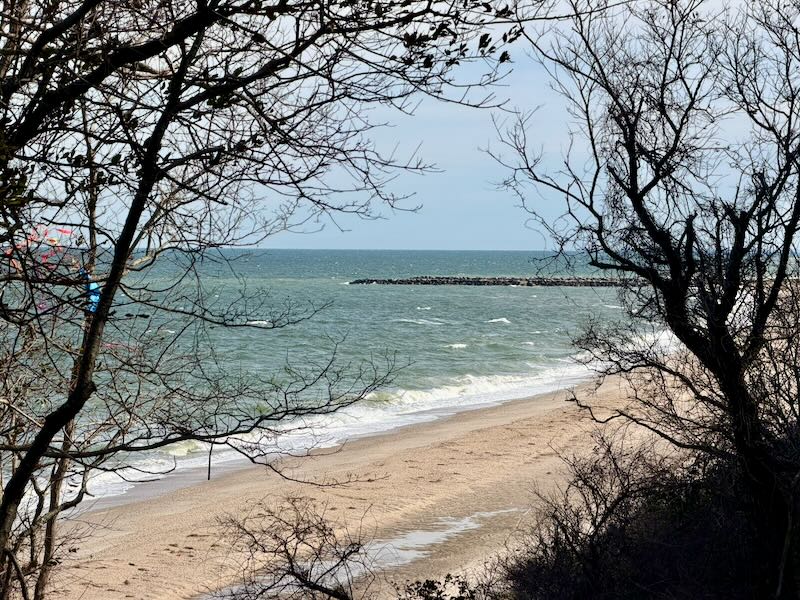
The property spans Shoreham and Wading River, encompassing nearly a mile of sand and gravel beaches, bluffs rising 100 feet, coastal forests, rare pine barrens and more than 40 acres of tidal marshes and shrub swamps. According to the state, it provides habitat for ospreys, endangered piping plovers and rare native plants, while helping protect Long Island’s sole-source aquifer.
Turner, a co-founder, past president and longtime board member of the Long Island Pine Barrens Society, said naturalists had recognized the land’s importance for decades. Serious efforts to bring it into public ownership had been underway for at least 20 years, he estimated.
Along the way, the forest faced another proposed energy use: a large solar farm.
Bail said he supports renewable energy but believed clearing the forest would have exacted too high a price. Turner said the project would have required extensive tree removal, excavation and grading of the steeply sloped terrain.
“It would have been devastating,” Turner said.
Both Turner and Bail credited longtime Pine Barrens Executive Director Richard Amper with playing a central role in the preservation effort. “Dick did what he had to do,” Turner said. “He did break some eggs, as they say, making his omelet.” He and others “worked behind the scenes,” he said, to get support for preservation from the Brookhaven Town Board. “And one thing led to another, and it got included to the [Pine Barrens] core, and Cuomo signed the bill,” Turner said. That eliminated the development threat but it didn’t address the issue of public access, which the state acquisition addresses.
State legislation enacted in 2018 expanded the Central Pine Barrens to include the environmentally sensitive Shoreham land.
Bail cited support from then-state Sen. Kenneth LaValle and then-Assembly Member Steve Englebright along with National Grid’s willingness to negotiate a sale.
DEC plans to install public parking and marked trails in the coming years. The state’s announcement also envisions beach access and accessible multi-use trails, though it did not specify when those improvements would be completed.
For Jane Alcorn, president of the Wading River Historical Society, the landscape connects two preservation struggles separated by decades.
A Wading River resident, Alcorn helped organize opposition to opening the Shoreham nuclear plant. She recalled that opposition could be lonely within the community, where the plant’s substantial tax payments weighed heavily in the debate.
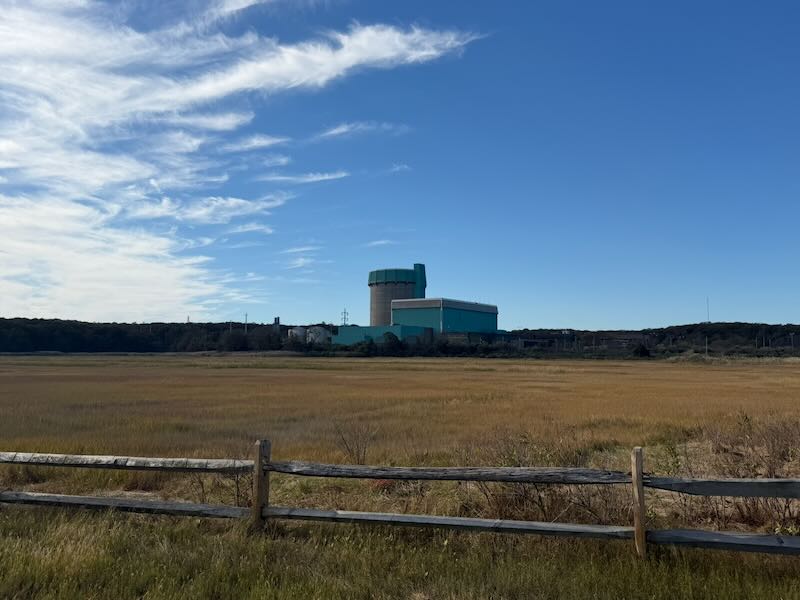
Built by the Long Island Lighting Company, the reactor underwent low-power testing but never entered commercial operation following years of community and government opposition. A state comptroller’s study documents the testing and the plant’s subsequent decommissioning.
Years later, Alcorn’s interest in the surrounding woods brought her to Split Rock. She said she immediately believed the immense formation would have held spiritual significance for Indigenous people.
This May, she accompanied Wallace and others on a visit to the site. Wallace subsequently spoke about sacred stones and sites at an August historical society program attended by about 120 people, Alcorn said.
Since then, she and Wallace have been pursuing ways to protect the formation and educate the community about its significance. Alcorn said people had painted the stones and that there was evidence of small fires among them.
She likened protecting the site to safeguarding a church, synagogue or mosque, explaining that “for the indigenous people, that is their church.”
Wallace said construction of the nuclear plant was “total desecration” of the sacred landscape. “If you look at the monument, if you look at the stone structure, and you look straight out into the water, you see this big blue building, which is the power plant, directly in front of you. And anything that was excavated from [the site] was just destroyed,” Wallace said.
He cautioned that a change in ownership alone would not ensure its protection: Visitors could also cause damage by disturbing the site or removing items. He said he is concerned about the still-unidentified potential recreational uses of the site.
“That’s why we’re concerned, and we’re still concerned,” he said.
Wallace also pointed to the energy uses continuing alongside the preserved acreage. The former nuclear plant and existing generating facilities occupy the developed eastern portion of the larger property, adjacent to the woodlands. A 50-megawatt battery energy storage facility is planned on LIPA-owned land near the former nuclear plant site.
LIPA approved a long-term contract with developer Key Capture Energy in December 2024. At that time, the authority said the battery facility was expected to be completed by 2028. LIPA’s project announcement identifies the site as a portion of the former nuclear plant property.
Alcorn said she and Wallace intended to continue discussions with DEC about safeguarding Split Rock.
For Wallace, understanding the place is essential to deciding how to care for it.
“It’s more than just preservation of a site, more than just environmental; it’s spiritual.”
The survival of local journalism depends on your support.
We are a small family-owned operation. You rely on us to stay informed, and we depend on you to make our work possible. Just a few dollars can help us continue to bring this important service to our community.
Support RiverheadLOCAL today.
