
























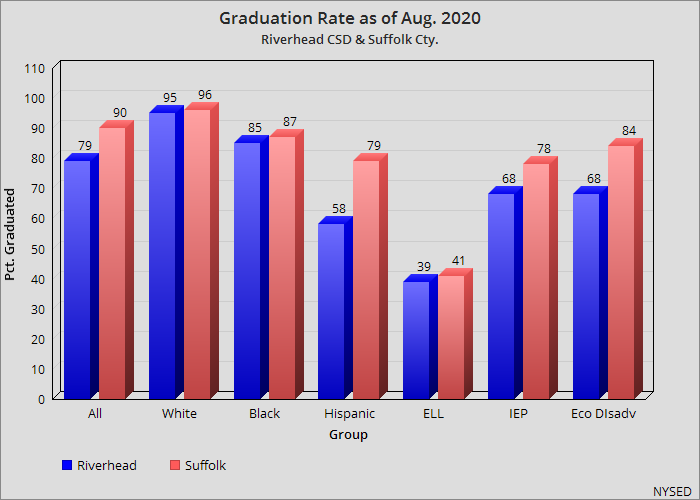
Riverhead High School’s graduation rate dropped to 79% in 2020, down from 82% in 2019 and 84% in 2018. Riverhead’s overall graduation rate remains well below Suffolk County’s 90% graduation rate and below the state average of 85%.
But the overall graduation rate does not tell the whole story, as school district administration officials demonstrated during a presentation at Tuesday night’s board of education meeting.
A deeper dive into the data released this month by the State Education Department discloses other factors that strongly influence the outcome: English language proficiency, IEP status (students with an individualized education program) and years enrolled in the school district are at the top of the list, followed by ethnicity and race.

There were 566 students in the high school’s 2016 cohort— students who entered ninth grade in 2016, who would be expected to graduate in 2020. That was up from 451 in the high school’s 2015 cohort.
White students had the best graduation outcomes. Ninety-five percent of the 213 white students in the cohort graduated as of August 2020, and nearly all graduated with Regents diplomas— 57% graduated with advanced Regents diplomas. One student dropped out and nine remained enrolled after August 2020.
The 2016 cohort’s 73 Black or African American students had an 85% graduation rate, up from 76% in the 2015 cohort. But only 16% earned advanced Regents diplomas and 62% earned Regents diplomas. Five students remained enrolled after August 2020 and five students dropped out.
There were 269 Hispanic or Latino students in the 2016 cohort, the largest ethnic/racial subgroup. Only 58% of this group graduated as of August 2020. Sixty-seven dropped out, while 46 remained enrolled beyond their fourth year. Just 14% earned advanced Regents diplomas, and another 37% earned Regents diplomas.

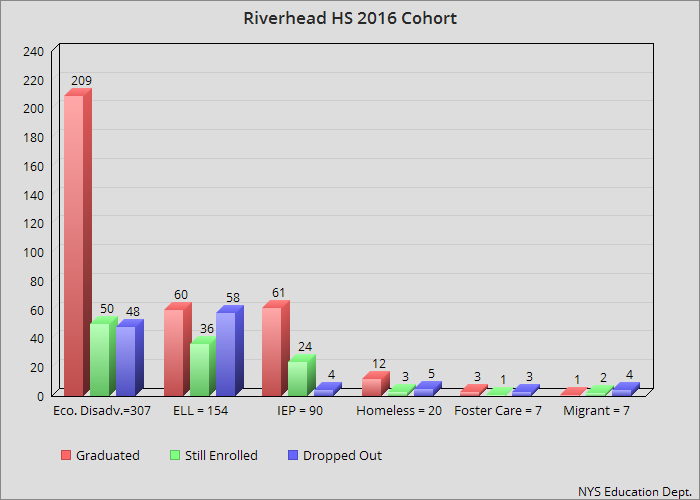
A student’s proficiency in the English language is a major predictor of graduation outcome. Students with English language proficiency had a 92% graduation rate, while the rate for students classified as ELL (English Language Learners) had 39% graduation rate. Among ELL students in the 2016 cohort, 58 (38%) dropped out. Thirty-six remained enrolled beyond their fourth year.
The data shows a strong correlation between poverty and graduation outcomes. Students classified as economically disadvantaged comprised 54.3% of the 2016 cohort. Among those 307 students, 209 (68%) graduated as of August 2020, 48 dropped out and 50 remained enrolled. Forty-three percent of those who graduated earned Regents diplomas, with 17% earning advanced Regents
There were 90 students with disabilities in the 2016 cohort. Sixty-eight percent of those students graduated as of August 2020, with 43% earning Regents diplomas, 2% earning advanced Regents diplomas and 22% earning local diplomas. Twenty-seven percent remained enrolled beyond August 2020 and 4% dropped out.
Riverhead High School principal Sean O’Hara discussed the newest data to the school board Tuesday night.
“It would be an understatement to say that this is not where we want to be,” O’Hara said of the 79% graduation rate. However, he said, “it’s important to acknowledge the improvement in some of our subgroups.”
Riverhead’s graduation rates for subgroups of the 2016 cohort were higher than the state for five subgroups (Black, White, ENL, not-ENL and IEP) and the same as or higher than both the state and the county in three subgroups (Black, White, ENL).
“We know there is work to do and we have already begun our next level of work,” O’Hara said.
District officials have been analyzing the high school’s dropout data, he said. Of the 70 students in the 2016 cohort who dropped out, 56 left before their fourth year of high school (2019-2020), he said: 15 students dropped out in their first year (2016-2017), 26 dropped out in their second year, 15 dropped out in their third year.
This is improving so far for the 2017 cohort: eight dropped out in their first year (versus 15 first-year dropouts in the 2016 cohort); eight left in their second year (versus 26 second-year dropouts in the 2016 cohort; and 16 left in their third year (versus 15 in the 2016 cohort) — for a total of 32 students so far in the 2017 cohort.
An analysis shows a strong correlation between the leaving early and how long a student is in the district, O’Hara said.
Of the 70 dropouts in the 2016 cohort, 47 (67%) were in the district less than two years — 28 of those students (40%) were in the district less than one year.
Only six students who left early (8.6%) were in the district longer than three years, he said.
The remainder — 17 students — were in the district between two and three years.
“This year and moving forward,” O’Hara said, “we need to identify those at risk for not finishing on time sooner. We must make an effort to re-engage them and develop a program for support,” he said.
“Make no mistake. Our high school administrative team is not just looking to improve the overall graduation rate. We are committed to crushing it,” O’Hara said. “And our ultimate goal is to be recognized among top schools in New York State.”
He described programs in place to identify and support at-risk students, including support teams, programs for connecting with and engaging parents or guardians, repeater courses, credit recovery for seniors, and a program specifically aimed at students who require more intensive support, as well as home visits for students with excessive absences, after all means of communication have been exhausted.
The 2019-2020 initiatives included a reboot of the school’s business program, featuring half-year courses, a work-study program and a business advisory board made up of community business owners, O’Hara said.
Parent involvement in any form can have a positive impact on student achievement, the principal said. The high school parent-admin connection, or PAC, provides a platform for parents to engage in roundtable type discussions. Now in its second year, the PAC meetings have seen an increase in attendance, possibly as a result of the virtual format.
The school is in the process of expanding the re-engagement task force to include teachers, he said. One goal is to create an early warning system to sooner identify students at risk of exiting early or not meeting graduation requirements on time.
We re in communication with Ms Tona regarding the creation of an alternative program using existing resources,” The hope is to offer an academy or an alternative program that will help re-engage and support students whoa re airsick of exiting early, not completeing on time or who may have difficulty being successful in a traditional high school mode.
Denise Stevenson, the district’s director of ENL and world languages for grades 5-12, discussed programs aimed at ELL students, who often need extra time to graduate due to lack of English proficiency.
“Research shows it takes five to seven years to attain fluency in a language,” Stevenson said. Some students are starting 9th grade with little or no English.
Others are students with interrupted or inconsistent formal education. They may enter school mid-year and miss a portion of the curriculum. Or, they may have been attending school but have low literacy due to inadequate educational systems in their native country, she said. Students with interrupted or inconsistent formal education are at high risk to drop out, Stevenson said.
Many ELL dropouts are starting high school as older students. Students who enter ninth grade at 16, 17 or 18 years old are more likely to drop out, Stevenson said, usually so they can work full-time.
Stevenson said the district is in its second year of a transitional bilingual program, which starts in Spanish and transitions to English.
“We believe it will increase our future ENL graduation rates,” she said.
The survival of local journalism depends on your support.
We are a small family-owned operation. You rely on us to stay informed, and we depend on you to make our work possible. Just a few dollars can help us continue to bring this important service to our community.
Support RiverheadLOCAL today.
