

























Residents again pushed back on plans for a 7-Eleven gas station and convenience store at a long-blighted property on the Riverside traffic circle, asking the Southampton Zoning Board of Appeals to reject the application during a virtual public hearing Thursday night.
The property owner is seeking an interpretation from the Southampton Zoning Board of Appeals that a proposed 3,024-square-foot convenience store is a customary accessory use to a gasoline filling station and multiple variances to accommodate its proposed development on the irregularly shaped, approximately one-acre site. The matter came before the ZBA for a hearing on Thursday night.
The proposal includes, besides the convenience store, a six-pump, 12-station fueling facility with canopy, and 30 parking spaces.
Title to the property has been in the same family for decades, according to online deed records. It is currently owned by 9-11 Flanders Road, a limited liability company based in Lynbrook. It was previously developed with a gasoline service station which has been been vacant for many years.
The ZBA held a virtual hearing on the application Thursday but took no action pending compliance with the State Environmental Quality Review Act. ZBA members rejected the argument advanced by the applicant’s planning consultant, Jefferson Murphree, that the action is a “type II” action for purposes of SEQRA review and instead agreed the action is an unlisted action, requiring coordinated review. Designation as a “type II” action guarantees a negative declaration — meaning the proposed action will not have any significant adverse impacts — and dispenses with further in-depth SEQRA review of the proposal.
An unlisted action, on the other hand, could receive a negative declaration or a positive declaration — meaning the proposed action will have significant adverse impacts that require mitigation measures. If an action receives a positive declaration, an environmental impact statement is required.
The planning board held a presubmission conference with the applicant in March and indicated the plan would be considered a “type II” action and the planning board would seek lead agency status for the review.
The ZBA cannot rule on the variance requests until after SEQRA is completed, so it adjourned the hearing o March 17, to allow coordinated review to take place.
The site lies within the Highway Business zone, in which a gas station is a permitted use. A convenience store is not a permitted use in the HB district, so the applicant is seeking an interpretation that at the convenience store use is a customary accessory use to a gas station.
“The use is not a 7-Eleven,” Murphree said. “This is a use for a gasoline service station.” He cited the 3,024-square-foot size of the proposed convenience store to show that it is an accessory use, not a principal use.
According to a the convenience store trade publication CSP Daily the average size of a 7-Eleven convenience store is 2,500-4,000 square feet. The newly constructed 7-Eleven store on West Main Street near Osborn Avenue and opened last April, is a 3,062-foot building. A recently developed 7-Eleven convenience store on Route 58 in Riverhead is 2,667 square feet. The convenience store is a permitted use in that zone and has a gas station as an accessory use.
The Flanders Road site is also within the Riverside Overlay District. The overlay district allows for a variety of uses, including high-density residential development, that are not allowed in the HB district. The overlay district, enacted in December 2015, implemented the Riverside Revitalization Plan, which was developed for Riverside by Southampton Town over a period of years. The overlay district is intended to create “a mixed-use and walkable gateway center to enhance the vibrancy of the Riverside Hamlet Center and create a diversity of uses,” according to the plan.
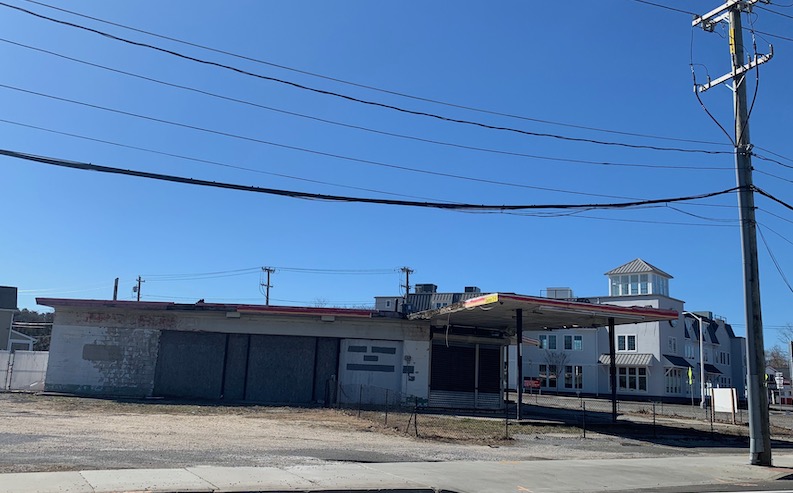
The re-establishment of a gas station on the blighted property on the circle — where two other gas stations are currently operating, one with a convenience store — is not part of the Riverside Revitalization Plan and local residents are adamantly opposed to the proposal.
Longtime executive board member and past president of the Flanders, Riverside and Northampton Community Association Vince Taldone has been an outspoken opponent of the proposal since it was first aired last winter.
In addition to the revitalization plan and resulting zoning overlay district, Taldone emphasized how much public money has already been spent on Riverside revitalization and the development of a new hamlet center for Riverside — funds to rebuild the rotary, to acquire land for a park on the opposite side of the rotary, to acquire 46 acres on the Peconic River to create a wetlands area that will become part of the sewage treatment outflow system, and to acquire easements for the wastewater treatment facility, which is needed in order to develop the hamlet center in keeping with the revitalization plan.
Everything is lined up to move forward, Taldone said.
“We’ve dealt with the blighted Getty station for decades, and we are now approaching the time when that sewer can be built,” he said. “There will be buildings surrounding this site that are mixed-use. They’re designed for pedestrian access. They’re designed for a natural, friendly flow between downtown Riverhead and Riverside. We will have parks, restaurants, affordable housing, market rate condos. This is all in the overlay district plan,” Taldone said.
The plan was 10 years in the making, he said, and it was “community sourced,” a process that included surveying residents door-to-door “because we had to reach people who didn’t go to community meetings to find out what they wanted in their hamlet center,” Taldone said.”And believe me it was not a mega gas station and another 7-Eleven.”
The proposal is “exactly the opposite of what the town’s planning staff and the community want for this location,” Taldone said.
His sentiments were echoed by Bayview Pines Civic and Taxpayers Association President Joann Long Merrill, as well as current FRNCA President Brad Bender and about a half-dozen other local residents opposed to the proposal.
The applicant’s attorney, Keith Brown of the Melville law firm Brown, Altman and DiLeo, submitted to the ZBA a document, dated May 13, 2021, he said was Murphree’s response to the planning board’s presubmission conference, where a host of community members raised the same objections. The document was not made public online.
“This will serve the people who work the overnight shifts — the health care workers, the first responders,” Brown said.
“The owners have owned it for the better part of several decades. The application use is allowed by zoning,” he said.
“How long are we going to wait for sewers to be installed? This one-acre site is not going to blow up the entire Riverside Revitalization Plan,” Brown said. The roundabout is “a major hub to all parts of western Long Island and the South Fork and it makes sense to have a highway use there as it has been for the last 50 years.”
The applicant’s traffic engineering consultant, Andrew Villari of Stonefield Engineering & Design in Islandia, said the proposed use will not increase traffic in the area.
“These are what’s known as pass-by intensive uses, meaning that people aren’t really going out of their way to get gas. People aren’t really going out of the way to stop by the convenience store or use both. They’re doing so on their way to work,” Villari said.
“There are 40,000 vehicles around there that currently go through the roundabout in a day. So it’s a high volume of traffic. The intended customers for the proposed use are those vehicles that are already going through the intersection. We’re not inviting new traffic here,” he said.
Murphree read from the Riverside Overlay District code, which states that the “overlay zones do not replace the underlying zoning rules and regulations that currently exist in the ROD. They provide an alternative option for landowners to use in developing and redeveloping their land and buildings within the ROD. All existing rights, allowable uses, and approval procedures under the Town of Southampton Zoning Law remain in full force and effect…”
“So we are following what is adopted by the town board,” Murphree said, taking exception to the suggestion that the proposal does not comply with the town code.
The survival of local journalism depends on your support.
We are a small family-owned operation. You rely on us to stay informed, and we depend on you to make our work possible. Just a few dollars can help us continue to bring this important service to our community.
Support RiverheadLOCAL today.
