












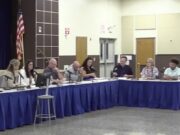




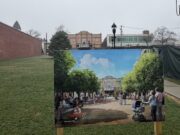


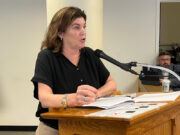


Riverhead Town is getting ready to bring a lawsuit in the hope of getting back title to the Vail-Leavitt Music Hall in downtown Riverhead.
The Town Board at its next meeting is scheduled to take up a resolution authorizing the town attorney to bring the action. Officials say the Council for the Vail-Leavitt Music Hall, which took title to the property from the town in 1982 has not fulfilled its obligations to maintain, manage and operate the property as required by the terms of the conveyance.
“Our concern is that if nothing takes place and its not restored, with the condition it’s in, if we do nothing, it becomes harder to restore,” Council Member Ken Rothwell said in a phone interview Friday. “I fear that if we don’t take any action, the theater is going to become more dilapidated and the longer we wait, the more it’s going to cost to restore,” Rothwell said. More damage will occur, he said, noting, “The roof is leaking.”
The group’s lack of progress in the restoration says they’re not capable of it, Rothwell said. “If you’ve been managing something for so many years and you have so little to show in progress and you still don’t have a plan in place — how long do we wait and at what risk?”
Rothwell said he was “very disappointed” that the organization didn’t apply for any of the $10 million State Downtown Revitalization Initiative grant. “That in essence tells me there is no interest on that board to restore that theater,” he said.
Community Development Director Dawn Thomas said the organization “never completed the business plan” required for the state DRI grant, so they missed out on that funding.
“They are inept,” Thomas said. “Well meaning and not bad folks but the asset needs to be protected and that was their charge when they took it over,” she said.
The town in 1980 obtained federal grant funding to purchase the century-old building that housed an upstairs opera house. The opera house had not been operated as a theater for many years — having had stints that included a roller rink, a gambling parlor and a Chinese restaurant, according to a 1981 Newsday article. It was described as “a shambles” by a local businessman who was a founder of the Council for the Vail-Leavitt Music Hall, Harold Smith.
The town conveyed title to the organization in March 1982, according to the resolution on Wednesday’s meeting agenda. The deed has a provision known as a “reverter clause,” which allows the town to recover the property if it is not used for the purposes for which it was conveyed. According to the resolution on Wednesday’s agenda, those purposes were “educational, recreational and/or any other cultural purpose.” The reverter clause also allows the town to recover title “in the event that the historical character of the property was not properly maintained.”
The board of directors of the Council for the Vail Leavitt disputes the town’s claims.
The current board president, Will Miller, said he was surprised that the town was considering the action.
The organization has been working on restoring the theater and has been operating it as a theater, board president Will Miller said in a phone interview Friday. “We have signed contracts for upcoming shows,” Miller said.
Furthermore, Miller said, the reverter clause can’t be enforced and the town is aware of that. He points to a News-Review story from the 1990s that quotes then-Supervisor Joe Janoski acknowledging that “the language in the reverter was too vague to sustain a cause of action,” said Miller, a retired attorney.
Miller said he and other members of the council’s board would attend the Town Board meeting to object to the resolution in the hope that officials will table it and sit down with the council to discuss it.
Vail-Leavitt board member and longtime president Bob Barta said the council did submit a business plan for the DRI application but “somebody considered it unacceptable,” Barta said the Vail was never told why. “We were never given any information about what was unacceptable about it or anything that needed to be addressed,” he said. “I’m baffled.”
Both Barta and Miller expressed the belief that the town “used” the Vail-Leavitt, which is listed on both the national and state registers of historic places, as one of downtown’s assets in order to secure the $10 million grant.
“They used us as bait to get the DRI,” Miller said.
Barta said the Vail has managed to survive despite having had “absolutely zero financial support from the town,” other than in-kind services when the organization sponsored the Riverhead Blues Festival. “The Vail has been left to survive by its own wiles, which somehow we have managed to do over all that time, and still get some bookings and still pay our bills and meet up with our our mission statement about that we’re going to provide arts and educational, cultural benefit to our community,” Barta said.
“I don’t see any way that we’ve violated any of those terms (in the deed.) I don’t I don’t see any clear cause of action,” Barta said.
The survival of local journalism depends on your support.
We are a small family-owned operation. You rely on us to stay informed, and we depend on you to make our work possible. Just a few dollars can help us continue to bring this important service to our community.
Support RiverheadLOCAL today.
