

























For fans of the true crime genre, “Horrific Homicides” provides a rare inside account of four murder trials in Suffolk County told by the judge who presided over them.
Most prominent among the horrific homicides is the infamous “Amityville Horror” murder of six family members shot to death in their beds in November 1974 by Ronald DeFeo Jr.
In a manuscript completed shortly before his death in April 2014 and published by his daughters in 2021, Judge Thomas Stark tells the story of the murders of DeFeo’s parents and four siblings from the unique perspective of his seat on the bench. Stark’s account covers it all in rich detail, from the first call to police, to jury selection, trial proceedings, verdict, appeals — and the bizarre events that followed, surrounding the “haunted house” hoax that spawned “The Amityville Horror” best-selling book and two movies.
Stark’s daughters Elizabeth Dugan and Ellen Stark will discuss “Horrific Homicides: A Judge Looks Back at the Amityville Horror Murders and Other Infamous Long Island Crimes” Saturday at 1 p.m. at the Suffolk County Historical Society. (Registration is required as seating is limited. Register here.)
Stark’s book opens with the DeFeo trial but delves into four other murder trials he presided over: a “scorned woman”charged with conspiring to arrange the kidnapping and murder of her unfaithful boyfriend; an “irate deli proprietor” whose desire for revenge against complaining neighbors led to the deaths of a mother and two children in a fire at their home; and “the drunken cop,” who shot and killed a fellow NYPD officer as they drove in a third officer’s car following a night of heavy drinking.
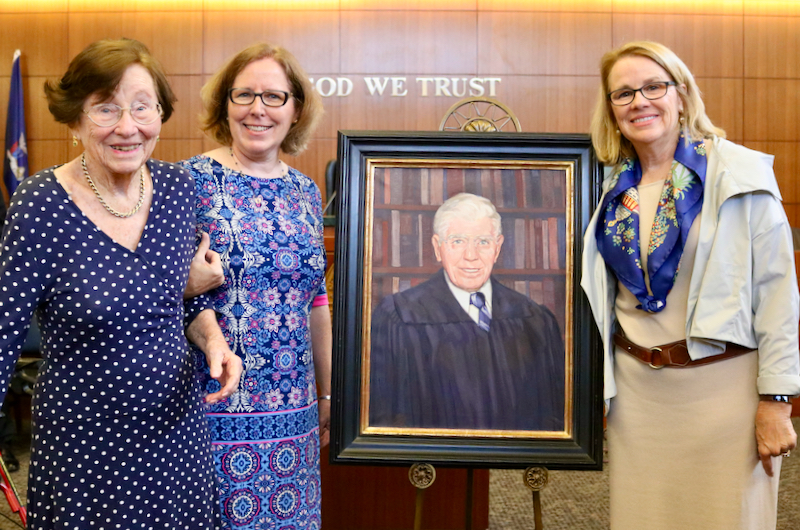
File photo: Denise Civiletti
Stark’s daughters, Elizabeth Dugan and Ellen Stark, who have both had careers in journalism, edited his manuscript, pored over his files, and added a chapter describing “a trio of memorable cases,” relying on their father’s extensive notes.
Only one of the three involved a murder. Another involved a political scandal. The third is a case dating back to Stark’s days on the county court bench. He described the case as “the notorious Southampton house-wrecking case” involving the “beach house revels” of “scandalous socialites” over Labor Day weekend in 1963.
The case drew national attention, a story in The New York Times, and a major piece in Life magazine.
“It was his first year as a judge,” Ellen Stark said. He was not expecting that kind of attention. But there was public outcry over the “Southampton debutantes” case, because the revelers initially faced no charges. The trial was covered by the wire services and was picked up around the world, Ellen Stark said.
“It’s a more cheerful, lighthearted story to end on, after all these terrible murders and, you know, awful, awful things,” Dugan said.
Stark presided over 255 criminal jury trials. Thirty-eight of them were major homicides. The “Horrific Homicides” collection represents the four he found most memorable, his daughters said.
With the notoriety of the DeFeo case, the story of the haunting “sort of took over the narrative,” Ellen Stark said. “And I think he always felt like he really wanted to tell people about the actual trial and the legal issues at play,” she said.
Having taken a deep dive into their father’s files, the sisters have a detailed understanding of the cases and the trials recounted by the judge in his book. But they have knowledge of many more cases he presided over.
“Growing up, there’s no question my dad discussed all sorts of dreadful murders at the dinner table,” Dugan recalled.
“My mother would sometimes not want him to talk about it, but I have strong memories of him sort of discussing, ‘Then, he went into another bedroom with a rifle and shot the next kid.’ I do remember Dad talking about the events of the murder,” Ellen Stark said.
“He often came home at night and talked about what the trials were that were going on and share details of them in a sort of matter-of-fact way, because he found it interesting and figured we would too,” she said.
Stark had “an encyclopedic memory,” his daughters said. He was a great student of history and enjoyed researching local history.
He published a book in 2005 called “Riverhead: The Halcyon Years 1861-1919,” which chronicles a period of progress, growth and advancement in the tiny community where Stark was born in 1925.
Stark attended Holy Cross College and Harvard Law School. During World War II he served as an officer in the U.S. Navy. He was a Riverhead town attorney, a town justice — at a time when the justices also served on the Town Board — and a member of the Riverhead Board of Education. His career on the bench spanned more than 35 years.
The survival of local journalism depends on your support.
We are a small family-owned operation. You rely on us to stay informed, and we depend on you to make our work possible. Just a few dollars can help us continue to bring this important service to our community.
Support RiverheadLOCAL today.
