
















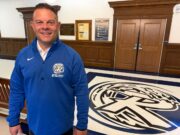






Riverhead’s new supervisor made some bold declarations during his inaugural address on New Year’s Day, promising a town government that will reach “a level of transparency…that has not been seen before.”
Among the initiatives Supervisor Tim Hubbard mentioned are holding Town Board work sessions that have meaningful agendas, where real discussion takes place, in real time, as the board, town staff and consultants develop strategies and plans for Riverhead’s future. Town Board members will also give monthly reports on the departments and committees they are responsible for monitoring and coordinating. At work sessions, board members will also discuss the substance of resolutions on the agendas of upcoming official meetings, so that board members and the public fully understand them.
And, Hubbard said, the work sessions will once again take place with board members sitting at the table, face to face with the people they’re meeting with. Under his predecessor, board members sat on the elevated dais, a seating arrangement not conducive to a productive working meeting.
Hubbard also acknowledged the need to repair the broken-down relationship between elected officials and many of the citizens they represent. And he aims to repair it, he said.
“No more circus atmosphere at board meetings,” Hubbard said during his speech Monday. “If individuals cannot be civil, then they will not be given the floor.”
Hear, hear. This is very welcome news indeed. The Aguiar administration was marred by the hostility with which the former supervisor greeted anyone who questioned her about nearly everything. Questions, whether posed by fellow board members, residents, or the press, were treated as an attack, often with the supervisor accusing whoever was asking questions of having a “political agenda.”
Every resident has the right to ask questions and express opinions – even when questions are pointed and opinions are critical. That’s how democracy works. When you’re elected to govern, you have to understand that this comes with the territory. People who question and criticize are not your enemy because they question or even criticize you.
History is full of examples of leaders who refused to accept this, and it’s never worked out well. Eventually, it even works out to the detriment of the elected official. And the past four years are a case in point. Some very good things happened during the last supervisor’s tenure, but the way she often treated others – whether residents at the podium, other board members, employees or reporters – often rudely and disrespectfully, detracts from those accomplishments.
Government is supposed to be about public service. It’s not about ruling over others and exerting authority. That kind of demeanor and attitude sets the tone for the hostile atmosphere that often existed at Town Board meetings over the past four years. It feeds the suspicion of residents who feel disrespected and left in the dark. And they often responded in kind. A leader’s demeanor and attitude also sets the tone for the entire organization.
Hubbard promises a fresh start and has the opportunity to transform the town’s government into what it should be: friendly, open, transparent and for the people.
He said he will restart holding the quarterly civic roundtable meetings, where civic groups can sit down with the supervisor for free-ranging conversations about what’s going on in their communities. He’s also promised to include residents and civic groups in a new committee or commission to devise new plans for the Calverton Enterprise Park.
These are important steps in the right direction to build bridges with residents who’ve often — justifiably — felt left out of important planning processes, such as the initial “central advisory committee” formed to work with planning consultants on the comprehensive plan update.
Keeping in touch is an important part of good leadership and good government, as Hubbard knows. He’s spent his life in Riverhead, nearly all of it in public service, and he’s a naturally approachable, friendly person.
But it requires more than lip service, and we trust the supervisor knows that too. Residents must have a seat at the table. An open and civil dialogue between the public and elected officials, as well as members of the boards and committees appointed by elected officials, is key to good government.
Riverhead cannot be at war with itself if it is to thrive.
Suggestions for the supervisor’s to-do list
We are enthused by the things the new supervisor had to say on Monday, and we respectfully have some suggestions for items to add to his “to-do” list for transparency and open government in Riverhead.
Let the sun shine — on all meetings
All committee meetings should be open to the public, whether or not the State Open Meetings Law requires it. That law sets the minimum requirements and it’s widely acknowledged to set a pretty low bar in many ways. Riverhead should aspire to do better, much better, than the bare minimum. That includes opening to the public meetings that have previously been behind closed doors.
One prominent example are so-called pre-submission conferences, where two Town Board members, together with upper-level staff, meet with developers to discuss proposals before they formally submit applications – and long before the plans are aired in a public forum.
This practice smacks of backroom deals made in the dark, favors being granted in exchange for who-knows-what. Whether or not that’s the result, that’s what it looks like from the outside. And that itself is bad. It breeds distrust.
And when proposed zoning changes publicly surface that pretty specifically benefit a particular property owner and a particular developer — an example being the code change that would allow a luxury resort on the Long Island Sound proposed, informally so far, by a firm that’s had some of those pre-submission conferences with board members and top planning officials – the public is going to question what’s really been going on. Because the public only gets to see the dog-and-pony show result: a tailor-made zoning amendment, and eventually, the development proposal itself.
And when this takes place as the town is entering the home stretch of its comprehensive plan update, it’s even worse.
This does not inspire trust. In fact, it’s the very opposite of open government: deals being struck behind closed doors and trotted out before the public basically after the deal is done. That’s been going on for too long in Riverhead – it certainly predates the Aguiar administration. And it’s wrong.
Are these conferences even necessary? Hubbard himself said during the candidate forum hosted by the Heart of Riverhead, that other towns don’t follow this practice. Why does Riverhead? And pre-submission conferences, when they do take place, can be open meetings — the Village of Greenport conducts them that way — and conversations with developers regarding requesting changes to town laws and regulations to enable their projects should always be held in a public work session. Period.
The town’s Code Revision Committee’s meetings must also be opened to the public. This committee consists of two Town Board members, legal and planning staff, who discuss which town laws should be changed and how they should be changed. It’s also where a heavily scrutinized proposal usually goes to get changed after a public hearing. Sometimes, it’s where they go to die. Read our editorial from 2022 about the secrecy and importance of Riverhead’s Code Revision Committee here.
Riverhead’s Code of Ethics desperately needs reform. It’s pathetically weak. Former Supervisor Yvette Aguiar was correct to bring a reform proposal to the board, suggesting that Riverhead overhaul the code and begin with the state’s model code of ethics as a springboard. Unfortunately, she fumbled the presentation, failed to bring a copy of the model code to the table and fellow board members, who seemed like they felt personally attacked that day for reasons that weren’t clear to the public (Who knows what went on behind the scenes leading up to that meeting?) jumped all over her. Aguiar said she’d reschedule the discussion, but never did. That’s too bad. It’s a discussion and a reform that is sorely needed in Riverhead. Read our editorial from last year about why Riverhead’s Code of Ethics needs an overhaul here.
Another important open government reform the town should implement is requiring all appointed boards, committees and advisory groups to prepare meeting agendas to be posted on the town’s website at least 72 hours before all meetings. The agendas should be accompanied online by documents and resolutions to be discussed and/or acted on at the meeting. Aguiar, to her credit, was scrupulous about requiring this for Town Board meetings and work sessions and it was extremely helpful. It’s the only way the public can know and understand what’s being discussed at a meeting. What good are open meetings if the topics of discussion are not disclosed in advance and the documents to be discussed aren’t available for the public to read so they can follow the discussion?
The supervisor, who sets the agenda for all Town Board meetings and work sessions, should make it clear to town departments that discussion items will not be placed on the board’s agenda unless documents to be discussed are submitted to his office for posting to the town website with the agenda – not brought to the meeting and then posted after the fact.
The Town Board should adopt a formal policy requiring this disclosure (agenda and documents online at least 72 hours before a meeting) for all boards, committees and advisory groups – even boards that are established pursuant to state law, such as the Planning Board, Zoning Board of appeals and the Riverhead IDA. The Planning Board and ZBA are generally good about getting this done. The Riverhead IDA, not so much, even though state law and regulations actually already require this of all industrial development agencies in New York. The Riverhead IDA also falls short in complying with other disclosure requirements imposed by the state. The Town Board, which appoints the IDA board, simply should not tolerate this failure to comply any longer.
The public must know what these influential committees and groups discuss and advise the board on without the need to attend every meeting of the more than two dozen groups. While reports from Town Board members is certainly a welcome improvement, having agendas and minutes posted for each of these meetings is important for the public to actively participate and attend the meetings.
All site plan and special permit applications filed with the planning department and/or Town Board or town clerk should be listed on the Town Board’s regular meeting agendas. This was a practice followed for many years, but it has fallen by the wayside for some reason in recent years, even though with electronic communication and the submission of applications and documents in digital format, it should be easier now than ever. This is a bare minimum for allowing the public to be informed and it should be implemented immediately.
We again urge Riverhead Town to implement a system like the one in place in Southold Town where all applications, maps, documents required by the State Environmental Quality Review Act and correspondence pertaining to all applications are posted online, where they are readily accessible to the public at no charge. This would eliminate the time and expense of processing and fulfilling Freedom of Information Law requests to access most town records – and the cost of the town attorney’s time in responding to appeals when the town departments fail to comply with records requests, which all too often just get ignored. The system would pay for itself.
There’s been talk of hiring a new staff member to do PR for the town – “to let the public know all the good things that are happening.” All well and good, but the town already has staff to do that function and they are capable of doing it well. Local media, including this website, provide comprehensive community calendars for event listings, and we publish previews of upcoming events and cover them when they happen with stories and photos. The supervisor’s staff and the town board coordinator could be tasked with writing news releases and sending them out to the media to get those “feel-good” stories out there and make sure the local media knows about upcoming events to cover. The Riverhead BID and Chamber of Commerce also do a great job of getting the word out.
We think the cost of a PR person would be better spent on improving public access to records and updating the town’s website. Truly open government is the best form of “public relations,” in our opinion.
There’s even more to do, and we’ve written on this topic in the past, as documented on our editorial page.
The new supervisor, who brings with him eight years of service on the Town Board and more than three decades of service on the Riverhead Police Department, knows the community inside and out. He’s in a unique position to reform town government to be open and responsive to residents, and we applaud the direction he says he will take.
But his years on the Town Board, through the administration of three prior administrations, brings with it significant baggage, too. As an eight-year board member, he must bear some responsibility for things that went off-track, where more advocacy for transparency, among other things, was often lacking.
So, the new supervisor’s got a lot of work to do to rebuild relationships between town government and the people it serves and to earn the trust of residents it will need so that everyone is pulling together to make Riverhead be the best it can be.
We live in a beautiful place that’s somehow managed, against the odds, to retain much of its character as a place with a long, proud history, and managed to retain its sense of place, its sense of community.
To be sure, we’ll be rooting for the new supervisor’s success at this pivotal moment in the history of Riverhead Town. At the same time, we’ll be here to do our job to make sure he fulfills his promises – because accountability is also a key ingredient to local government that is representative, open and successful.
The survival of local journalism depends on your support.
We are a small family-owned operation. You rely on us to stay informed, and we depend on you to make our work possible. Just a few dollars can help us continue to bring this important service to our community.
Support RiverheadLOCAL today.
