

























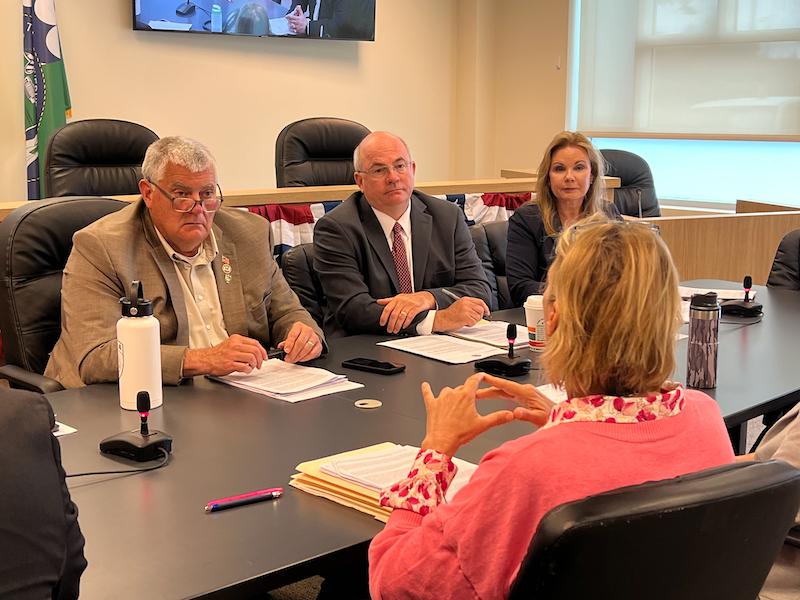
A proposal to allow agri-tourism resorts north of Sound Avenue in Riverhead, which was shelved earlier this year, received a warm welcome back the Town Board this week.
The code change would allow the development of agri-tourism inns and resorts on at least 100 acres of land in the RA-80 zoning district, which covers most of the land on the north side of Sound Avenue. The development would require a special permit from the Town Board and the preservation of at least 70% of the land for agricultural production. The other acreage could be developed as a resort with up to 150 guest rooms and amenities like a spa, restaurant and conference rooms.
The proposal was shelved in April after a disagreement with the town and the Long Island Farm Bureau that stemmed from the farm industry group’s advocacy for the inclusion of vertical and indoor farming on the preserved land. Town officials and the town’s Farmland Preservation Committee wanted the land to be “traditionally” farmed.
The proposal discussed at Thursday’s work session is slightly modified from code that was considered by the board in April. It includes a requirement that the preserved land be limited to “agricultural uses dependent on the use of agricultural soils” as defined by state law. Deputy Town Attorney Annemarie Prudenti, who helped write the legislation, said in an interview after the presentation that the code is intended to specifically exclude vertical farming.
All the Town Board members were in favor of the proposal, arguing the code change would help preserve farmland and scenic vistas along the Sound Avenue corridor, although Council Member Bob Kern voiced an objection to the minimum land required for the development.
“I think the key component in putting this together, I’ve said all along, was to preserve that historic corridor, but mostly it’s aesthetics,” said Council Member Ken Rothwell, who has been a strong proponent of the legislation. “Riverhead is a farm based community, and that’s what we’re looking at as we traveled down Sound Avenue…I want that to be preserved and stay like that forever.”
Prudenti said planners and Town Board members met with members of the Farmland Preservation Committee and Agricultural Advisory Committee to discuss the legislation. Prudenti said Planning Board member Ken Zilnicki, a farmer, was disappointed that the code was shelved and helped push the legislation forward.
There was at least one developer interested in building a resort. Alfred Weissman Real Estate, a real estate firm based in Westchester, had featured the North Fork Resort, a “luxury resort and spa” on the Long Island Sound, in the “new development” section of its website last summer. Emails obtained by RiverheadLOCAL show early drafts of the proposed code were created with the input of the firm’s attorney and planning consultants.
MORE COVERAGE: Hubbard, town staff defend developer’s involvement in agri-tourism zoning code proposal
Prudenti said in an interview that the town has not communicated with Weissman or any other developer on the version of the code currently being considered by the board.
Prudenti told the board that an agri-tourism resort is consistent with the current comprehensive plan — which mentions “farm vacations” as a possible agri-tourism activity — and the “future” comprehensive plan. The Town Board is currently considering an updated comprehensive plan, and the latest draft of the plan recommends agri-tourism resorts. The inclusion of agri-tourism resorts in the current draft plan has been opposed by some residents, the Southold-based conservation group The Group for the East End, and Southold Town.
As town officials discussed the proposal on Thursday they tried to get ahead of concerns raised by residents at past Town Board meetings, including the potential traffic impacts of a development on the two-lane Sound Avenue.
Senior Planner Greg Bergman said a resort built under the code “couldn’t be considered” a “significant trip generator,” citing the New York State DEC’s Full Environmental Assessment Form (FEAF) Workbook on the traffic impacts of developments.
The workbook says a hotel/motel with 250 or more rooms would result in a “substantial increase to traffic” for the purposes of completing the environmental assessment form. It also says that even if a development does not meet the threshold outlined in the workbook, a traffic analysis may still be necessary if the development meets certain conditions, including the lack of existing left turn lands on the adjacent roadway to a proposed access point, high traffic volumes on surrounding roads, and other factors.
Prudenti said the code further mitigates traffic impacts by limiting the seating capacity of a restaurant allowed on the development, prohibiting temporary structures on the site and prohibiting the use of the restaurant as a catering facility. (The code says the venue may be used for private parties and events if they are “only made available to guests during the time of stay at the inn and resort.”)
Other than the language intended to exclude vertical farming, the new draft requires the resort be setback from Sound Avenue at least 250 feet, a reduction from the prior proposal, which required a 500 foot. That change was not mentioned during the work session. Prudenti said in an interview after the presentation that the setback change was, in the opinion of town officials and farmers, “too onerous.”
During Thursday’s discussion, Kern objected to the requirement that a resort be developed on at least 100 acres of land.
“I don’t even want to see a 50-acre property go into a subdivision, because what it’s doing is it contradicts what we’re trying to do here. So I think the 100 minimum is too high, I would go lower,” he said.
The other council members did not agree with Kern. “You can’t take it back,” Rothwell said. “And I think you got to see how it develops, see how it works. And then if it’s working, and it’s doing exactly what we hope it will do, then we’ll expand it later in the future.”
“I see it working,” Kern said. “I don’t think this is a matter of see if it works. I think this is going to work and I think we need to make it work.”
The other board members did not voice any objections, only support.
Council Member Joann Waski said the code is an “excellent tool” to preserve farmland on Sound Avenue.
“One of the most important things to me is preserving farmland,” Waski said. “As a lifelong resident here in Riverhead, I have watched over the years so many subdivisions go up. I’ve seen the impact that they’ve had on our school. I’ve seen the impact on traffic. I don’t want to see anything but farms on Sound Avenue.”
Council Member Denise Merrifield said the proposal results in “smart economic growth while maintaining agricultural preservation. That’s what we ran on,” she said.
Hubbard, who dropped his support of the legislation in April after the disagreement with the farm bureau, said the objections with the farmers have been “hammered out” and supports moving the legislation forward.
Hubbard also said he disagrees with the opposition of residents in Willow Ponds, a condominium development near where Weissman had proposed building its resort, who had come to the Town Board in December to speak about the potential for a code change. “I’m not really buying that too much because your development was made there and it’s okay for you now, but it’s not okay for somebody else afterwards,” he said.
In addition to the buildings made a part of the resort, the developer would be allowed to build up to 300,000 square feet of structures on the preserved agricultural land, which could include greenhouses, barns and agricultural worker housing. Both agricultural and non-agricultural buildings would be allowed to be up to 35 feet tall.
“There is a natural instinct to be concerned when anybody uses the word inn [or] resort or anything along that lines: What are we talking about? This is not a Marriott Marquis that is going to be a four-story hotel, it is not that,” Rothwell said. “This is a low lying development project that is not going to be seen or viewed from South Avenue. That’s the whole key component.”
The survival of local journalism depends on your support.
We are a small family-owned operation. You rely on us to stay informed, and we depend on you to make our work possible. Just a few dollars can help us continue to bring this important service to our community.
Support RiverheadLOCAL today.
