
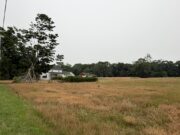

























A proposal to allow agri-tourism resorts on land north of Sound Avenue in Riverhead has been shelved.
The “appropriate balance” between the farmland preservation and development aspects of the code proposal “remains a source of ongoing discussion and debate,” Hubbard said at the outset of Tuesday’s Town Board meeting. A resolution scheduling a hearing on the town code amendments to enable an agri-tourism resort development was set to be voted on this week, but was not included in the final Town Board agenda.
“And quite frankly, it remains to be seen whether the perfect balance exists,” Hubbard said. “I remain open to further discussion but defer to stakeholders of our local farming community as to whether this is possible and we will keep the public updated.”
Hubbard said in an interview today that the town’s Agricultural Advisory Committee and the Long Island Farm Bureau, a farm industry advocacy group, want the town to allow vertical farming and indoor farming on the land, while the Farmland Preservation Committee wants the land to be “traditionally” farmed.
The disagreement has created an impasse, Hubbard said.
“We couldn’t come to terms,” Hubbard said. “And if the farmers are not happy, then we are certainly not going to push this forward, because nobody wants to upset what the farmer has to do to make a living and to provide food to all of us who live here.”
“If they talk down the road some time and work some things out and come back to us and we feel it’s appropriate we would revisit it again without a doubt,” he said, referring to the two committees.
Richard Wines, a member of the Farmland Preservation Committee, said Wednesday that the committee had objections, but they were not associated with the use of the agricultural land. The Farmland Preservation Committee objected, he said, because the proposal required a developer to purchase only a small amount of farmland preservation credits to build a large resort.
“You would have been trading a 100 or 150 room resort for a few acres of preserved farmland someplace. It didn’t seem like a very good exchange,” Wines said. “So that was my main concern, is that it wasn’t doing what it said it was supposed to do.”
Under the proposal, the development of a resort would require a special permit of the Town Board. The purchase of credits to preserve farmland in other areas of town would not be required, but could be used by the developer to increase the resort’s density by up to 66%.
Deputy Town Attorney Annemarie Prudenti said the disagreement has been between the town and the Agricultural Advisory Committee and Long Island Farm Bureau. She said the town believes an agri-tourism resort is meant to be a farmland preservation tool that can help preserve the scenic vistas and agricultural soils along Sound Avenue. That would not be accomplished if the town allowed the development of indoor or vertical farming structures, she said.
The proposal, drafted by Prudenti, required that at least 70% of the agricultural land preserved be used for “agricultural production dependent on the use of agricultural soils.”
“They made clear that any requirement that the developer put to use any of the preserved prime agricultural soils as part of [agricultural] production…couldn’t be supported by the committee,” Prudenti said. “They want no restriction and no requirement to use [agricultural] soils for [agricultural] production on that property.”
Rob Carpenter, the Long Island Farm Bureau’s administrative director, did not immediately return a call requesting comment.
The code proposal was included in a draft agenda packet released last Thursday for review by the Town Board at its work session. Town officials discussed the most recent code proposal during the March 21 work session with members of the town’s Agricultural Advisory Committee and Farmland Preservation Committee. A hearing on a previous draft of the proposal had already been canceled after farmers raised objections.
While the March 21 discussion pointed to support by town officials and farmers for the revised proposal, Carpenter’s comments during the discussion indicated the farmers were not getting everything they wanted.
The code would require the agri-tourism resort be built on at least 100 acres of land, with at least 70% of that land being used for agricultural production. The other acreage could be built as a resort with a spa, restaurant, conference rooms and other amenities. The code would allow up to 300,000 square feet of structures on the 70 acres of agricultural land, which could include greenhouses, barns and agricultural worker housing. Both agricultural and non-agricultural buildings would be allowed to be up to 35 feet tall.
Council Member Ken Rothwell, who has been a strong supporter of the legislation said at yesterday’s meeting, “I think it has incredible advantages to assist farmers, it’s one of many tools in which farmers will have. But until the farming community feels that this is brought to precision — that I want to know that it overly helps our farming community and weighs more on the farming community than any type of development hand.”
The town, he said, is “not building large-scale hotels on Sound Avenue,” and that the legislation was meant to “preserve and protect not just the historical values of [Sound Avenue], but also the beautification of it.”
“And no one wants to see, you know, immersed trailers stacked high, you know, doing hydroponics and other things,” Rothwell said, referring to a method of growing plants without soil and in an artificial environment. “I think we want to keep the historical heritage of Sound Avenue and its beautification. So I think we have a little bit of work to ensure that that is, in fact, the case if this legislation moves forward.”
Rothwell did not immediately return a call today requesting comment.
Council Member Bob Kern, the Town Board liaison to the Agricultural Advisory Committee, said yesterday that he thought the issues with the code proposal would be resolved by the meeting.
“I can’t believe how close this is. And I thought for sure this would happen, I would wake up today and it would be resolved,” Kern said. “So I’m going to do everything I can to see this happen, because I think it’s really a great thing for TDRs, preserving farmland and helping farming in general.”
In separate discussions surrounding farming, Kern has pushed for allowing vertical farming, a type of indoor farming where crops are stacked, and can include the use of techniques like hydroponics.
Kern also expressed support during the March 21 work session to allow farmers to conduct on-site processing of agricultural goods to create related products. He gave as an example a tomato grower processing tomatoes to make tomato sauce — something usually done in a factory setting. The draft agri-tourism code the board was considering would specifically prohibit processing on the preserved agricultural land.
There has been at least one developer interested in building such a resort. Alfred Weissman Real Estate, a real estate firm based in Westchester, had featured the North Fork Resort, a “luxury resort and spa” on the Long Island Sound, in the “new development” section of its website last summer. Emails obtained by RiverheadLOCAL show early drafts of the proposed code were created with the input of the firm’s attorney and planning consultants.
Michael Cohen, an executive at Alfred Weissman Real Estate, did not respond to an email requesting comment on the revised code and a question as to whether the firm had any input on revisions.
| MORE COVERAGE: Hubbard, town staff defend developer’s involvement in agri-tourism zoning code proposal |
Although town officials had embraced the proposal, not everybody was on board with Riverhead Town’s proposed code. Southold Town Supervisor Al Krupski sent a letter to Riverhead Town on behalf of the Southold Town Board on March 13, which said the area north of Sound Avenue is not an appropriate location for a resort. The additional traffic from agri-tourism resorts “is expected to negatively impact the quality of life of residents and travelers on the road,” Krupski wrote.
Town Board members dismissed Southold Town’s objections during the March 21 work session discussion.
The Group for the East End, a nonprofit environmental conservation group based in Southold, raised similar concerns in a letter to the town and recommended the town remove reference to agri-tourism resorts from its draft comprehensive plan.
“It didn’t encourage agriculture in Riverhead, and it didn’t even require a resort — you could build a strip motel,” Wines, the Farmland Preservation Committee member, said. “It made no sense. And so I’m glad they’ve withdrawn it.”
The survival of local journalism depends on your support.
We are a small family-owned operation. You rely on us to stay informed, and we depend on you to make our work possible. Just a few dollars can help us continue to bring this important service to our community.
Support RiverheadLOCAL today.
