
























From the street, Peconic Crossing, the five-story apartment building at 11 West Main Street, looks much the same as it did in September 2018, when tenants first began moving into it.
The building interior tells a different story, however.
Dead house flies littered the dirty gray carpeting in the hallways during a walk through the building Sunday afternoon.
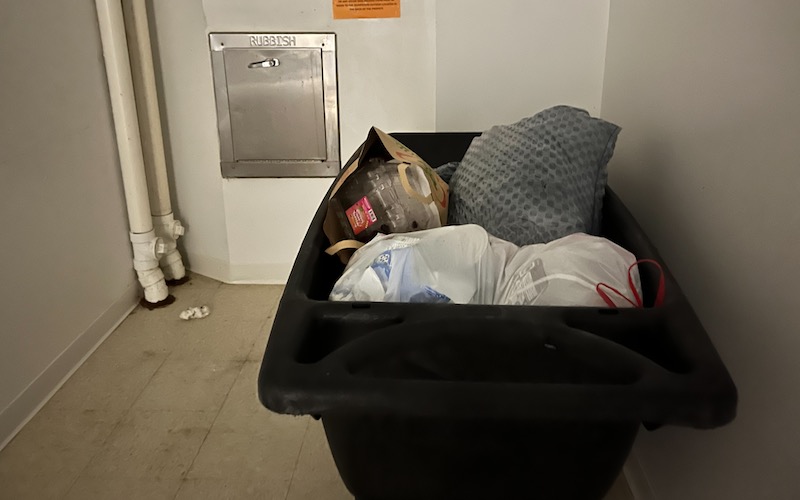
The halls were warm, airless and dank. The air conditioning was not running. A foul odor lingered in the air — the unmistakable smell of garbage emanating from the trash rooms where garbage chutes were off-limits for disposal. Building management had placed large plastic carts in each of the small, unventilated rooms, and tenants were instructed to deposit their garbage bags in the carts for removal.
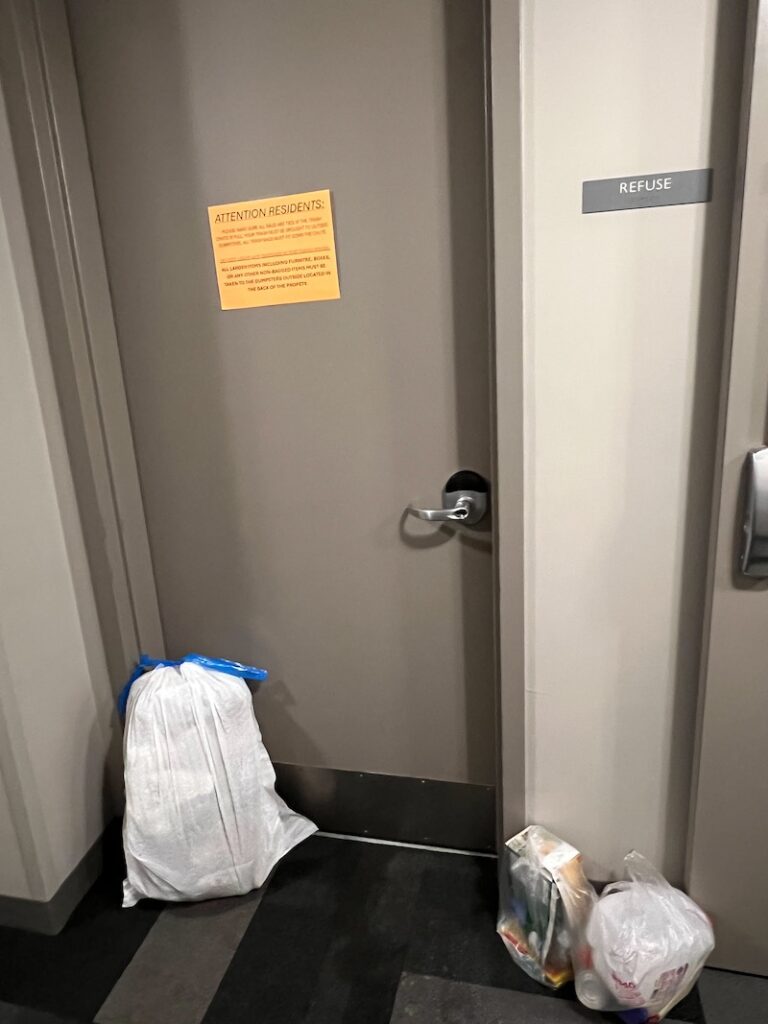
On one floor, plastic bags filled with household garbage were sitting outside the locked trash room door. The door could not be opened. Its lock was not responding to residents’ key fobs. Two trash rooms that were accessible had inoperable lights, requiring entry into a pitch-black, putrid-smelling room— without being able to keep the door open for light or air when a resident walked inside to deposit a trash bag in the cart.
Fruit flies swarmed about in the stagnant hallway air, especially near the doors to the trash rooms on each level.
Fruit flies also hung in the air of the community room on the fifth floor, where a group of residents sat down for an interview with RiverheadLOCAL Sunday, to talk about conditions they described as deteriorating and increasingly intolerable. They agreed to be interviewed for this article on the condition of anonymity, worried, they said, about retaliation by the landlord or other tenants and about the stigma they and their children may face in the community.
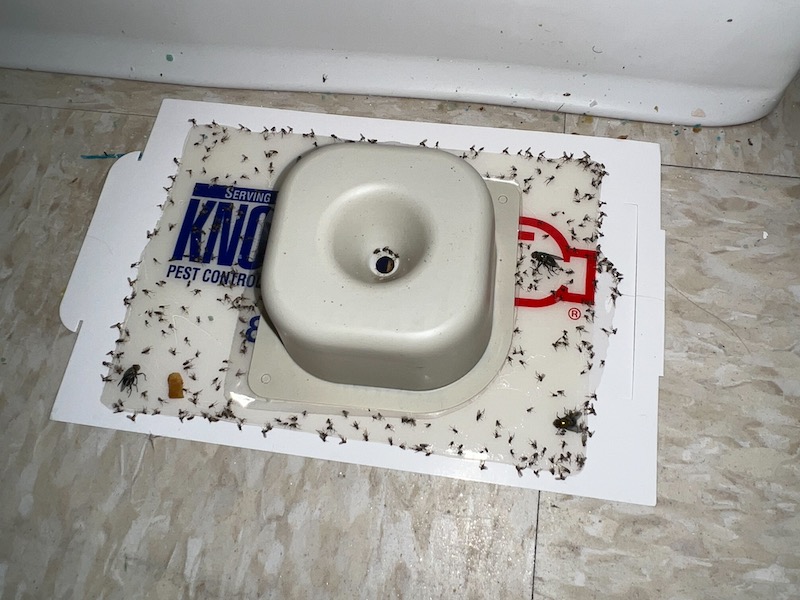
Residents said the building is infested with bed bugs, roaches and carpet beetles, and there’s little they can do to protect their own apartments. The pests are known to spread throughout multiple dwellings via cracks, electrical conduits and plumbing — and by clothing, backpacks purses or laundry.
Management’s presence at the site has decreased, residents complained. There is no full-time community manager in the office on premises and there is no regular maintenance worker on site, they said Sunday.
Garbage being stowed in the trash room carts is not brought out frequently enough. Things that break are not fixed in a timely manner — even when the result is a nonfunctioning front door entry system, or in the case of two residents interviewed Sunday, even when they were unable to lock their own apartment doors for an entire week when they left for work in the morning.
Hailed when it opened as “the first waterfront affordable housing project on Long Island,” by the chairperson of the Long Island Regional Economic Development Council, Peconic Crossing overlooks the Peconic River at Grangebel Park, offering 45 income-restricted apartments to people earning no more than 60% and 80% of the area median income.

“It was such a beautiful building when we first moved in,” said A., a single mom who works as a server at a local restaurant.
“We’ve been here since day one. And to see a decline like this is disgusting,” she said.
“And it’s not fair for us because pretty much everybody in this apartment building, besides a few, are hard-working people,” she said.
Three of the residents interviewed said they had thrown out their furniture — sofas, chairs, beds — because of bedbugs. And they could not afford to replace their lost possessions. One said she was still sleeping on an air mattress.

On Sunday, a large trash container was parked outside the building with living room furniture piled in it. The residents in the meeting said they did not know who the furniture belonged to. One resident produced photos taken at an earlier date, showing mattresses in the container and furniture piled up outside the rear of the building.
“We can’t afford to move,” said another resident, who works in the Riverhead school district. “There’s nowhere else to go. Everything is too expensive.”
The residents said they’ve repeatedly complained to the building owner, but the problems persist. They’ve complained to the town as well, they said.
The stress of the situation has been horrific, the residents said.
“I thought I was having a mental health breakdown,” said S., an x-ray technician and the mother of a 13-year-old girl, who found bedbugs in her daughter’s room on May 30. She got a steamer and was steaming her possessions for two weeks straight, she said.
An exterminator came twice, she said — the second time without notice when she was at work.
“When I got home my bedsheets were off the bed. My stuff was all thrown on the floor.” She said she didn’t know what to make of her ransacked apartment, but thought she smelled bug spray so she called and emailed Conifer and got a response “a couple days later” acknowledging that they had an exterminator in her apartment.
“My two cats were still in the apartment. I told them I never gave anybody authorization or consent to come into my apartment when I wasn’t home. And if you’re going to come into my apartment and you’re going to spray chemicals, let me remove my animals and let me know what’s been sprayed,” S. said. The exterminator provided no paperwork about the pesticide used, she said.
“It’s crippling,” said B., a fire district manager, EMT and the mother of a young son. “It’s mentally and physically crippling for some people to have to handle what’s going on in our own home and still be productive every single day to be able to afford to live here and take care of our families,” she said.
“And not only that, but it’s humiliating. We are good, clean people. And now we have this stigma of — if my son says something at school, well, now I have a teacher calling me and parents of other students asking about bedbugs. And then they’re like, his backpack can’t come to school.” It’s traumatizing for the children witnessing what’s going on, B. said.
Dave Lanzillo, a spokesperson for building developer Conifer Realty said in an email today the company has “an exterminator on retainer who conducts monthly preventative maintenance and is available to address any additional issues reported by residents.”
Conifer’s on-call exterminator promptly addressed recent reports of bedbugs, Lanzillo said. Reports are thoroughly investigated and remediated to ensure the building meets state and county standards, he said.
“Bed bugs have been reported in several apartments, and each case was effectively managed by the exterminator,” Lanzillo wrote.
Lanzillo said the company brought in a “sniffer dog” to inspect the entire facility on July 11. The dog identified a few additional apartments, he said, and the exterminator treated those units he was able to access.
“Occasionally, some residents do not allow the exterminator to enter their apartments, which is a violation of their lease agreement,” Lanzillo said. “We promptly work to resolve those instances by contacting the resident, reminding them of their lease obligations and arranging for a follow-up visit. If lease violations continue, the resident is subject to eviction proceedings,” he said.
“There was a small issue which has since been resolved where our ‘garbage room’ was closed because of a safety issue with one of the chutes. During that time residents were expected to bring their garbage to bins in the exterior lot. However, now that the repairs have been made tenants can resume disposal through the room down the chutes,” Lanzillo said.
When told what a reporter observed of the garbage in the building on Sunday, including the carts in the trash rooms for placement of garbage bags — a condition residents said had existed for some time, with one saying it’s been that way for a month — Lanzillo said he would pass the information along to the property management team so it can be addressed.
“As of July 29, a new, full-time community manager has been hired and is on-site at Peconic Crossing,” Lanzillo said. “We also have a cleaning company that is on-site three to four times a week and a full-time maintenance team that is on-site daily,” he said.
Lanzillo said “it’s important not to lose sight of the significant progress Peconic Crossing has undergone,” referencing “challenges including the activity in the adjacent parking lot and park.” Once the “challenges” were identified, he said, “Conifer was able to work with the police and the community to provide additional support to residents.”
Working with police, he said the company took many measures to reduce the number of police calls to the area of the building during the height of the pandemic.
“We have also worked closely with local officials to evict highly troublesome and menacing tenants, further ensuring a safer and more secure environment for all residents,” he said.
Residents on Sunday acknowledged that criminal activity in and around the building has diminished. Apparent drug activities in one of the apartments had resulted in entry by people who did not belong in the building. There were people smoking crack and weed in the stairwells, the residents said. One person overdosed in a common area bathroom on the fifth floor, they said. Now that bathroom is kept locked and inaccessible to tenants using the common room or gym, they said.
Riverhead Town Community Development Administrator Dawn Thomas expressed frustration during a phone interview today.
Conifer needs to have both a full-time manager and on-site security at Peconic Crossing, Thomas said. There are a few apartments that are still presenting problems from the standpoint of criminal activity on site, Thomas said, though she acknowledged the situation has improved over what it had been during the pandemic, when she said “it was absolute bedlam.”
“It was totally unacceptable. Everyone deserves safe, clean and appropriate places to live, especially children. It’s a moral obligation,” Thomas said.
“So people who are behaving badly must face the consequences and management is obligated to provide those consequences to ensure that people have clean, safe, appropriate housing.”
Thomas said she had several meetings with Conifer representatives and New York State Homes and Community Renewal, a major project funder, that resulted in modifications such as new cameras, better security and a gate.
“Recently we started getting more complaints again,” she said.
Conifer received substantial public assistance to develop the property, Thomas noted.
According to public documents, Conifer received $4.55 million in federal storm recovery funds, and other funding for a total of $5.489 million, with more than $9 million in low-income housing tax credits and a grant from New York State Energy Research and Development Authority.
Conifer was also granted 100% real property tax abatements for 10 years by the Riverhead Industrial Development Agency, which also granted mortgage recording and state and county sales tax exemptions.
The development, a $17.5 million project, was intended to be economic development and housing opportunities for people displaced by Sandy and housing for artists, Thomas said.
Conifer’s spokesperson said the company is “proud of the efforts we have undertaken and we remain committed to maintaining a clean, safe, and pleasant living environment for our residents.”
Lanzillo said the company welcomes “ongoing communication” and encourages residents to report any issues directly to it so Conifer can address them “promptly and effectively.”
One resident wrote a letter to the company July 22 detailing complaints. As a result, a newly appointed regional manager is scheduled to meet with her on Wednesday, she said.
The survival of local journalism depends on your support.
We are a small family-owned operation. You rely on us to stay informed, and we depend on you to make our work possible. Just a few dollars can help us continue to bring this important service to our community.
Support RiverheadLOCAL today.
