
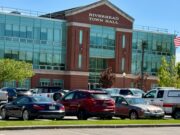















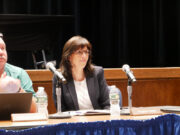







In a branching discussion of the 2025 proposed budget during last week’s work session, Town Board members defended increases to elected officials’ salaries, discussed perceived mistakes in past budgets and explored the possibility of state legislation to allow the town to use recreation fees charged to residential developers for repairs and maintenance at town parks.
Board members showed no appetite for amending the budget plan put forward by Supervisor Tim Hubbard last month, which will have a public hearing during the Town Board’s Nov. 7 meeting, scheduled for 2 p.m.
Board members defend raises
The 2025 preliminary budget proposes increasing the salaries of elected officials, including the supervisor and council members. The decision to increase their salaries, while at the same time proposing a 7.92% increase to the town-wide tax levy — a record high since the 2% tax levy cap was imposed by the state in 2012 — has faced community criticism.
Town Board members’ salaries haven’t increased in more than a decade. The salary paid to a town supervisor — currently $115,148 per year — last increased in 2008. The salary paid to council members, by law a part-time position, is currently $48,955 per year; it last increased in 2012.
MORE COVERAGE: Hearing for 2025 town budget and tax cap override scheduled for Nov. 7 at 2 p.m.
Hubbard said many elected officials in the town are “sort of department heads,” apparently referring to the positions of town clerk, town assessors, tax receiver, town justices and highway superintendent. The salaries for those positions have been increased more consistently over the years. People in those positions are elected by voters just like the Town Board, but often do not have competitive races. With the retirement of Democrat Diane Wilhelm as town clerk last year and the election of former council member James Wooten to that position, all elected offices in Riverhead Town government are currently held by Republicans.
| Postion | Current salary | Proposed salary | % Increase |
| Town Supervisor | $115,148 | $125,148 | 8.7% |
| Council Members* | $48,955 | $52,627 | 7.5% |
| Town Clerk | $88,038 | $93,038 | 5.6% |
| Receiver of Taxes | $88,038 | $93,038 | 5.6% |
| Assessor (2) | $88,038 | $93,038 | 5.6% |
| Chairperson, Board of Assessors | $101,376 | $107,154 | 5.7% |
| Highway Superintendent | $99,543 | $104,543 | 5% |
| Town Justice (2)* | $88,800 | $93,038 | 5.6% |
Hubbard said the salaries of elected officials in Riverhead are, compared to surrounding towns, “woefully low.”
“So in going through each individual position and looking at when they last got a raise— and this whole budget is somewhat based on the fact that if you got a raise last year, you weren’t going to get a raise this year, whether it be a merit raise, if you’ve got a contractual raise or a bump up due to a promotion in your job, we wouldn’t give you a raise again this year, even though you might be an exemplary employee, and we’d love to do it,” Hubbard said.
Deputy Town Attorney Annemarie Prudenti said it wouldn’t be appropriate to talk about the raises of elected officials “who act as true department heads” in public, and suggested they be discussed in closed-door executive session meetings.
Hubbard said the supervisor position hasn’t had a salary increase in 16 years. An 8.7% increase is “basically a half-percent raise each year, which… might be the easier way to do it in the future,” he said.
“Maybe base elected officials’ raises off of what the unions get, and this way you keep kind of an even flow going on,” Hubbard said. “But as elected officials, we’re often hesitant to vote for raises because we’re voting for raises for ourselves, and we all feel funny about that. The public hates that and we understand that. But it is a necessity.”
It’s important for getting “quality people” to run for office, Hubbard said.
“I know last election time, there was a struggle on both parties to get qualified people to run for offices,” Hubbard said. “[A]nd town board in particular, you guys are considered part-time, and your salary is woefully low. You know the amount of hours you put in to do this job. And in all fairness you should be compensated for that.”
Council members Ken Rothwell, Bob Kern and Joann Waski are business owners. Rothwell, a funeral director, owns funeral homes, including one in Wading River. Waski owns a title abstract company in Riverhead. Kern owns a marketing consulting firm.
“I am open to suggestions on the salaries, and if you think we went too far in this first round, I’d be willing to back down some,” Hubbard said. “Or back down even if you wanted to go, say, back down to what the unions got and consider that. But then next year, we’ll be doing the same thing again, because we have to then try to play catch up still some more.”
Waski said the salary increase issue has been something that she’s “been personally struggling with, because I did not seek this position because of the salary that was attached with it.” She said being on the Town Board “probably cost me more for everything that I need to attend and keep paying for out of my own pocket to go to all the fundraisers that we’re invited to.”
“There is a cost to this position, and I understand that there is never going to be the right time for a town board to vote for a raise for them themselves,” Waski said. “And I almost feel guilty being in this position to have to vote on this. And personally, I would like to say I don’t want the raise. But at the same time, I’m hurting some of the other elected officials by doing that. So I’m really struggling with what to do in this situation.”
Council Member Denise Merrifield said she supports the raises. “Because I want the public to be aware that, while you recognize that public service is important, when it comes to police officers and firefighters, it’s also important for … public officials,” she said. “I know that people don’t necessarily think of us as public servants, as politicians, but we are. And I don’t think that public service means that you should not be compensated in some way.”
Merrifield agreed with Waski that there is a cost with taking the position. “And I’m gladly happy to do that, but I want everybody to be aware that it is an awful lot of time and energy, and it is an expense,” Merrifield said. “Many times we’re driving to different events on our own time and on our own money. It’s not like we have a designated time period that we’re involved in this job — and I’m very happy to do that. But I want the public to be aware that it’s a public service position, and public servants shouldn’t be denigrated or thought of any less than any other type of public servant — police officers and such.”
Merrifield said board members are paid lower than their peers in all the townships in Suffolk County, other than Southold.
Hubbard said board members have the option of refusing their raises. He noted former council member Jodi Giglio did that when she was on the board. Giglio declined the board’s $1,017 pay raise in 2012 and kept her salary at the 2011 level of $47,598 in subsequent years until she left the board in 2020, following her election to the State Assembly.
Rothwell said that, while he’s supportive of the raises, he would be willing to “waive any type of raise.”
Prior budgets ‘kicked the can down the road,’ board members say
Hubbard said the Town Board will have to pierce the tax cap again next year.
“All indications right now are pointing towards that’s going to have to be done,” he said. All Suffolk County towns are “in the same boat” with their budgets, he said, citing the rising costs of insurance, wages and retirement payments.
Hubbard put together a “great budget,” Rothwell said, specifically highlighting increases to police funding and funding for raises for town employees under their union contracts. “We’re catching up in terms of creating a quality life here in Riverhead that we can keep good workers. And so that comes with a rising budget.”
MORE COVERAGE: Hubbard proposes 2025 budget, with $4.1 town-wide spending increase and 7.9% tax levy hike, piercing cap
Rothwell said the town was “put in a difficult situation during COVID, where we did not increase our budget for two years. But what we were really doing was putting off the necessities that we needed, putting off replacing equipment, replacing cars — upgrades across the board.”
“We basically just pushed it down to the road as far as we can, and now here they are in front of you and so you have a difficult position, to do that, to resolve it. But you have to,” he said.
“Dozens of times we’ve kicked the can down the road,” Hubbard said. “I’m guilty of that. I was on the board at the time too. And it’s always nice to say, hey, let’s get a 0% tax increase, but everybody knows that’s going to catch up to you somewhere down the road, just simply because the CPI goes up every year. There’s never a 0% of that. So there’s no way you can play that every year and not get caught up in it down the road. And that’s where we’re finding ourselves now.”
Prudenti said the Town Board put itself “in a deficit unintentionally” by refusing to increase taxes during a difficult time.
“And as I’ve said before, this is not only a Town of Riverhead problem. This is a nationwide problem,” Waski said. “There is such a thing as inflation. We’re living through it right now. Everything is more expensive to go to the grocery store, it’s more expensive. It’s everywhere. And eventually you just can’t keep doing the zeros. You have to pierce the cap, unfortunately.”
Kern said the police are “50% of our budget” and it is important that the town has police so that people feel safe and secure. (Editor’s note: Roughly $20.5 million is spent on the Riverhead Police Department. That is under one third of the town’s general fund budget, which does not include expenditures of special districts.)
Money for parks
“I do think the last thing anybody wants to do is add to the budget,” Rothwell said. However, he said town parks need upgrades, specifically noting that the parking lot at Police Officers Memorial Park (Bayberry Park) in Wading River needs to be paved — a project which costs $150,000.
Fees paid into a fund for park and recreation improvements can only be used for capital construction projects, not for repairs and maintenance, Rothwell said. The town should invest some money long-term into restoring town parks, he said.
It’s been difficult for the cash-strapped town to set aside money from its annual operating budget to fund a capital projects program.
Hubbard said he had originally budgeted for the cost of “redoing the Reeves Beach boat ramp.”
“I’ve been year after year trying to put money away for this and instead we just throw money every year at it to band-aid it,” he said. “For what we’ve thrown money at since I’ve been on the board we could have [spent] the $70,000 ready and done it right, and it would be fixed.”
In the past, the town has relied on one-time payments, such as money paid by commercial solar energy companies pursuant to negotiated agreements between the town and developers. These agreements, known as community benefit agreements, have produced hundreds of thousands of dollars for specific public purposes, including covering most of the cost of the town’s comprehensive plan update.
The town has anticipated a similar agreement with the developer of Riverhead Solar 2, a 36 MW commercial solar facility in Calverton that was granted a permit by the state Office of Renewable Energy Siting on June 25, 2021. The developer has been working to fulfill various permit conditions, according to the public docket.
Hubbard said money received from a Riverhead Solar 2 community benefits agreement, which has not been finalized, could provide funding for park and recreation facility improvements.
Rothwell, who led the effort to site the domed ice rink at Veterans Memorial Park, said in November 2022 that the Riverhead Solar 2 community benefits agreement, then being negotiated, would fund the construction of bathrooms at the park as required by the town’s contract with the ice rink operator.
“We feel very confident that in the next week or two, the community benefit money will be available, the agreement will be signed and we’ll have that money to do that,” Rothwell said in a Nov. 14, 2022 interview.
Today, the status of the Riverhead Solar 2 project — along with any revenues that might come to the town by way of a community benefits agreement with the developer — remains uncertain.
“That project is not, quote, dead yet,” Prudenti told the board last week. The developer applied through the New York State Energy Research and Development Authority (NYSERDA) for an award that will allow the project to move forward, she said.
In an interview this week, Prudenti said, ““It’s my understanding that due to the significant price increase for the equipment and the [solar] panels that it wouldn’t be a viable project for them unless they receive funding assistance through NYSERDA.”
In the meantime, Prudenti said, she and Merrifield will work to try to amend state law to allow the town to use the per-lot and per-unit recreation fees paid by residential developments for repairs and maintenance.
Hubbard said the Suffolk County Supervisors Association has sent letters to Gov. Kathy Hochul asking for “a different setup for the tax cap.”
Currently, the tax cap — which is how much the town can increase its levy amount — is either 2% or the rate of inflation, whichever is less. Certain expenditures are excluded from the 2% “cap,” including large pension cost increases, large tort judgments, major capital improvements and the amount of local tax base growth.
Hubbard said the supervisors are advocating for certain additional capital expenditures to be excluded from the cap.
A municipality can override the 2% levy limit with a supermajority vote.
Rothwell also said he would like to see the town solicit sponsorships for businesses and people can help pay for park improvements. Prudenti said she doesn’t foresee state law changing to allow towns to do that, but that the more realistic option would be expanding the fees for new developments so that industrial subdivisions and developments pay fees that go towards park projects.
Hubbard said he is working with East End mayors and supervisors on creating legislation to “ask the state to consider how the [community preservation fund] is distributed among the five eastern towns.” The community preservation fund is generated by a 2% tax on real estate transfers, and the tax typically generates significantly less money in Riverhead Town than it does in Southampton and East Hampton. It was originally created to generate money to preserve farmland, but has been expanded to allow towns to fund water quality improvement projects with the money.
“We want the state to look at that and see if it can equally be equally proportioned out to the five towns that are preserving land. You know that the goal isn’t town lines here. The goal is preserving land,” Hubbard said.
“So a fair equity of distribution of those funds would make sense to us, obviously, Southold is on board with this also and so we will be requesting some relief from the state on that,” he added.
The survival of local journalism depends on your support.
We are a small family-owned operation. You rely on us to stay informed, and we depend on you to make our work possible. Just a few dollars can help us continue to bring this important service to our community.
Support RiverheadLOCAL today.
