



















Riverhead Supervisor Tim Hubbard has proposed a $4.1 million town-wide spending increase in 2025, according to his tentative budget released today.
His budget would require a 7.92% increase in the property tax levy for all three town-wide funds— the general fund, highway fund and street-lighting district — bringing the total taxes collected to just under $56.8 million.
If adopted, it would be the largest tax levy increase since the state imposed the tax levy cap, which took effect in 2012. By law, the Town Board is required to pass a local law authorizing the increase above the state-imposed tax levy cap. The town is also using $1.75 million in fund balance to fund the town’s general fund operations; the largest expense in the general fund is for the Riverhead Police Department.
To fund the budget the town must increase the tax rate by 7.55%, from $62.319 per $1,000 of assessed value to $67.025 per $1,000 of assessed value. That would result in a residential property in Riverhead with a market value of $720,000 (an assessed value of roughly $60,000) paying $292 more in property taxes per year towards those three funds, according to town officials.
In addition to property taxes to support the three town-wide funds, taxpayers will see property tax increases under the cap to cover rising spending for other expenses that are not town-wide, such as those for the sewer district, water district, ambulance district and parking district, depending on the location of the property being taxed. Residential properties with a market value of $720,000 within the garbage and refuse district will see an increase of roughly $66 per year for their garbage and recycling pickup, according to town officials.
“Just as the price of a box of cereal or a stick of butter have increased, so too have the costs to run the Town,” Hubbard wrote in his letter accompanying the proposal. He cited increases to insurance premiums and retirement contributions as a major expenditure, as well as contractual obligations and the need to replace old vehicles, and maintain and improve aging infrastructure and equipment.
The tax levy increase cap is 2% for local governments in 2025. Governments can levy taxes above the cap for certain expenditures, including payments into the retirement system. Factoring in the exceptions and the expected growth of the town’s tax base, the increase over the tax levy cap is 4.14%, according to Financial Administrator Jeanette DiPaola. Hubbard wrote that “several surrounding municipalities will find the need to also pierce the tax cap for 2025.”
Hubbard said he refused to cut expenditures in the budget for essential town equipment and services.
“We looked at cutting some, but they were necessary services, so we couldn’t,” Hubbard said in an interview after the meeting. “There was no way to say: Okay, we’ll cut A, but we’ll keep B, because both of them were equally important. So we had to keep all the services.”
“We’re asking our people to do more with less every single year,” Hubbard added. “And again, that’s going to catch up at some point in time too. But that’s why we didn’t want to cut any services and we certainly didn’t want to have to lay somebody off.”
Hubbard said he told the town’s department heads to submit conservative budget requests anticipating that it would be a “tough year.” “They did a very good job with that, so I want to thank them,” he said. Hubbard also said he met with Town Board members to collaborate on the budget.
The town is adding three new positions, one each in the community development, planning and information technology departments. The town is also abolishing three unfilled positions: one justice court interpreter, the recycling coordinator, who was never hired, and the town’s building and planning administrator, who is currently on leave with full pay until next March, when he will resign under the terms of a settlement agreement.
Hubbard said the town had to budget for salary increases to make sure employees are retained; he said that approximately 30 employees have either retired or resigned since the start of the year, several citing salary as a reason for leaving.
“Additionally, Department Heads have repeatedly reported difficulty in attracting qualified candidates,” Hubbard wrote. “It is my hope that salary increases — which make up only 7% of the total increase required by this proposed budget — will assist in attracting qualified workers, maintaining continuity and mitigate attrition.”
The town’s overall operating budget, which includes spending that is not assessed town-wide, would increase to $117.3 million; the 2024 overall adopted budget is $111.4 million. In addition to using $1.75 million from the general fund’s fund balance, the budget proposes using $4.65 million from fund balances in the sewer, scavenger waste and water districts to cover expenses in those districts.
The total general fund spending, which covers most general operating expenses of town government, including the police department, comes in at around $64.8 million under the spending plan.
Proposed spending on the town police department represents 31.6% of total general fund spending and would increase from $18.6 million to $20.48 million. The number of officers is not increasing, but the town has allocated money to purchase five new police vehicles, Hubbard said. The town has added more than a dozen new police officers over the last few years and expects to have 100 officers hired by this November, Hubbard, a former police detective, said.
The budget plan would also give the town’s elected officials raises. The increases include:
- Supervisor: $115,148 to $125,148 (8.7% increase)
- Town council members: $48,955 to $52,627 (7.5% increase)
- Town justices: $88,800 to $93,038 (5.6% increase)
- Tax receiver: $88,038 to $93,038 (5.6% increase)
- Town clerk: $88,038 to $93,038 (5.6% increase)
- Assessor chair: $101,376 to $107,154 (5.7% increase)
- Assessors: $88,038 to $93,038 (5.6% increase)
- Superintendent of highways: $99,543 to $104,543 (5% increase)
The highway fund, which covers the expenses of the repairs and maintenance of town roads and sidewalks, comes in at just over $7.7 million — a 2.85% increase over the 2024 adopted budget. The street-lighting district fund, which covers the cost of purchasing, maintaining, repairing and operating street lights and traffic signals in town, is proposed at $954,400, a reduction of $170,500 from this year’s adopted budget.
Hubbard proposes spending $6.28 million on debt service, a slight increase over the $6.26 million the town appropriated for this year. The town has authorized bonds for several purchases over the past few years, including to purchase the Town Hall property on West Second Street, which Hubbard said the town is considering making the new justice court and police headquarters. The town has a principal payment for the bond on the building to make next year, DiPaola said.
How does the budget work?
The town supervisor is required to file a budget proposal with the town clerk on or before Sept. 30. After the budget is filed, the town clerk is required to present the proposal — known as the tentative budget — to the Town Board at a regular or special meeting on or before Oct. 5.
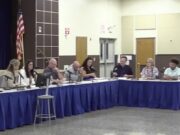
The Town Board held a special meeting this morning for the town clerk to present Hubbard’s budget, then discussed the proposal during the work session.
The Town Board is required to review the budget and can revise it as they see fit. The tentative budget, together with any amendments made by the Town Board, becomes the preliminary budget, upon which the board is required to hold a public hearing. The hearing must be held on or before the Thursday immediately following the general election. The general election this year is Tuesday, Nov. 5, so the Town Board is required to hold a hearing on the preliminary budget on or before Thursday, Nov. 7.
The board may make additional changes to the preliminary budget after the hearing, but must adopt the budget by resolution on or before Nov. 20. To adopt a budget that exceeds the tax levy cap, the Town Board must pass a local law, with a supermajority vote, overriding the tax levy limit.
If the Town Board fails to adopt a budget, the preliminary budget becomes the final adopted budget for the next fiscal year.
Editor’s note: This article has been amended to clarify that the state imposed tax levy cap is not always a flat 2%. It is either 2% or the rate of inflation, whichever is less. The cap is at 2% this year and the last three years. It was also amended to clarify that there are exceptions to the 2% tax cap.
The survival of local journalism depends on your support.
We are a small family-owned operation. You rely on us to stay informed, and we depend on you to make our work possible. Just a few dollars can help us continue to bring this important service to our community.
Support RiverheadLOCAL today.
