























The Riverhead Board of Education will need to decide whether or not to participate in a controversial initiative introduced by the State Education Department aimed at encouraging nearby school districts to share resources.
The state initiative, known as “regionalization,” would allow districts in similar geographical regions to develop plans for sharing staff, coursework and other resources to broaden educational opportunities for students, according to the New York State Education Department (NYSED). NYSED published emergency regulations to codify regionalization in September.
The regulations are being revised to make the program voluntary for school districts after some school boards, parents and politicians across Long Island protested the rule, arguing that it would strip local control away from school districts. NYSED officials have said regionalization would not remove local control, and is intended to help create local solutions to current and future problems. It is also a completely separate process from combining local school districts.
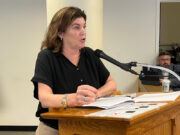
Riverhead’s school board and district administration will discuss at its school board meeting next week whether the district will opt out of the planning process. The district’s interim superintendent and school board president said they currently don’t see any benefits or harms from the district being involved in regionalization — although they also said the impact of the intiative is currently vague.
“I don’t know what, if anything, positive would come for Riverhead. I don’t know if it would really benefit us. I don’t think it would hurt us, though, either,” school board president James Scudder said. “But now, with it being voluntary, it’s kind of like, how many other districts are really going to participate?”
Regionalization would require the superintendents of each of the state’s 37 regional Boards of Cooperative Educational Services, or BOCES, to coordinate with school districts in their boundaries to develop the plans. School districts have until Jan. 15 to notify NYSED whether they intend to participate in the regionalization planning process.
Plans would be complete in October 2025 for implementation in the 2026-27 school year; the plans would be updated every 10 years.
NYSED Senior Deputy Commissioner Jeffrey Matteson said there are gaps between students in school districts across the state. “How do we address that problem?” he told the NYS Board of Regents during a presentation at a committee meeting in September.
A key problem regionalization could help address, Matteson said, is the possibility of the state changing the way it funds local school aid. Currently, the state contributes billions of dollars to school districts in “foundation aid.” But Gov. Kathy Hochul has said that the foundation aid formula overfunds school districts that have experienced decreased enrollment under a policy called “hold harmless,” which ensures districts receive as much aid as they did the year before. Hochul said the foundation aid formula must change for the financial stability of the state; the state authorized studying potential changes to the foundation aid formula as a part of its budget.
Matteson said regionalization could help school districts alleviate staffing issues and adjust to coming changes to state graduation requirements by helping schools offer more diverse courses.
“In no way did I feel that we were being asked to share resources. Whether that would come down the pike at some point, I don’t know,” Riverhead Interim Superintendent Cheryl Pedisich said. “But school districts, if you think about it, share resources with one another naturally, and that has happened with districts. If you have certain programs and other districts don’t, then sometimes students might come over and take advantage of that, because it’s a mutual agreement between districts to do that.”
Scudder, the school board president, said shared services are “not going to solve the issue of funding that is needed for these kids.”
Innovation for schools is “most likely to happen with the folks who are closes to the problem,” Matteson said during his presentation. “They will come up with the best ideas on what to do for their students, because they see the problem right in front of them; they know what the resources are to their school district and their region — and we want to hear from them.”
“This is about a conversation about what are some things that we could put in place as a department, or even ask the legislature to put in place, so that you could do more sharing, provide more opportunities for students,” Matteson said.
At its Sept. 26 meeting, the NYS Board of Regents passed a resolution authorizing an emergency rule establishing the regionalization process. The rule required school districts to submit an assessment of their strengths and needs to help develop the regionalization plans.
The rule immediately received backlash from some Long Island school districts. More than 60 school board trustees, under the letterhead of the Coalition of New York State School Board Members, wrote in a letter on Oct. 29 that NYSED was misusing its emergency powers and infringes on the rights of school boards.
Regionalization has become the subject of political attacks since. Long Island Republicans have proposed the “Our Schools, Our Rules Act” to prohibit mandatory regionalization plans.
“Any changes to the State’s educational system must protect local control, allow schools to opt in or out, and ensure a fair distribution of education aid to address the many challenges facing school districts on Long Island and throughout New York,” Sen. Anthony Palumbo said in a statement last month. “The Albany centric, top-down approach, has been a failure on a number of issues, including common core, and I believe students, teachers and districts would be better served by fewer, and not more directives from state bureaucrats.”
In response to the backlash, Education Commissioner Betty Rosa said there would be edits to the regulations that said school districts would be able to elect not to participate in the regionalization planning process.
Pedisich said the way the regionalization was rolled out — including it’s beginning as an emergency rule — “led to people to feel a sense of suspicion.” Pedisich said Riverhead has not received a lot of inquiry from the community about regionalization like other school districts across Long Island have.
“There are districts that feel that this is a precursor to removing local control of school districts. I’m not sure that that at all was the intent of the Board of Regents,” Pedisich said.
Pedisich and Scudder said the district administration and school board will discuss at Tuesday’s school board meeting whether it wants to opt out of the regionalization process. Scudder said he does not know whether the board’s discussion will in public or in private; he said regionalization has been the subject of a “conspiracy” in other communities that the state is looking to take over local school districts.
“I think once we make the decision whether we’re going to participate or not, we’ll make that public. But I don’t know the other board members think of having a public discussion about it,” Scudder said.
The survival of local journalism depends on your support.
We are a small family-owned operation. You rely on us to stay informed, and we depend on you to make our work possible. Just a few dollars can help us continue to bring this important service to our community.
Support RiverheadLOCAL today.
