
















The cow horns filled with manure and buried in the soil over winter are usually the detail that gets people’s attention first, along with the idea of farming according to lunar and cosmic rhythms.
But for Rex and Connie Farr, biodynamic farming is less about mysticism than it is about paying closer attention to the land — the soil, the vines, the weather, the insects, the water and the long agricultural history of the 60-acre Calverton farm they have worked without synthetic chemicals for more than 40 years.
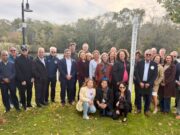
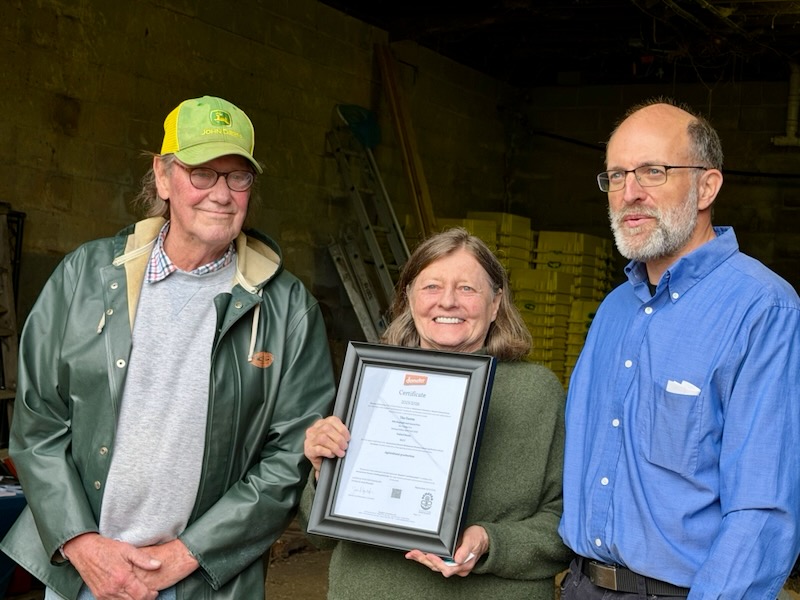
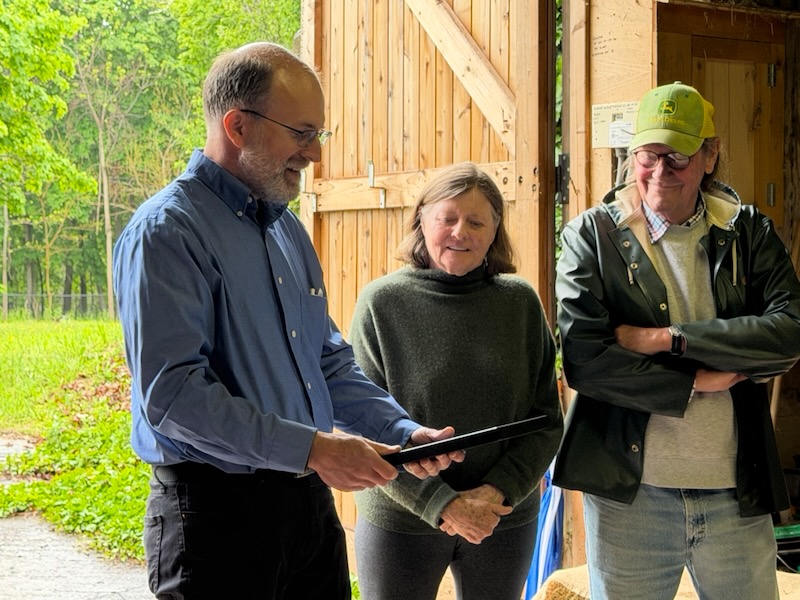
That work earned Farrm Wines a formal distinction Thursday afternoon, when Demeter USA executive director Evrett Lunquist presented the vineyard with Demeter Biodynamic certification during a gathering at the Farrs’ Youngs Avenue farm.
The certification places Farrm Wines among a small group of East Coast vineyards certified by Demeter, the nonprofit organization that certifies biodynamic farms and products in the United States. Farrm Wines is also Long Island’s only 100% certified organic vineyard, which Farrm Wines says makes it Long Island’s only 100% certified organic vineyard.”
The designation is the latest milestone for a farm Rex and Connie Farr purchased in 1984, when the property was still a former potato field. Neither came to farming through a conventional agricultural path. Rex had worked in the music industry representing musicians. Connie had built a career in Manhattan in the designer textile trade.
They began converting the property to organic farming in 1985. In 1990, the farm became what Farrm Wines describes as the first certified organic farm on Long Island.
The Farrs initially grew herbs, fruits and vegetables, eventually producing dozens of varieties and selling to green grocers and vendors in Manhattan. The vineyard came later. In 2005, they planted 8.5 acres of Bordeaux grape varieties: Cabernet Franc, Merlot, Malbec and Petit Verdot.
For years, the Farrs sold their certified organic grapes to other North Fork winemakers. Farrm Wine’s first wines were made from the 2012 harvest, beginning with a reserve and a rosé. The vineyard now produces estate wines in collaboration with North Fork winemaker Greg Gove.
Rex Farr said Thursday that growing grapes organically on Long Island has been humbling, despite his decades of farming experience.
“Thank God I had been farming for 40 years,” he said, before turning the program over to Lunquist.
Lunquist, who farms a certified organic and biodynamic farm in Nebraska and has worked with Demeter since 2001, said biodynamic farming is often reduced in the public imagination to cow horns and the moon. Those are part of it, he said, but they are far from the whole practice.
Biodynamic agriculture began in Europe in 1924, when Austrian philosopher Rudolf Steiner delivered a series of lectures to farmers concerned about declining soil and livestock health. Demeter was founded in Germany in 1928 to codify and certify biodynamic practices, making it one of the oldest ecological certification systems in the world.
Lunquist described biodynamic agriculture as “the original organic” and “the original regenerative,” saying it helped influence later organic and regenerative farming movements.
The practice starts with organic principles: avoiding synthetic pesticides, herbicides, fertilizers and genetically modified organisms. But Demeter certification goes further. It certifies the whole farm, not just a field or crop, because biodynamics treats the farm as a single living organism.
That means the health of the soil, plants, animals, insects, compost, surrounding habitat and human stewardship are viewed as interconnected. Demeter requires certified farms to maintain biodiversity areas, use biodynamic preparations, build fertility through composting and other farm-generated methods, and undergo annual inspection and renewal.
“The farm as a whole ecosystem — we call it an organism,” Lunquist said. “We’re not looking at just one piece.”
Some biodynamic practices are easy to understand in conventional agricultural terms: composting, cover cropping, reducing off-farm inputs, encouraging beneficial insects and building soil biology. Others are more esoteric.
Some agricultural scientists consider aspects of biodynamics pseudoscientific, particularly claims involving cosmic forces and specialized preparations, though many growers credit the system’s emphasis on soil health and biodiversity.
The best-known preparation, known as BD 500 or horn manure, is made by placing cow manure in a cow horn and burying it in the soil over winter. When it is dug up, Lunquist said, it has transformed into a compost-like material. A small amount is stirred into water for an hour and sprayed over the land to stimulate soil life, earthworm activity and humus formation.
Another preparation, BD 501 or horn silica, is made from finely ground quartz crystal packed into a cow horn and buried during the warmer months. It is later sprayed as a fine mist over plant foliage. Lunquist said the preparation is used to enhance the plant’s relationship to sunlight, photosynthesis, ripening and crop quality.
Other preparations use plants such as yarrow, chamomile, stinging nettle, oak bark, dandelion, valerian and horsetail, each associated with specific soil, compost or plant-health functions in biodynamic practice. Horsetail, for example, is used in damp conditions as part of biodynamic fungal prevention.
At Farrm Wine, vineyard work is guided by a biodynamic calendar that considers lunar phases and the traditional biodynamic categories of root, leaf, flower and fruit days. Rex Farr said there are about 25 jobs that have to be done in the vineyard, and he tries to time the most important ones, including spraying, to the biodynamic calendar.
He acknowledged some of the practices can sound strange, even to him.
“I’m still scratching my head,” Farr said, referring to Steiner’s prescriptions for preparations and timing. But, he added, “the damn thing works.”
Lunquist did not shy away from the skepticism biodynamics can provoke. He said some people dismiss it as “crazy” or too strange to take seriously, while others regard it as the highest standard of organic or regenerative farming.
Wine, he said, is one area where biodynamics has gained particular recognition, because winemakers and wine drinkers already talk about terroir — the way soil, climate and place shape the character of a wine.
“It’s often said in biodynamics that the vineyard makes the wine,” Lunquist said. “There’s obviously things you can do in the winery, but when you start with good quality grapes, a lot can shine through.”
Rex Farr made the same point in more local terms. The grapes grown at Farrm Wine, he said, reflect soils shaped by glacial deposits thousands of years ago.
“That’s 20,000 years in the making,” he said as guests sampled the vineyard’s wines. “It’s all about soil.”
The Farrs have also taken steps to ensure the land remains farmland. They sold the development rights on the 60-acre property to Peconic Bay Trust, permanently preserving it from development.
Their work has drawn environmental recognition beyond the wine world. In 2025, Rex and Connie Farr were named Environmentalists of the Year by the Sierra Club Long Island Group.
For Lunquist, the certification recognizes not a new direction for the farm, but a long-standing commitment now formally documented under Demeter’s standards.
Demeter certification, he said, is not a one-time label. It requires an application, inspection and annual renewal. The process can take months, and certified farms must continue to meet whole-farm standards.
For the Farrs, who have farmed without synthetic chemicals since 1985, the certification is another step in a philosophy they have followed for decades.
Rex Farr said he wants visitors to do more than taste the wine. He wants them to walk into the vineyard and feel the place where it is grown.
“Wine epitomizes the relationship between soil and crop,” he said. “Booze and food is all about soil.”
The survival of local journalism depends on your support.
We are a small family-owned operation. You rely on us to stay informed, and we depend on you to make our work possible. Just a few dollars can help us continue to bring this important service to our community.
Support RiverheadLOCAL today.
