






















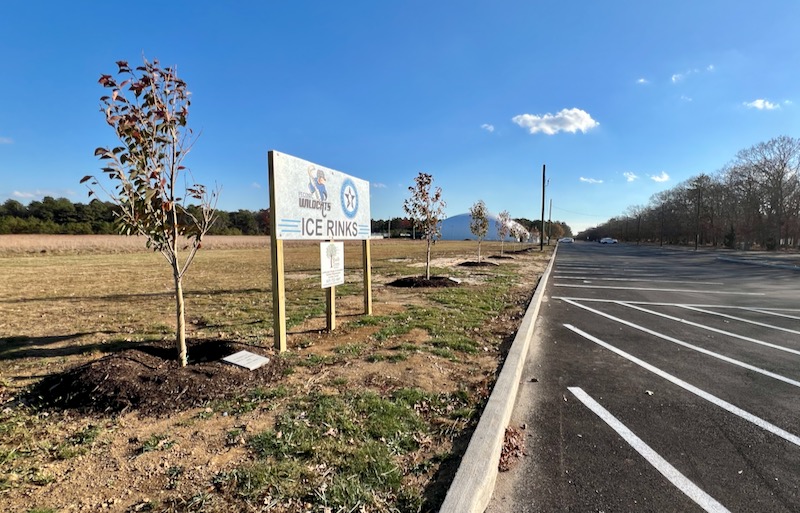
Riverhead Town has so far allocated roughly $1.7 million for the Peconic Ice Rinks at Veterans Memorial Park in Calverton, cobbling together funds originally set aside for other purposes because the main funding source counted on by officials has not yet come through.
The contract between the town and the rink developer and operator, approved in October 2022, requires the town to provide parking, infrastructure extensions and bathrooms for the facility, as well as to reimburse the operator, Peconic Hockey Foundation, for utility costs at a set amount each year. The town has allocated roughly $1.36 million to those capital projects so far. It has reimbursed Peconic Hockey a little under $180,000 in utilities and has agreed to pay up to $161,617 in utility costs next year.
While the Town Board has committed large amounts of money to bring the project to the town, the benefits of the ice rink to Riverhead Town residents, so far, have been unclear. Only a handful of residents had registered for resident discount programs at the rink as of late October. Free benefits for residents promised in the town’s contract, including skating lessons, hockey lessons and weekly skating sessions, never happened. Officials faulted poor publicity by the town.
MORE COVERAGE: ‘We haven’t gotten our money’s worth’: Ice rink falls short on benefits for Riverhead residents
The Town Board did not publicly discuss the total expected expenditures needed to complete the work required by the contract prior to approving the deal. Town officials said they planned to rely on bulk payments expected from the developer of a commercial solar energy facility. But that solar project has been stalled for the last two years and its fate remains uncertain.
The board also has not publicly discussed what has been spent to date or the sources of funding used, in the absence of the anticipated solar company payment.
Determining the total cost to the town of developing the ice rink facility, which has not been previously reported, requires identifying budget transfers and allocations in a dozen Town Board resolutions passed during the last two years. This article is based on a review of those resolutions, documents obtained through Freedom of Information Law, and numbers provided by the town’s financial administrator about how much the town budgeted to reimburse Peconic Hockey for utility expenses.
The allocations do not represent the total amount to be spent by the town; capital projects associated with the ice rink are still open and capital projects often are closed under-budget or need more funding while in development. None of the utility costs budgeted for the 2025 year have yet been spent and there remains the possibility that the town may not reimburse Peconic Hockey for the whole amount, or that the organization makes a profit in the new year and remits those revenues to the town under the terms of its contract. The allocations also do not include expenditures for town staff time devoted to the project.
Town officials say that the improvements to Veterans Memorial Park necessary to develop the ice rink would have been needed independent of the new attraction. But the ice rink’s development timeline, spelled out in the contract, required these projects to be hastened and required town officials to find alternative funding sources because the anticipated solar company payments did not materialize.
Breaking down the town’s appropriations
Officials allocated funding for the hockey rink from federal COVID relief money, from the town’s fund balance, from bulk payments made by other solar developers — including funds earmarked for open space and farmland preservation — and from other capital projects, as documented by Town Board resolutions.
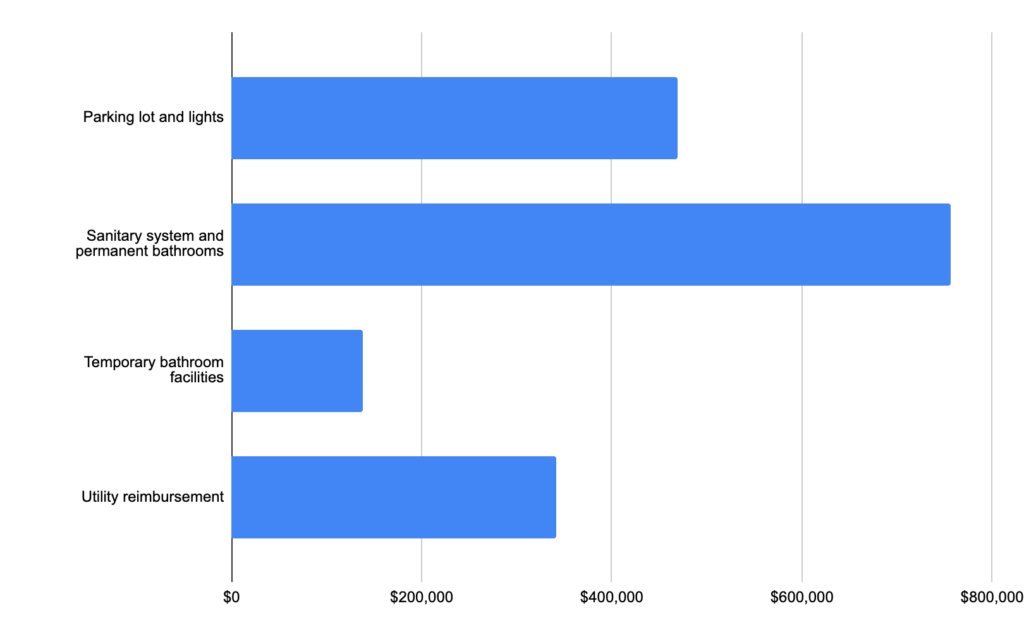
The biggest capital expenditure associated with the ice rink is the cost of a sanitary system and permanent bathrooms on the site, to which the board has allocated a total of $756,500.
The town first sought to develop permanent bathrooms at Veterans Memorial Park in 2006, but got jammed up by the county health department, which required bathrooms to be hooked up to a sewage treatment plant — a condition the town cannot afford to meet. The park has been relying on portable toilets since the ballfields there opened in 2013.
The health department has now agreed to allow the bathrooms to be served by a sanitary septic system until the Calverton Sewer District can be feasibly extended to treat wastewater from the facility.
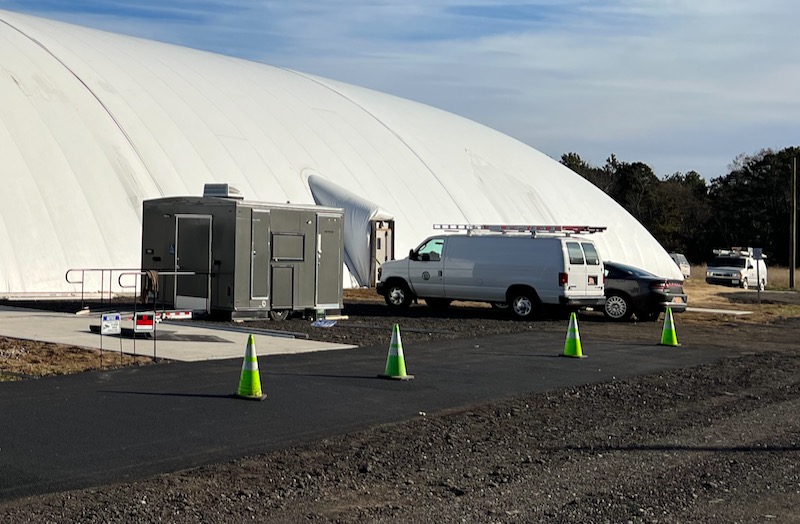
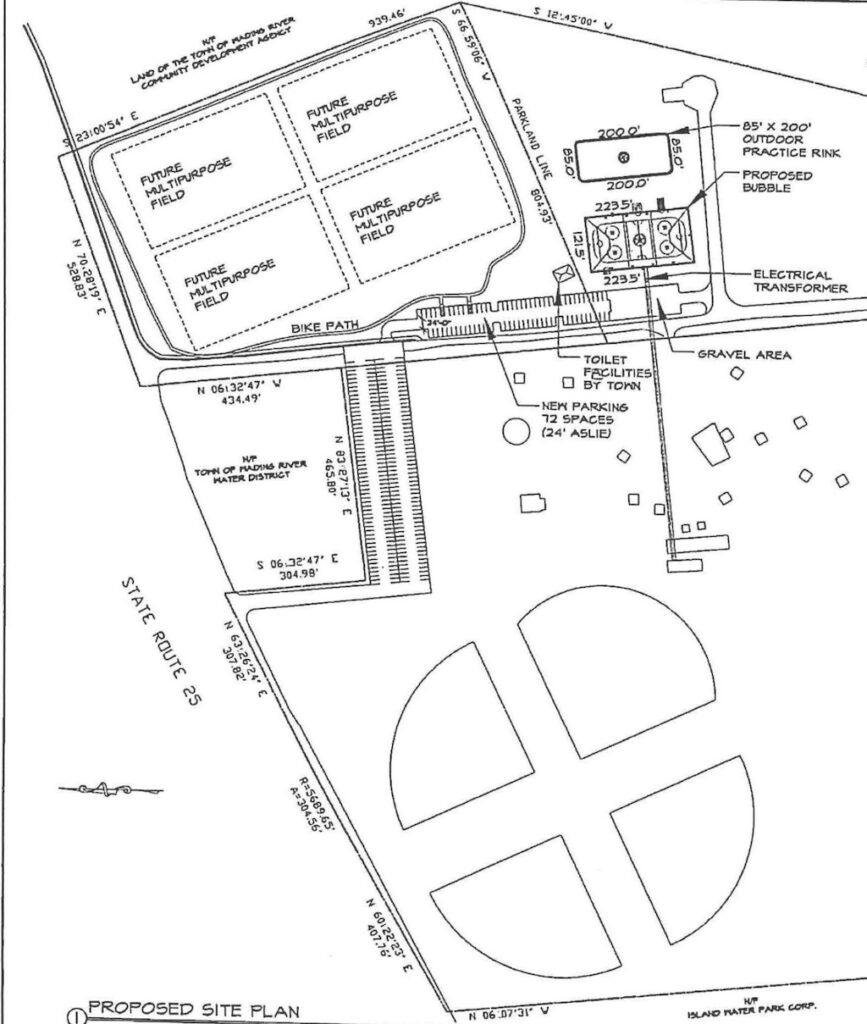
The Town Board has allocated $468,924 to the new parking lot and exterior lights for the facility. And it has allocated $137,700 to temporary bathroom facilities — including a restroom trailer currently placed next to the ice rink — until the permanent bathrooms can be constructed there.

Supervisor Tim Hubbard said in an email the capital projects “benefit all users of Veterans Memorial Park” and are not exclusive to the hockey rink. The park is “no way near completion” and that the town intends to “construct additional parking areas, basketball, tennis, volleyball and a large children’s playground.”
“I am proud of all the improvements at Veterans Memorial Park, the ball fields, pickleball courts, hockey rink, and plantings in honor of our veterans,” Hubbard wrote in the email. “Local interest in the hockey rink was admittedly slow in the beginning but I am told that more than 40 people signed up for the resident discount with more residents making inquiry and showing interest. There will be family skate opportunities over Christmas break. The Recreation Department will provide details within the next few days,” he wrote.
“While we certainly can identify many needs around town, I stand firmly behind the decision to earmark certain dollars for the betterment of the recreational amenities offered at Veteran’s Park, including the hockey facilities,” he added.

Council Member Ken Rothwell, the board member who led the development of the ice rink facility and is a financial supporter of Peconic Hockey, said in an email that the “parking lot and bathrooms were long needed at Veterans Memorial Park regardless if an ice rink was to be built.”
Council Member Denise Merrifield said in a phone interview she thinks the ice rink has been worth the money the town has allocated towards it so far. “I do think that it is something that’s a benefit to the community. I do,” she said. “And if they end up having tournaments and such, the hockey teams and such, that can only benefit the town as well, with people staying in hotels or people going to the restaurants during the winter, when it’s a little slower and it’s not the high season. That can’t hurt. That also will help the town.”
Council Member Bob Kern refused to comment on specific allocations made by the Town Board. He said bathrooms at Veterans Memorial Park are “desperately needed” and that the bathrooms “are not for the hockey rink, per se.”
“I don’t like to go off the cuff, so I really need to go back and look,” Kern said in a phone interview Tuesday. “I made decisions way back when. I need to go back and look [at] what decisions I made and why.”
Council Member Joann Waski did not return a call requesting comment.
Money for project drawn from fund balance, allocations to other expenses
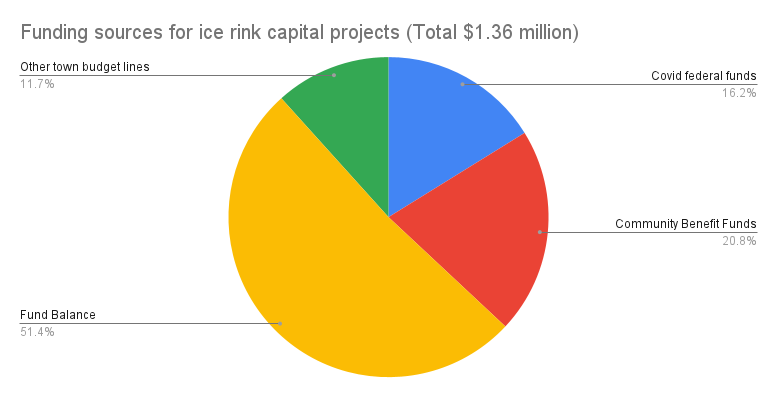
The largest source of revenue from these projects has been from the town’s general fund budget surplus, or fund balance. A total of $700,000 was allocated from the town’s general fund’s unassigned fund balance toward those projects. The town also transferred a total of $159,200 from other budget lines to capital projects required for the ice rink — including $122,700 that went unspent from the line designated to reimburse Peconic Hockey for utility costs in 2023.
The second-largest source of funding was the one-time bulk payments made by energy companies to the town for hosting large-scale solar projects — known as community benefit funds. The town allocated a total of $283,373 from community benefit funds for projects connected to the ice rinks. So far, the town has signed two community benefit agreements with solar companies — one provided the town $1.05 million and the other $1.5 million in community benefit funds.
The allocations made towards the ice rink projects were the second largest allocation of community benefit funds, second only to contracts with consultants to develop the town’s updated comprehensive plan.
Community benefit agreements between the town and two solar developers specify how community benefit funds should be spent. One of the purposes for such spending, outlined in the community benefit agreements, is for farmland and open space preservation. This was a key benefit because these solar facilities are built primarily on farm land zoned for industrial uses, resulting in the loss of agricultural production and environmental features in the town.

But the Town Board neglected the terms of one of the community benefit agreements in April, when it passed a resolution authorizing the use of $190,000 in funds earmarked for preserving open space and farmland to pay for the engineering and paving of the rink’s parking lot. Other resolutions authorizing the use of community benefit funds for ice rink projects do not say what those funds had been earmarked for in the agreements.
Town officials have said that Riverhead lacks money for farmland and open space preservation.. Board members pushed for the adoption of a code to allow resorts on the north side of Sound Avenue as a tool for preserving farmland and generating money to purchase development rights to preserve other farmland. The board backed off of the idea after backlash from residents and interest groups.
Richard Wines of Jamesport, a member of the town’s Farmland Preservation Committee, said it was “distressing to see any money that was earmarked for those purposes used for something else.” He noted that preservation of Riverhead Town’s farmland and rural character was the “number one item that came up in surveys” as a part of the update to the town’s comprehensive plan.
Kern and Merrifield said they were not aware that they voted to use money earmarked for open space and farmland preservation on the parking lot. They both said they would look into the subject and declined to comment further. Hubbard and Rothwell did not respond to a question about the use of the funds for the parking lot in their emails to RiverheadLOCAL.
The projects also benefited from federal funds, through the Covid-era American Rescue Plan Act. The 2021 stimulus package gave money directly to municipalities to spend on a wide range of projects, including infrastructure, replacing lost public sector revenue from the pandemic, providing premium pay to essential workers and supporting programs that support services and programs targeted at low- and moderate-income people.
The bulk of the money used by Riverhead from the American Rescue Plan Act was for a Riverhead Water District storage tank in Wading River. It was also used for park projects, including lights at two fields at Stotzky Park.
Board members did not respond to questions about the decision to use American Rescue Plan Act funding for the park projects associated with the ice rink.
Recreation committee co-chair: ‘What’s coming back to the town?’

Multifaceted projects at town parks — the construction and repair of tennis and pickleball courts, bringing water to dog parks, and new playgrounds — have in some cases cost the town more than $100,000 each in recent years. The capital projects required for the ice rink have eclipsed most other individual projects in terms of cost.
“The only thing that came close is when we originally opened all the softball fields over there,” said former town council member George Gabrielsen, a longtime member of the the town’s Recreation Advisory Committee and its current co-chairperson. That project, completed more than a decade ago, was funded by hundreds of thousands of dollars in grants.
“I don’t think it was ever done right from day one,” Gabrielsen said of the ice rink project. “They just rushed it through.”
While Peconic Hockey was solely responsible for building the ice rink facility structures — which Peconic Hockey’s president told RiverheadLOCAL last month cost around $3 million — the contract calls for Peconic Hockey to transfer ownership of the rinks to the town. The investments by the town to hold up its end of the bargain have been significant. Gabrielsen said Rothwell told his committee that the ice rink wouldn’t cost taxpayers any money. Rothwell has made similar statements about the ice rink in interviews with RiverheadLOCAL about the project over the last two years. Rothwell did not answer a question about this statement in his email response for this article.
Gabrielsen said the town should have involved the Recreation Advisory Committee in more conversations involving the rink. It could have been planned more carefully, with the benefits weighed against the costs, he said.
“You look at investment like that. What is coming back to the town? What’s the benefit to residents?” Gabrielsen said.
In late October, Hubbard said the town hasn’t “gotten our money’s worth in terms of people using the [discounts] and everything else.” According to data shared with RiverheadLOCAL at the time, the resident discount at the rink has only been used 44 times, and only 9 residents have signed up for the pass necessary to obtain the discounts.
Gabrielsen said a lot of people use ballfields, soccer fields and pickleball courts, but only a small group of people in Riverhead play hockey. “You’ve got to look at the bigger, broader spectrum of the amount of people using facilities. You can’t starve them — these other projects — over one project that doesn’t seem to be getting out of its own way,” he said.
Counting on future income to pay costs of rink improvements
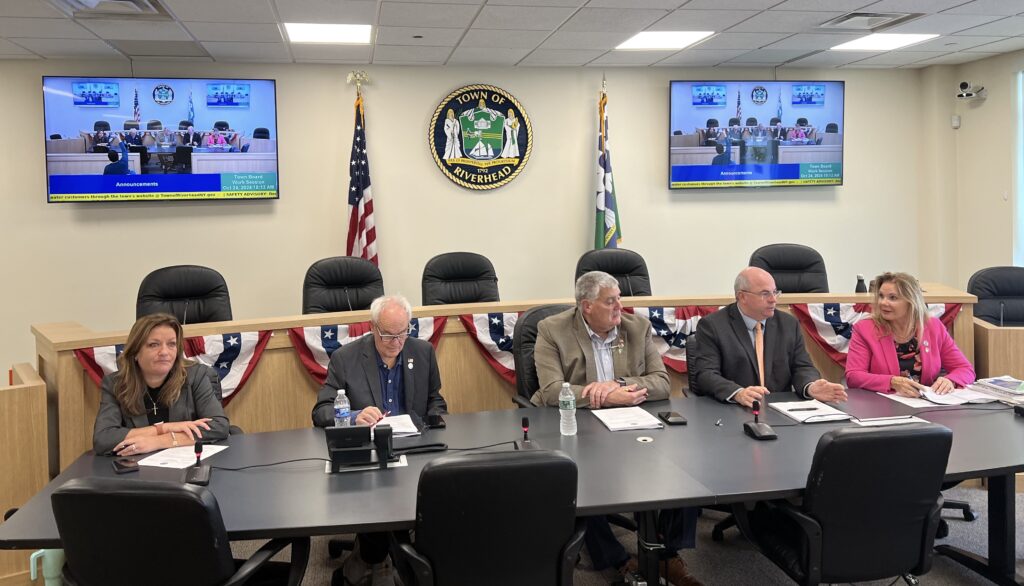
At a Town Board work session in October, Town Board members discussed the lack of funding for the maintenance of town parks. Rothwell said the town should invest some money long-term into town park projects.
The town supervisor said he had originally budgeted for rebuilding the boat ramp at Reeves Beach, but ended up cutting the $70,000 needed.
One of the solutions consistently raised during the work session was using money from a community benefits agreement with Riverhead Solar 2, a 36-megawatt commercial solar facility in Calverton that was granted a permit by the state Office of Renewable Energy Siting on June 25, 2021.

Rothwell had hoped to cover the cost of the new bathroom facility at Veterans Memorial Park using community benefit funds from that project. He said in a November 2022 interview that he was “very confident” that the community benefit agreement would be signed “in the next week or two.”
Although granted a permit by the state, the company developing the Riverhead Solar 2 project, AES, is still waiting to secure a contract with the New York State Energy Research and Development Authority. Town officials and an AES spokesperson said last month the company was awaiting the results of a bid for a NYSERDA contract.
That money could be further away now. Last week, Gov. Kathy Hochul announced the recipients of the contracts for 2023 bid; the Riverhead Solar 2 project was not included in the list. A NYSERDA spokesperson confirmed that the agency will not be announcing additional contracts under that solicitation.
A bid for the 2024 solicitation for a NYSERDA contract closed in October, but a NYSERDA spokesperson did not say when the results would be announced. Josh Baird, AES’s senior development director, said in a statement that the company “remains committed to the Riverhead Solar 2 project and the benefits it will generate for the town of Riverhead. We are diligently focused on seeking solutions to contract the project, which will allow it to move forward.”
More investment required, including a water main extension

There are still expenses at Veterans Memorial Park coming down the pike that town officials will need to find money for to fulfill the town’s obligations under the contract with Peconic Hockey. The ice rink facility needs a fire hydrant within 600 feet of the facility to obtain a permanent certificate of occupancy. Fire Marshal Andrew Smith said he will not sign off on a permanent certificate of occupancy or permits to add locker rooms to the facility without the hydrant. Until the rink has its permanent C.O. it is not allowed to expand.
The water main and hydrant will cost roughly $170,000, according to Riverhead Water District Superintendent Frank Mancini. There is currently no concrete plan in place to fund the project. The town will also likely need to pay for some, if not all, of the cost.
The Riverhead Recreation Department keeps a list of park project priorities. According to the list, provided by Recreation Superintendent Raymond Coyne in an email, the parking lot at the hockey rink is the highest priority park project due to possible safety issues.
Slightly less than half the projects on the Recreation Department’s list are maintenance projects, which means the town cannot fund them with recreation project fees, its primary source of income for park projects. Those fees are paid by new developments in lieu of providing dedicated park space for new residential buildings and subdivisions. By law, the fees can be used on capital projects, but not top-priority maintenance projects, like resurfacing parking lots and basketball courts, replacing broken lights at tennis courts, or new fences and gates.
Gabrielsen said those maintenance projects have been “put kind of on hold because of [the ice rink]. There’s no money,” he said.
“The majority of town is probably getting ignored at the expense of the rink,” he added.
Since RiverheadLOCAL published its article Oct. 28 on the underuse of the Peconic Ice Rink by Riverhead residents, the town Recreation Department has begun advertising a free program at the ice rink: an ice skating social for people age 55 and older on Jan. 28 and Feb. 25 from 1:15-3:15 p.m..
The Recreation Department is now advertising resident discounts at the ice rink on the first page of its seasonal brochure. Hubbard said more than 40 residents are now signed up for the discount program at the ice rink — up from the nine in October. Coyne did not return a call requesting comment for this article.
How much time has staff put into the project?
Amounts spent on the ice rink project do not include the cost of labor for the numerous town employees — including engineering staff, building and grounds maintenance crews, and town highway department workers — who have all devoted significant hours on the project.
It may not be possible to determine the precise amount of labor costs, because timekeeping records don’t necessarily log specific projects.
For example, Riverhead Town Engineer Ken Testa said in an email that the department doesn’t generally keep records on the time its staff or the building and grounds division staff spend on particular projects.
Highway Superintendent Mike Zaleski said highway workers helped establish the parking lot at the park. “I would say it was a couple hours here or there, maybe five to eight times in a year,” he said. His crew is busy, so they did not spend much time on the project, he said.
Buildings and grounds workers moved bleachers donated from the former Mercy High School in Riverhead by Peconic Bay Medical Center to Veterans Memorial Park for use at the ice rink facility. The transportation of the bleachers cost the town an estimated $25,559, according to an email obtained through Freedom of Information Law; the estimate was based on pay schedules published by FEMA.
The survival of local journalism depends on your support.
We are a small family-owned operation. You rely on us to stay informed, and we depend on you to make our work possible. Just a few dollars can help us continue to bring this important service to our community.
Support RiverheadLOCAL today.
