













The quiet stretch of track just past Long Island Railroad mile marker 69 in Calverton, west of the Edwards Avenue crossing, gives little hint of what happened there on a stormy Friday evening in August 1926, when a luxury express carrying more than 300 people left the rails at full speed and tore through a pickle factory beside the line.
According to news accounts at the time, the double-headed express to Greenport, traveling at nearly 60 mph, hit a defective switch at the siding that served the Golden Pickle Works, sending both locomotives off the track and hurling its parlor car into the one-and-a-half-story wood-frame building.
Six people were killed, including a young mother and her two small children from North Carolina, an East Marion summer resident, and the second locomotive’s engineer and firemen, both from Greenport. At least a dozen more people were injured as the derailed cars, the factory and its contents collapsed into a tangle of twisted steel, lumber and salt.
Nearly 100 years later, the Railroad Museum of Long Island is seeking to place a historical marker at the site, in remembrance of a wreck that was once front-page news across Long Island and is now largely forgotten outside railroad and local history circles.
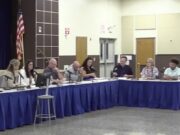
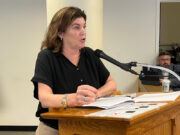
“For some time, we have thought, as did Ron Ziel, prolific historian and writer for the Long Island Railroad, that something should be at Calverton, at the site, as a memorial,” Railroad Museum of Long Island President Don Fisher told the Riverhead Town Board at its Nov. 18 meeting. He was there to ask the board for a letter of support for a historic marker at the location of the wreck.
“It was a horrific tragedy at the time for the railroad, and it changed the face of Calverton,” Fisher said. “It really was tragic, but a part of our history here in the town,” he said. The marker would ensure “that the people who were lost are not forgotten, and that all of our citizens traveling our byways would notice this as a place of an important piece of our history.”

On the afternoon of Friday, Aug. 13, 1926, the Long Island Rail Road’s deluxe Friday-only express left Jamaica bound for Greenport, carrying weekenders headed to vacation homes on the North Fork and Shelter Island. The train ran with two steam locomotives at the head end and seven steel cars behind, including a parlor car known as the Easter Lily, where passengers paid extra for upholstered seats and porter service on the long ride east.
At the time, the Friday express was marketed as a fast, comfortable way for city residents to reach their summer homes and hotels at the far end of the island. It made only two stops between Jamaica and Greenport. It was one of the railroad’s premier trains.
Along the main line west of the Edwards Avenue crossing in Calverton, the track passed the Golden Pickle Works, a factory served by a short siding. A switch there allowed freight cars to be set off for the plant. Investigators would later report finding a nut and cotter pin from the switch mechanism lying in the stone ballast beneath the operating lever. Federal and local inquiries concluded that vibration had likely shaken the hardware loose over time, leaving the switch point out of proper alignment as the eastbound express approached that evening.
Inside the pickle works, dozens of employees spent the day working among open vats and brine barrels. Later accounts say workers normally finished at 6 p.m., but the foreman decided to let them go a bit early that day, in part because of the heat and a storm building to the west. By the time the express neared Calverton, many had already left for home, a decision local historians believe helped limit the number of casualties inside the factory.
As the train neared the siding shortly after 6 p.m., a thunderstorm was rolling in and the sky had darkened enough that the coach lights were on.
When the lead locomotive passed the defective switch, its vibration threw the switch, “causing the second engine and the cars following it to swerve from the main line onto the spur,” the New York Times reported. “The second engine also dragged the first engine from the track, and the two plunged into the pickle works and piled up in a heap. The parlor car was up-ended momentarily, then with a crash fell through the roof of the pickle works and landed on its side in the interior,” the paper said.
Tons of salt used for making pickle brine were stored on the second floor of the factory, and when the parlor car cut through the building, salt poured down, burying part of the car, according to the Times’s report.
Witnesses described a roar that could be heard for about a mile and a cloud of steam, dust and debris rising over the fields. One local history column written decades later recounts that a large roadside billboard advertising Golden’s pickles toppled onto the wreck, coming to rest on a heap of twisted metal, broken barrels and scattered cucumbers.
The Riverhead News described the scene in dramatic detail in its next edition, published one week later.
“It hit with a deafening and sickening crash, and the hissing steam from the overturned locomotives was mingled with the cries of the injured passengers,” the paper reported.
People in Calverton and along Edwards Avenue ran toward the tracks when they heard the crash. A call went into Riverhead for help. Five Riverhead doctors — Benjamin, Terrell, Payne, Luce and Perkins — rushed to the scene, as did druggist Fred Barth, who brought with him “a large quantity of supplies.” The doctors, assisted by a “Mrs. Clayton of Riverhead, who aided them as a nurse every minute,” worked to treat injured passengers. First aid was given at the site and the more seriously injured were taken to Southampton Hospital by private cars.
The gathering darkness made it difficult to see until motorists lined up along the right-of-way and turned their headlights toward the derailed cars so rescuers could work.
About 100 soldiers from the 62nd Coast Artillery at nearby Camp Upton arrived with trucks and searchlights. They helped firefighters and volunteers pull passengers from the overturned coaches, tend to the injured and keep crowds back from the wreckage late into the night.
Among the six people killed were engineer William Squires and fireman John Montgomery of Greenport, who were crushed beneath the coal and wreckage of the lead locomotive.
Four passengers in the parlor car were also killed.
Dorothy Angell Shuford, 28, of Biltmore, North Carolina, was visiting her parents, who lived in Brooklyn and had a summer home on Shelter Island. She was traveling with her two young children, George Jr., age 3, and Dorothy, who had just turned 1 on Aug. 11, and with their maid, Laura Conley. The children were crushed and died instantly. Shuford was pinned in the wreckage. Doctors and others, including Riverhead electrician Treadwell Cheshire, toiled through the night to extract her from the car. She was taken to Southampton Hospital, where she died early the next morning from internal injuries, according to the N.Y. Times.
Harold Fish, a Manhattan stockbroker who was traveling to his summer home in East Marion, was buried in salt and suffocated.
Another East Marion resident, James Way, who was riding with Fish on the platform of the parlor car, nearly met the same fate as Fish. But, the Riverhead News reported, he was saved from a terrible death through the prompt action of former Riverhead Supervisor Dennis Homan and George Gassert of Riverhead. The two men arrived at the scene early and heard groans coming from inside the pickle house. They crawled under the train car where they found Way buried up to his neck in salt. Homan and Gassert began digging with their bare hands and kept digging to prevent the salt from engulfing the victim until the salt stopped pouring down.
Rescuers were able to free Shuford’s maid Conley from the wreckage, but only by amputating her leg at the scene. She also suffered a broken jaw and other injuries.
A LIRR employee was pinned beneath the parlor car and suffered a broken leg. An employee of the pickle factory was badly burned by escaping steam from the overturned locomotives.
Shuford’s parents, who were riding with her in the parlor car, were injured, though not seriously. They and other injured victims were treated but did not require hospitalization.
In the days that followed, while wrecking crews worked to lift the locomotives and clear the line, attention turned to how a premier Friday express could have come off the rails so violently at a quiet country siding. Railroad officials and investigators focused on the damaged switch serving the pickle works, looking for an explanation in the bent rails and scattered pieces of hardware.
Later inquiries by federal and county authorities framed the wreck as a failure of inspection and maintenance rather than crew error. Grand jury proceedings examined the condition of the switch, the railroad’s inspection practices and the broader question of how such a small mechanical fault could destroy a busy factory and cost six lives.
No criminal charges were brought, but the railroad faced sharp criticism over track conditions and oversight.
Clearing the wreck took days. Heavy equipment was brought in to lift the locomotives and crushed cars. Once the line was reopened, the damaged engines were hauled back west and eventually scrapped. The Golden Pickle Works, severely damaged when the parlor car crashed through its roof and wall, did not resume operations, according to later accounts. The wreck effectively ended pickle production at the site even after the tracks were repaired.
The scale of the disaster drew enormous crowds. At a time when Suffolk County’s population was about 120,000, one local historian later estimated that as many as 50,000 people came to view the wreckage in the days after the crash, creating what was described as Riverhead’s first real traffic jam as cars backed up on the roads leading to Calverton. Old railroad workers and longtime residents would refer to it for decades afterwards as the Great Pickle Works wreck.
News of the train wreck was carried in newspapers across the country.
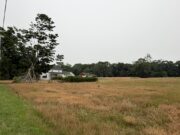
Today, there’s no hint of the place where the parlor car sliced through the Golden Pickle Works and where Calverton’s biggest employer at the time suddenly became a ruin. Brush and second-growth trees line the railroad right-of-way, and trains slip past the spot in seconds.
That obscurity is part of what the Railroad Museum of Long Island hopes to change with a marker at the site.
The William G Pomeroy Foundation has approved the museum’s letter of intent for a marker at the site of the Calverton train wreck, Fisher said. The foundation requires the town’s authorization to place the marker in the public right-of-way at the intersection of River Road and Railroad Avenue. That’s the approximate location of the switch that took that train off to the side into the pickle works factory, Fisher said.
The Railroad Museum would host a memorial at the site on Thursday, Aug. 13, to mark the 100th anniversary of the Great Pickle Works wreck. The historic marker would be unveiled during the memorial, Fisher said.
The marker will become one of the few physical reminders that anything extraordinary ever happened along that stretch of track, giving passing motorists and rail riders a clue to the story buried there, Fisher said. It would also be an invitation to stop for a moment to remember the stormy August afternoon when the deluxe express left the rails, the pickle house came down and an East End summer weekend turned into tragedy.
The survival of local journalism depends on your support.
We are a small family-owned operation. You rely on us to stay informed, and we depend on you to make our work possible. Just a few dollars can help us continue to bring this important service to our community.
Support RiverheadLOCAL today.
