





















For decades, beloved softball coach Bob Fox taught Riverhead kids how to stay calm under pressure, to think about the next play and never quit on a game.
On the morning of June 24, it was his 11-year-old grandson who had to remember those lessons.
Fox’s Ring doorbell camera captured the ordinary start to their day — a quick chat with the neighbor as the boy climbed into the car — and then the car pulling slowly up the street as Fox drove his daughter’s son to school. A few minutes later, the camera recorded something no one in the Fox family will ever forget: Cole sprinting back down the street to get help.
“They went up this hill and around the corner, and because it’s the hill and a turn, you have to go really slow,” Fox’s wife, Cathy, explained during an interview in the couple’s home in Flanders yesterday . “As soon as he made the turn, he collapsed on the steering wheel, made a gagging noise and collapsed.”
The car’s push-button ignition confused the boy; he wasn’t sure how to turn the car off. But he had the presence of mind to slide his grandfather’s foot off the gas pedal. Cole jumped out of the car and took off toward home — his house is right across the street from his grandparents’ home.
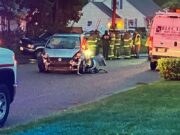
The car, with Fox slumped on the steering wheel, kept creeping forward, coasting the rest of the way down to Oak Avenue, across the intersection and into a stand of trees — no crash, no injuries, just a car that rolled to a stop off the road.
“It was really just amazing,” Cathy said. “There was no damage to the car. If it had kept going straight, it’s a hill and there’s a house at the bottom. He probably would have gone right into the house.”
By then the boy was already back home, calling for help. His father, Jeremy Eastwood, a state trooper, ran to the car and began CPR on his unconscious father-in-law until Flanders ambulance and fire department volunteers arrived. The 911 call came in as a car accident; only when first responders reached the car did they realize Fox had suffered a cardiac arrest.
“They had to shock him four times on the way to the hospital to get his heart going,” Cathy said.
Fox remembers none of it.
“I don’t remember picking him up or driving or anything,” he recalled, seated in his favorite chair in the family’s living room, a Blue Waves baseball cap atop his head. “I knew I was in the hospital.”
Fox had turned 77 on June 23, the day before his cardiac arrest. June 24 was also Bob and Cathy’s 53rd wedding anniversary — he was supposed to be taking her to lunch.
“He’ll do anything to get out of a lunch date,” she joked. Bob laughed.
A month in the hospital, then hospice talk
Fox spent 28 days in Peconic Bay Medical Center. There were complications. The inside of his throat was scraped, and doctors were worried he would aspirate if he tried to eat or drink, so they inserted a temporary feeding tube. As the weeks passed, he grew weaker.
“By the time the 28 days were up, he couldn’t sit up. He was that weak,” Cathy said. “They wanted to put a permanent feeding tube in, but his health care proxy says no permanent feeding tube. When we said no, they sent in the palliative care unit. They were talking about hospice.”
The family didn’t think it was time to give up.
“We thought that with rehab, with PT and OT, he’d be able to come back,” she said.
Instead of hospice, Fox was transferred to Quantum Nursing and Rehabilitation in Middle Island, a rehabilitation facility with a specialized neurological rehab program. When he arrived, he needed a Hoyer lift just to be moved from place to place. He could not stand, let alone walk.
“Within a week, he was walking with a walker,” Cathy said.
Their daughter Kelly took videos of those first shaky steps and sent them back to the nurses and staff who had cared for him at Peconic Bay. The clips quickly made the rounds.
“People up in the ICU and PCU had kind of followed him,” Cathy said. “She sent the video and I guess it went all around Peconic Bay. They were like, ‘Look, he’s walking,’ because when you saw him a couple of weeks before that, you wouldn’t believe it.”
Rebuilding memory, one name at a time
The cardiac arrest and repeated shocks left their mark. Lack of oxygen to his brain robbed Fox of his memory. He knew who his grandchildren were, but at first could not come up with their names.
“I had a hard time knowing the names. And that bothered me more than anything,” he said, growing emotional. “I know now,” he added with a smile.
Kelly responded the way a coach’s kid might: with a big, colorful poster. She put together a family chart with photos and names of their three children, eight grandchildren, their spouses — whom Bob and Cathy happily count as grandchildren too — and seven great-grandchildren. She hung the poster within easy view of his bed.
“Every day we went through all the names of the family,” Cathy said. “At first he would just watch, and then he started talking as we were showing it to him.”
Bob’s sense of humor, Cathy says, was the first thing to return.
“That was the first thing before anything else,” she said. “People were like, ‘Huh?’”
His humor was on full display yesterday, as he cracked jokes and teased his wife.
A coach’s life
If Fox’s recovery has surprised some, his stubbornness may not. Coaching has been part of his life since his Army days, when he was stationed in Panama and was put in charge of a women’s softball team made up of soldiers’ wives.
“They won the South American championship,” Cathy said. Later, officials briefly tried to take the title away when they learned the team’s shortstop was pregnant. The player got a note from her doctor clearing her to play, and the championship stood.
After the Army, Fox worked at the Grumman facility in Calverton as a firefighter.
Fox started coaching in Flanders Little League in 1972, the year the league began — and the year he and Cathy were married, he noted. He figures he stayed with it about 15 years. He later became an assistant coach and then head coach of the Riverhead High School softball team, spent time coaching at Mercy and also coached freshman baseball when the district briefly had enough players for a third baseball squad.
“You’ve got to love the game,” he said. “Second, you’ve got to like kids. You like kids and you want to teach — you’re teaching them to play a game, hopefully the right way, and they can enjoy it.”
He admits he was a yeller when he first started. “When I got mad, I yelled,” he said.
“I have calmed down a lot,” he said. “I realized I’m not getting anywhere with that. Kids can turn you off. But sometimes you have to yell because you’ve got to get something across,” he said.
“I just love the game of baseball, and I love kids, and I love coaching kids. It’s a lot of fun,” Fox said.
Over the years, the rewards arrived quietly: former players stopping him in town, Christmas cards with photos of their own children.
“I still see some of the girls I coached,” he said. “Most of them sent me get-well cards when I got hurt.”
Fox retired from coaching after the 2013 softball season. But that didn’t keep him away from the field or helping local athletes. He set about to help the Blue Waves softball team raise money to buy an automated external defibrillator for the Riverhead athletic department. See: Fundraising efforts secure crucial lifesaving equipment for Riverhead softball program (April 17, 2014). A charity game later helped pay for another AED at Stotzky Park. Both were purchased and available for the 2014 season. The memory of a young athlete who’d died when he was struck in the chest by a ball during a lacrosse game had stayed with him.
This summer, it was an AED that helped save his own life, along with the CPR started by his son-in-law and his quick-thinking grandson.
Home for the holidays
Their grandson, Cathy says, was badly shaken by what he witnessed that June morning.
“He was traumatized,” she said. “He didn’t go to school that day, of course. The next day, when he went, they had the social worker and the school psychologist, and they kind of sat with him. But once he found out [Bob] was all right, he was okay.”
It was a long recovery. Fox finally came home from rehab on Nov. 7. There are still memory gaps. He still tires easily. He still needs a walker to get around. But he can stand up on his own and he’s back in the comfort of his family home filled with memories, back to sitting in his favorite chair —which is draped in a Riverhead Blue Waves throw — back to joking with Cathy.
Asked what he thinks about it all now, he paused.
“I think it’s pretty amazing,” he said.

The survival of local journalism depends on your support.
We are a small family-owned operation. You rely on us to stay informed, and we depend on you to make our work possible. Just a few dollars can help us continue to bring this important service to our community.
Support RiverheadLOCAL today.
